Control-room and SCADA operator displays run continuously under a mix of overhead lighting and the self-luminous screens themselves, so the glass in front of them is read against both. An anti-reflective cover reduces the veil reflection that hides an alarm or a process graphic, and on a console that is cleaned daily it also has to survive years of wipes. This guide sets out the numbers that belong on the drawing and the ones that only matter if the installation is wrong.
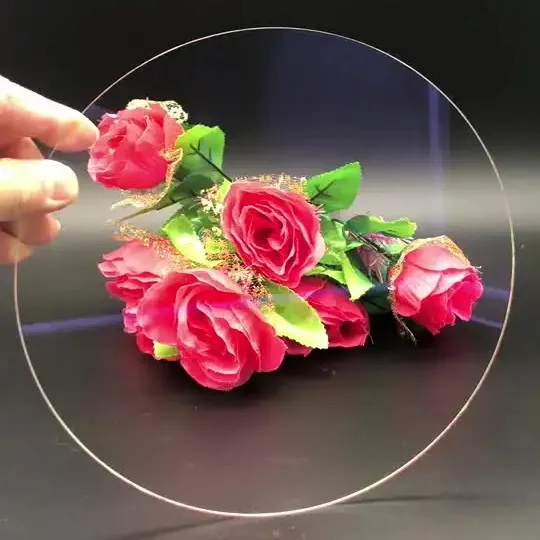
AR Anti-Reflective Glass in Industrial Control Room and SCADA Displays
Control-room and SCADA optics cover two surfaces that are often confused: the flat display covers over HMI panels and the larger operator-facing windows that look into a machine hall or a control floor. Both reject light twice, once at each uncoated face, and on a console the rejected light is the screen's own output bouncing straight back as haze. The display covers are flat, small and replaceable, which is where a multi-band AR stack is easiest to justify; the larger windows may also be safety glazing, which constrains how a coating can be applied and aged.
The tolerances that actually matter
For a display cover the useful numbers are transmission and residual reflectance across the display's own emission band, plus visible reflectance wherever the cover also serves as a window the operator looks past. Surface roughness and haze matter more here than on a land-based cover glass, because a wiped film scatters rather than reflects, and a coating cannot correct scatter that happens after it. Mechanically the tolerances that move cost are surface form and irregularity, not flatness alone; for a laminated operator window, wedge and parallelism across the bonded assembly decide whether an overlay stays aligned.
Design rules that reduce cost
Two decisions dominate the cost of a control-room AR part. The first is whether one side or both sides of the cover carry the functional layer; single-sided leaves the second face returning about four percent back toward the operator, which on a bright console is exactly the reflection the coating was meant to remove. The second is bandwidth: a stack tuned only to the visible band is cheaper to qualify and is usually sufficient for a display cover, whereas a cover that also sits in front of a near-IR sensor needs the near-IR peak specified and tested or the sensor loses throughput silently. Keep the stack within the band the installation uses, mount with a compliant gasket rather than a rigid clamp, and mark the coating face on the drawing.
Coating and deposition considerations
A control-room AR stack is a multilayer dielectric of alternating silica and a higher-index oxide. The difference from a consumer cover is the durability regime rather than the recipe: the coating has to survive repeated alcohol or detergent wipes, a warm enclosure and occasional abrasive contact from cleaning. That pushes toward dense oxide layers and a hard top surface rather than a soft anti-glare etch that would haze after a season of wipe-downs. State clearly whether the pane is coated before or after any lamination, because the two age differently and should not be qualified interchangeably.
How AR coated glass works in practice
An anti-reflective coating reduces the light that bounces off a glass surface instead of passing through it. Uncoated optical glass reflects roughly four percent per surface, so a display cover in the operator's line of sight returns about eight percent of the console's own output straight back as veil. A multilayer AR stack brings average visible reflectance below half a percent and lifts transmission into the high nineties at the design wavelength. On a console the measurable result is the operator's ability to read a faint alarm at a glance, which is why the coating specification, the display luminance and the room lighting have to be reviewed together rather than bought separately.
Requirements specific to Industrial Control Room and SCADA Displays
Control-room and SCADA applications add 24/7 duty, frequent alcohol or detergent wipe-down and an operator reading a self-luminous screen at close range. Specify reflectance and transmission in the console's own emission band, qualify the stack against the actual cleaning regime rather than a generic indoor durability test, and require a wipe-durable surface. For operator-facing safety glazing, state whether the coating is on the outer face, the inner face or both and hold wedge across the laminate so an overlay does not shift. Records should tie each pane to its coating run and to a first-article spectral curve so a replacement console cover reproduces the original.
- Reflectance and transmission specified in the console emission band, not only visible
- Coating qualified against the real wipe and detergent regime, not a generic indoor test
- Coating face documented on the drawing for single- or double-sided parts
- Wedge and surface form controlled so overlays do not shift
- Batch traceability with a first-article spectral curve for each coating run
Framework references: ISO 10110 for surface figure, surface quality and edge-chip limits on the finished pane. Where the part is safety glazing, fire and impact classification should follow the applicable site or equipment rule set. RoHS and REACH declarations depend on the coating stack and are the supplier's to state against the current official text, not to be assumed.
Selection data at a glance
| Parameter | Typical value | Notes |
|---|---|---|
| Visible reflectance | <= 0.5 % average | 420-680 nm |
| Transmission at console band | >= 90 % typical | Per display emission |
| Surface form | PV <= 0.5 um standard | ISO 10110-5 |
| Wedge / parallelism | 2 arcmin achievable | Holds overlay registration |
| Environment | Wipe-down, warm enclosure | Control-room duty |
| Coating face | Documented on drawing | Path-dependent |
Frequently asked questions
Does a control-room cover need an anti-glare etch as well as AR?
Usually one or the other. An anti-glare etch scatters rather than reflects and is forgiving of wiped film, but it hazes with repeated cleaning. On a display cover a durable AR stack is preferred; on a window the operator looks past, a hard etch can be the more serviceable choice. Specifying both is usually paying for one or the other twice.
Can the same AR coating serve a display cover and a near-IR sensor window?
Only if the stack is designed across both bands. A visible-only stack gives up near-IR transmission, and a near-IR-tuned stack can leave a visible surface that still reflects. Decide which bands the installation actually uses before the coating is designed, because widening the band after first article means a new deposition run.
Why does wedge matter more on a laminated operator window?
Two glasses and an interlayer bonded together each contribute their own tolerance, and the stack sums them. The result is a wedge that displaces any overlay the operator aligns to the screen or to a process graphic, which reads as an aiming error rather than as an optical fault.
Need a quotation for ar anti-reflective glass?
Send your drawing, target specification or coating requirement and an optical engineer will reply within 24 hours with a price and a lead time.
Request a Quote Email an engineer