Requirements in AR/VR and smart glasses have been shifting - thinner parts, wider bands, harsher environments - and those shifts change what optical glass cold processing suppliers are being asked to hold. This article reviews where the demand is heading, what it means for specifications, and how to structure sourcing so that a design is not locked to a single process.
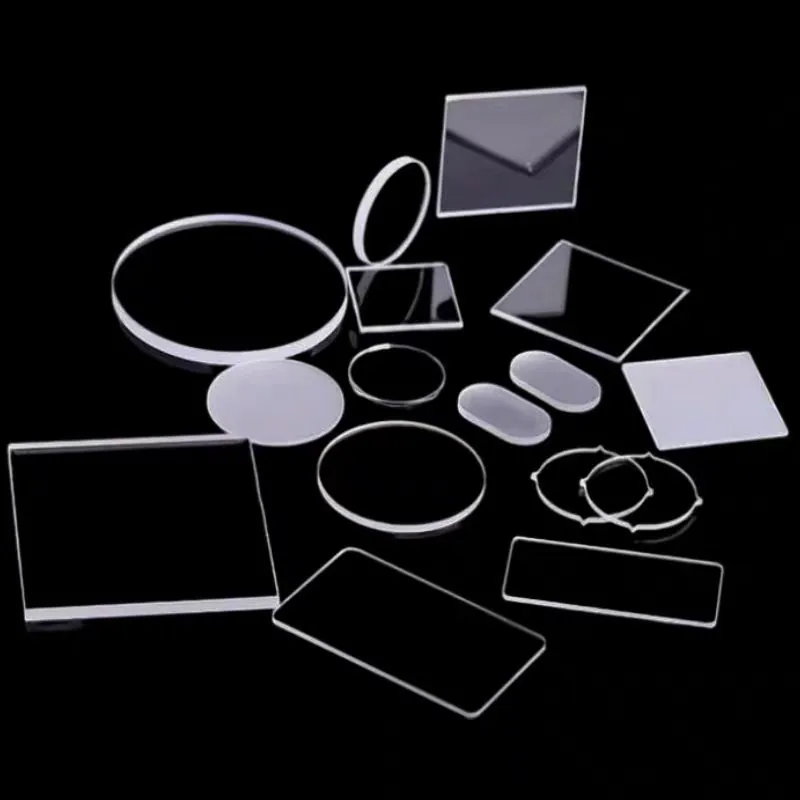
Optical Glass Cold Processing in AR/VR and Smart Glasses
In AR/VR and smart glasses, that translates into a specific set of requirements rather than a general preference for quality. Head-mounted optics are judged by the human eye at a distance of centimeters, so haze, stray light and color shift are immediately visible. Weight and thickness drive the industrial design, which pushes designers toward thin or ultra-thin glass, wafer-scale processing and coatings that survive being worn, dropped and cleaned daily.
What drives cost and lead time
Cost in cold processing is driven by three things: how much material has to be removed, how tight the tolerance is, and how many parts share the setup. Material dominates for sapphire, quartz and large blanks. Tolerance dominates whenever it forces a finishing operation - going from 60-40 to 20-10 scratch-dig roughly doubles polishing labor, and single-point diamond turning is a different cost class entirely. Batch size decides amortisation: a fixture that costs a few hundred dollars is irrelevant across 5,000 parts and decisive across five. The cheapest article to buy is almost never the cheapest to own, though. In AR/VR and Smart Glasses, a part that arrives with a consistent edge and a documented coating curve removes an incoming-inspection station, and that saving usually exceeds the price difference between two quotations.
How optical glass cold processing works in practice
Cold processing covers every shaping step that happens at room temperature: cutting the blank from a sheet, generating the outline, grinding the surface to size, lapping and polishing to optical quality, then edging, drilling, chamfering and cleaning. Unlike hot forming, no thermal cycle is applied to the part, so the substrate keeps the optical homogeneity the glass maker certified. For AR/VR and Smart Glasses, the practical consequence is that the glass supplier's refractive index, transmission and CTE values survive manufacturing unchanged. Cold processing is normally the only route for parts that must be flat to a fraction of a wavelength, carry a functional coating, or hold a dimensional tolerance tighter than a few hundredths of a millimeter. It is also the route that scales: the same diamond tools and CNC programs that cut one prototype handle a ten-thousand-piece order, which is why most custom optics programs start with a machined sample rather than a molded one.
Design rules that reduce cost
A drawing that respects how glass behaves costs less and ships faster. Keep holes at least one thickness away from an edge and at least two thicknesses apart; glass does not tolerate a thin web between two holes. Replace sharp internal corners with radii of at least 0.5 mm, because a sharp corner is a crack starter. Respect the aspect ratio - a 1 mm hole in 5 mm glass is practical, a 1 mm hole in 20 mm glass is not without ultrasonic or laser drilling. Specify the chamfer rather than leaving it to the shop; an unspecified edge will be whatever the operator considers normal. For AR/VR and Smart Glasses, also state the reference surface: which face is the optical face, which datum sets the outline, and whether a coating pattern must register to a machined feature. Half of all first-article queries trace back to an ambiguous datum rather than an impossible tolerance.
Standards, documentation and traceability
Buyers increasingly need a document trail, not just parts. ISO 10110 governs the drawing conventions for optical elements, including surface form, centring and surface imperfections, and ISO 12123 covers raw optical glass specifications. MIL-PRF-13830B remains the common scratch-dig language in North America. Environmental compliance is handled through RoHS and REACH declarations, while automotive and medical programs add IATF 16949, ISO 13485 or ISO 9001 depending on the sector. In AR/VR and Smart Glasses, the standards that actually gate a release are usually the customer-specific ones: a cleanliness specification measured in particles per square centimeter, a traceability requirement back to the glass melt, or a first-article inspection report in a defined format. Confirm these before the first part is cut, because retrofitting traceability onto a finished batch is impossible.
Requirements specific to AR/VR and Smart Glasses
In AR/VR and smart glasses, that translates into a specific set of requirements rather than a general preference for quality. Head-mounted optics are judged by the human eye at a distance of centimeters, so haze, stray light and color shift are immediately visible. Weight and thickness drive the industrial design, which pushes designers toward thin or ultra-thin glass, wafer-scale processing and coatings that survive being worn, dropped and cleaned daily.
- Haze below 0.1 percent for see-through combiner paths
- Wafer-scale thickness uniformity for thin glass
- Wavelength-selective behavior at defined angles of incidence
- Light weight with impact resistance
ISO 10110 for optical drawings, IEC 62368 context for the finished device, and RoHS and REACH declarations.
Selection data at a glance
| Parameter | Typical capability | Notes |
|---|---|---|
| Cutting tolerance | ±0.02 mm standard, ±0.01 mm on CNC | Diamond blade or scribe-and-break |
| Thickness range | 0.05-25 mm | Below 0.3 mm needs carrier fixturing |
| Edge chamfer | 0.1 - 0.3 mm x 45 deg | Edge chips held under 0.05 mm |
| Flatness | λ/4 to λ/10 at 633 nm | Pitch polishing on fused silica |
| Parallelism | ≤ 10 arcsec | Double-side polishing |
| Surface roughness | Ra ≤ 1 nm on polished faces | Ra 0.3 nm achievable |
| Scratch-dig | 40-20 to 60-40 | MIL-PRF-13830B / ISO 10110-7 |
| Minimum hole | 0.5 mm diamond, 0.1 mm ultrasonic or laser | Aspect ratio up to 5:1 |
| Prototype lead time | 5 - 10 working days | Volume runs 15 - 25 days |
Frequently asked questions
How thin can you go before handling becomes the problem?
Around 0.5 mm parts stop behaving like rigid bodies. Below that we mount them on carriers or sacrificial plates, which adds cost but prevents the flexing, chipping and edge damage that otherwise dominate yield.
Do you supply material certificates with the parts?
Every shipment carries the substrate lot, a dimensional report and, where relevant, a coating curve. Additional documentation such as RoHS or REACH declarations, first-article inspection reports or full traceability packages can be included when specified at quotation.
What is the fastest route from prototype to production?
Send the drawing and the application, and run the first article as a machined sample rather than a molded or cast part. Machined samples prove the tolerances and the coating at low cost, and the same CNC program then scales into volume production without a redesign.
Need a quotation for optical glass cold processing?
Send your drawing, target specification or coating requirement and an optical engineer will reply within 24 hours with a price and a lead time.
Request a Quote Email an engineer