Fluorescence microscopy stacks excitation, emission and dichroic filters, and the practical comparison is between hard-coated interference filters and the dyed or polymer alternatives on blocking depth, transmission and durability. Getting the comparison right matters because bleed-through and autofluorescence are the two things that destroy a weak signal.
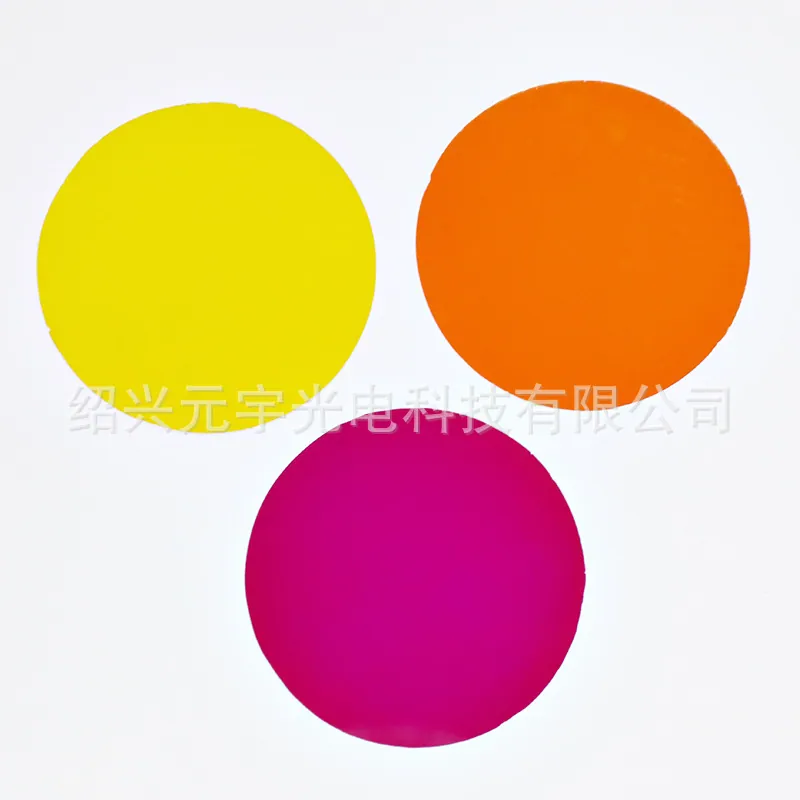
Coated Color Filters in Fluorescence Microscopy and Life Science
A fluorescence microscope separates the excitation light from the emitted light with three filters: an excitation filter that passes the illumination band, a dichroic that reflects excitation and passes emission, and an emission filter that blocks the residual excitation. The comparison that matters is how sharply and how deeply each option blocks the wrong band, because any leak appears as background that hides the target. Life-science use also expects clean, biocompatible handling and a filter set matched to the fluorophore in use.
Substrate and material selection
The substrate is usually thin optical glass for a filter cube, or a polymer film where weight and impact resistance matter more than figure. Hard-coated filters are sputtered onto glass and are flat enough to sit in the imaging path; dyed gelatin filters are thin and cheap but soft; polymer-interference filters are light but can have more angle sensitivity. Thickness is matched to the cube so the filter seats without introducing focus shift.
What drives cost and lead time
Cost scales with the number of layers, because blocking depth comes from more interference layers, and with whether the band is a catalogue standard or a custom edge. A hard coat costs more than a dyed filter but lasts, and a measured spectral curve per filter adds metrology and lead time. For a one-off lab set a catalogue band is fastest; for an instrument the custom band is worth the wait.
The tolerances that actually matter
The numbers that change the result are the centre wavelength and bandwidth tolerance, the optical density in the blocking band, and surface flatness where the filter lies in the imaging path. Interference filters also shift with incidence angle, so the tilt the cube imposes belongs in the tolerance. A filter that is a few nanometres off centre can pull the emission band into the block and kill signal.
How it compares with the alternatives
Hard-coated sputtered filters are durable and spectrally sharp but cost more; dyed gelatin filters are cheap and absorbent but bleach and scratch; interference filters on polymer are light but angle-sensitive. The trade is between durability, spectral steepness and size: a hard coat wins for instruments that run daily, while a dyed filter is acceptable for occasional teaching use where signal is strong.
Requirements specific to Fluorescence Microscopy and Life Science
Fluorescence use demands high optical density to suppress autofluorescence and bleed-through, sharp edges to separate excitation from emission, and clean handling so the sample is not contaminated. Match the filter set to the fluorophore, and document the centre wavelength, bandwidth and optical density so a replacement filter reproduces the original performance.
- Hard-coated interference filters for sharp edges and high optical density
- Centre wavelength and bandwidth matched to the fluorophore
- Surface flatness only where the filter lies in the imaging path
- Documented optical density and spectral curve per batch
Framework references: ISO 10110 for surface figure and surface quality where the filter is in the imaging path. Optical density and band should be stated against the fluorophore's excitation and emission, and the service life of dyed or polymer filters confirmed because they bleach with exposure.
Selection data at a glance
| Parameter | Typical value | Notes |
|---|---|---|
| Type | Hard-coated interference | Durable, sharp |
| Blocking | OD ≥ 4-6 typical | Suppress bleed |
| Band | Centre plus FWHM | Fluorophore-matched |
| Substrate | Thin optical glass | Filter cube |
| Flatness | λ/4 where imaged | ISO 10110 |
| Angle shift | Note vs incidence | Tilt-sensitive |
Frequently asked questions
Hard-coated or dyed filter?
Hard-coated is sharper and durable; dyed is cheap and bleaches under strong illumination. For daily instrument use the hard coat pays back quickly.
Why does optical density matter so much?
Insufficient blocking lets autofluorescence and excitation leak through, which raises background and can hide a weak emission entirely.
Do filters shift with angle?
Interference filters do, because their layers are wavelength-selective with path length. Keep incidence near normal or tolerance for the shift the cube imposes.
Need a quotation for coated color filters?
Send your drawing, target specification or coating requirement and an optical engineer will reply within 24 hours with a price and a lead time.
Request a Quote Email an engineer