Calcium fluoride windows serve deep-UV and infrared beam paths where ordinary glass cannot transmit, and they are soft enough that the specification has to protect the part as much as describe it. Because CaF2 is a single crystal with its own cleavage and birefringence behaviour, the drawing rules differ from those for glass. This guide sets out the tolerances and handling rules optical engineers should put on the drawing for calcium fluoride crystal windows.
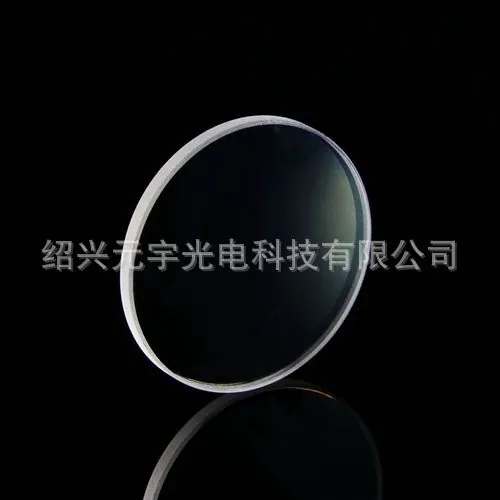
Optical Quartz and Crystal Glass in Calcium Fluoride Crystal Windows
In a deep-UV or IR instrument the CaF2 window is the element that lets the beam through where fused silica and ordinary glass would absorb, so its transmission band is the reason the part exists. As a single crystal it is soft, slightly birefringent and cleavable, which means a window that would be routine in glass becomes a handling and tolerance problem in calcium fluoride. The specification has to treat the material's weakness as a first-class constraint rather than an afterthought.
Coating and deposition considerations
The coating has to be applied at low temperature and low stress, because CaF2 is soft and thermally sensitive and a stressed stack can craze or detach the surface. A thin AR coating tuned to the working band recovers most of the surface reflection without loading the crystal, and the deposition must avoid the conditions that would micro-crack a cleavage-prone material. State the band and the angle of incidence, because the crystal's birefringence makes off-axis behaviour angle-dependent.
How quartz and crystal glass works in practice
In use the window transmits the deep-UV or IR band the instrument needs and the AR coating keeps that transmission high at the surfaces, while the crystal's birefringence is managed by keeping the beam close to normal incidence. A well-specified window passes the band cleanly and survives handling; an under-specified one shows scatter from surface damage or splits along a cleavage plane under clamping stress. The part is judged by how much of the wanted band reaches the detector, not by a generic optical grade.
The tolerances that actually matter
For a CaF2 window surface finish and edge condition matter more than figure, because a scratched or chipped surface scatters the deep-UV light the instrument is most sensitive to and a damaged edge can run a cleavage. Wedge and parallelism matter where the window sits in a converging beam, but the dominant risks are surface and edge, not form. The tolerances that move performance are the ones on finish, edge and coating adhesion, not the catalogue flatness number.
Design rules that reduce cost
Cost drops when the aperture and thickness are no larger than the beam needs and the surface finish is specified only as fine as the wavelength demands, because deep-UV scatter control is expensive to over-buy. Choosing a standard orientation and a simple AR band avoids bespoke deposition, and protecting the edge in the mount removes the damage that causes scrap. The cheap window is the one whose tolerance budget was written for the crystal, not lifted from a glass catalogue.
Requirements specific to Calcium Fluoride Crystal Windows
Crystal-window duty adds cleavage, softness and birefringence to the usual optical constraints, so surface finish, edge protection and low-stress coating lead the specification. Choose a low-temperature deposition tuned to the band and the design angle, keep the beam near normal incidence, and design the mount to protect the edge rather than clamp it. Qualify the part for handling and cleaning, because a CaF2 window that survives the metrology bench can still fail at the first wrong wipe.
- Low-temperature, low-stress coating
- AR tuned to band and angle
- Surface finish set by wavelength
- Edge protected in mount
- Near-normal incidence
- Handling and cleaning qualified
Framework references: surface, wedge and edge limits per ISO 10110, with crystal-specific notes on cleavage and birefringence. Environmental declarations such as RoHS are the supplier's to state against the current official text.
Selection data at a glance
| Parameter | Typical value | Notes |
|---|---|---|
| Material | CaF2 single crystal | Band |
| Coating | Low-temp AR | Band |
| Surface | Fine per wavelength | Scatter |
| Edge | Protected in mount | Cleavage |
| Angle | Near normal | Birefringence |
| Handling | Qualified clean | Survive |
Frequently asked questions
Why is CaF2 specified instead of fused silica?
Because calcium fluoride transmits deep-UV and parts of the infrared where fused silica absorbs, and for those bands there is often no glass alternative. The trade is that CaF2 is soft and cleavable, so the part needs more careful handling and coating than a silica window.
Why does the coating have to be low temperature?
Because CaF2 is thermally sensitive and a high-temperature or high-stress stack can micro-crack the surface or detach, which scatters the very deep-UV light the window exists to pass. Low-stress deposition protects the crystal while still recovering surface reflection.
What tolerance matters most for a CaF2 window?
Surface finish and edge condition, because deep-UV scatter comes from surface damage and a chipped edge can run a cleavage under clamping stress. Figure matters less than for a glass element unless the window sits in a strongly converging beam.
Need a quotation for optical quartz and crystal glass?
Send your drawing, target specification or coating requirement and an optical engineer will reply within 24 hours with a price and a lead time.
Request a Quote Email an engineer