Dichroic colour filters were invented for theatre: a coating that reflects one colour band and transmits the rest, running cool because the unwanted light passes through the glass instead of being absorbed as heat. For decades the market was shows — spots, fresnels, moving heads. In 2026, the demand curve has changed shape: architectural facades, display windows, horticultural lighting and museum lighting have all started ordering dichroic filters at volumes the entertainment market never produced.
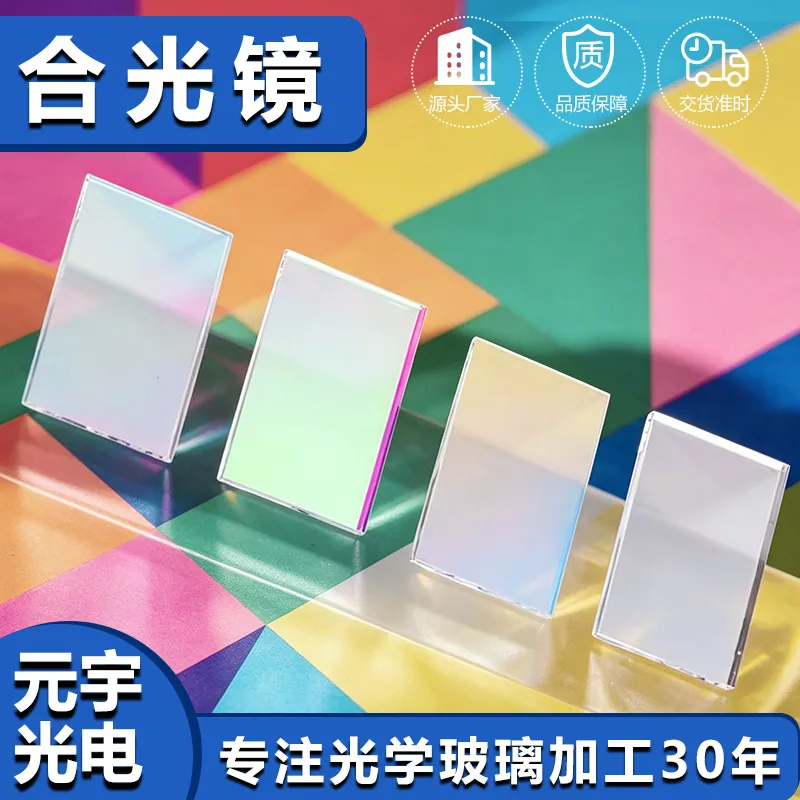
Why architectural lighting switched to dichroics
Absorption gel filters — the dyed plastic sheets that coloured every stage for fifty years — melt, fade and need replacing. Dichroic glass filters do not fade: the colour is in the interference stack, stable for decades under the UV and heat that destroy dyes. For a facade installation specified to run ten years without service access, that difference is decisive.
The shift was enabled by LED sources. Early LEDs were efficient enough to make filtering pointless — colour came from the emitter. But high-end architectural and display lighting has moved back toward white high-CRI engines with filtering, because a filtered white source delivers colour rendering that RGB mixing cannot: saturated primaries without the washed-out whites between them. Museum and retail lighting lead this trend, and architectural follow-spots and facade washers have carried it outward.
What the new buyers specify differently
Entertainment buyers accepted catalogue colours. The new markets do not:
- Custom colour points. Facade programmes specify chromaticity coordinates on the CIE diagram, not "blue". Dichroic designs are being quoted against xy targets with tolerance windows — a specification style borrowed from display calibration.
- Transmission efficiency. A theatre spot wastes power invisibly; a facade installation runs at a fixed energy budget. Higher transmission in the passband, and deeper rejection outside it, convert directly into energy savings and darker skies compliance.
- Durability in the environment. Exterior filters see humidity, temperature cycling and UV in a way stage equipment never did. Coating recipes and edge sealing (or frameless, edge-protected formats) are now part of the specification.
- Consistency across a large installed set. A facade uses hundreds of matched filters. Colour point matching between filters — not just against the target, but filter-to-filter — determines whether the installation looks uniform. This is a lot-consistency requirement that entertainment suppliers historically never faced.
The horticultural wildcard
Grow-lighting is the fastest-moving sub-market. Research into plant response to specific wavelengths is producing lighting recipes with narrow spectral requirements, and dichroic filters that carve custom bands out of white or broadband sources are becoming a tool in that space. The volumes are agricultural, and the colour specifications are scientific — an unusual combination for a filter product line.
What a good architectural filter supplier provides
- Colour point design capability: from xy coordinates or source spectrum to a coating design.
- Measured spectral curves per production lot, with filter-to-filter matching data.
- Environmental qualification: damp heat, UV exposure, thermal cycling, abrasion.
- Formats for the application: flat filters, reflectors, and coated glass shaped to existing fixtures.
- Long-term recipe stability, with change control — because a facade retrofit ten years on must match the original install.
Colour filtering has left the dark and moved into the built environment. The physics is the same as it was on stage; the engineering discipline around it — colour matching, durability, energy budgets — is entirely new, and it is resetting what filter suppliers need to prove before a building contractor will sign.
Product page: dichroic color filters — specifications, coating options and lead times.