X-ray instruments and vacuum beampipes need a window that transmits the X-ray band of interest, holds a vacuum and survives the beam, and the glass or low-Z window in that path is the element that balances X-ray transmission, mechanical strength and radiation behaviour. The specification is a set of trade-offs between a light, X-ray-transparent window and one that is strong and easy to seal, because every choice moves the transmission, vacuum and safety budgets together. This guide sets out the tolerances and material rules optical engineers should put on the drawing for glass and glass-ceramic windows in X-ray and beampipe duty.
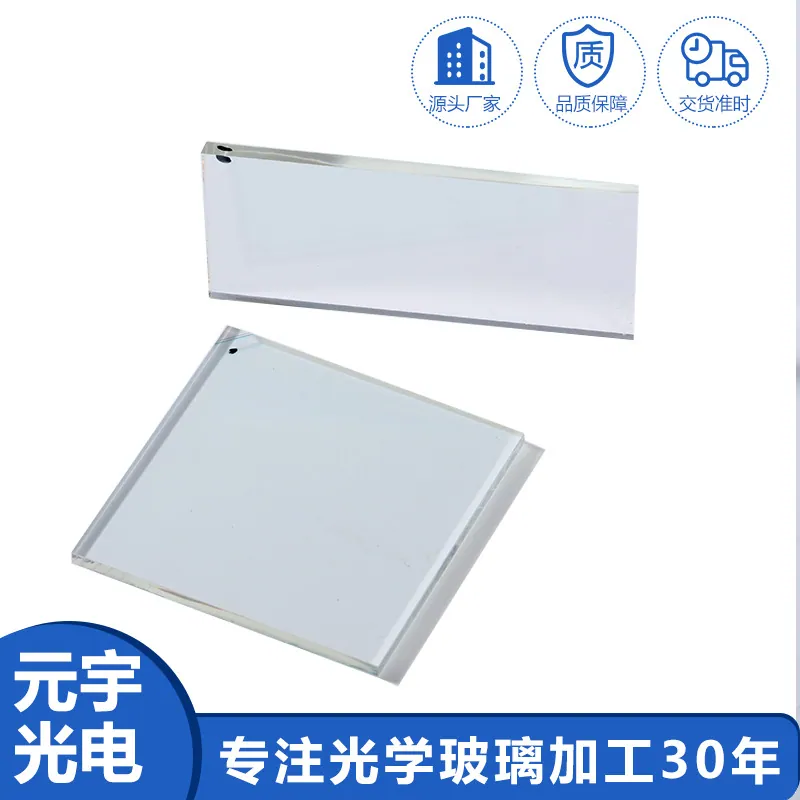
Optical Glass Materials in X-Ray Window and Vacuum Beampipe Applications
X-ray instruments and vacuum beampipes need a window that transmits the X-ray band of interest, holds a vacuum and survives the beam, and the glass or low-Z window in that path is the element that balances X-ray transmission, mechanical strength and radiation behaviour. The specification is a set of trade-offs between a light, X-ray-transparent window and one that is strong and easy to seal, because every choice moves the transmission, vacuum and safety budgets together. This guide sets out the tolerances and material rules optical engineers should put on the drawing for glass and glass-ceramic windows in X-ray and beampipe duty.
Coating and deposition considerations
Most X-ray windows are uncoated optical glass or a low-Z material, because any coating adds mass that absorbs the very X-rays you want to pass, so coating choices are limited to occasional protective or conductive layers that are kept extremely thin. Where a coating is used it must survive the beam and the vacuum without outgassing or darkening, and its added absorption is accounted for in the transmission budget. State explicitly whether the window is coated at all, because the default is none.
How optical glass materials works in practice
In use the window sits under vacuum on one side and beam on the other, so it must be flat, well-seated and free of stress that would crack it under differential pressure. Its X-ray transmission depends on thickness and atomic number, so the part is thin where transmission matters and supported where strength matters. A window that meets the spec holds its vacuum and its transmission through the instrument’s pressure and beam cycles; an under-specified one fails at the seal or leaks X-rays sideways.
The tolerances that actually matter
For an X-ray window the thickness and its uniformity decide transmission and pressure rating, and the seat geometry and surface quality decide the vacuum seal and the stress concentration. Flatness and edge quality matter where the part is clamped, because a warp or a chip becomes a leak or a crack. The tolerances that matter are the ones that hold the vacuum and the beam path, not the generic optical limits.
Design rules that reduce cost
Cost drops when the aperture and thickness are sized to the beam and the pressure rather than to a generous catalogue maximum, and when a standard window form is used instead of a custom shape that needs special fixturing. Picking a material the supplier processes routinely avoids custom melting, and keeping the surface class to what the seal needs avoids extra polishing. The cheap window is the one whose budget was written for the vacuum and the beam, not copied from a viewport catalogue.
Requirements specific to Glass Materials for X-Ray Window and Vacuum Beampipe Applications
X-ray and beampipe duty make the window a vacuum and radiation element, so X-ray transmission, pressure rating and seal geometry lead the specification. Size the thickness and aperture to the beam and the vacuum, keep the seat and edge quality tight, and treat any coating as a transmission penalty to justify. Qualify the part on its vacuum-holding and X-ray-transmission behaviour through the instrument’s cycles, not on a generic optical figure.
- Thickness and aperture sized to beam and pressure
- Low-Z material chosen for X-ray transmission
- Seat geometry and edge quality held for vacuum seal
- Coating avoided unless its function justifies the loss
- Flatness and stress control to avoid crack under differential pressure
- Material from a routine supplier process
Framework references: surface form, flatness, scratch-dig and edge quality per ISO 10110, and vacuum and radiation requirements per the relevant instrument or facility rule set. Environmental declarations such as RoHS are the supplier’s to state against the current official text, not to be assumed for a component used in an X-ray instrument.
Selection data at a glance
| Material | Index (nd) | Typical use | Notes |
|---|---|---|---|
| Property | Set by | Why | |
| Thickness | Beam + pressure | Transmission | |
| Material | Low-Z | X-ray pass | |
| Seat | Chamber geom | Vacuum hold | |
| Edge | Clamp stress | No crack | |
| Coat | Function only | Avoid loss |
Frequently asked questions
Why avoid coating an X-ray window?
Because any coating adds mass at the surface, and mass is exactly what absorbs the X-rays you are trying to transmit. A protective or conductive layer is only worth it when its function outweighs the transmission loss, and even then it is kept extremely thin and accounted for in the budget.
What tolerance matters most for a vacuum window?
The seat geometry and edge quality, because they decide whether the window seals and where the clamping stress concentrates. A warp or a chip at the seat becomes a leak or a crack under differential pressure long before a looser optical figure would ever matter.
How do I balance X-ray transmission against strength?
By putting the thin section only where the beam passes and supporting it with a stronger seat or frame, and by choosing the lowest-atomic-number material that still meets the pressure rating. Thinner transmits more but holds less vacuum, so size both to the actual beam and pressure rather than to a safe-looking maximum.
Need a quotation for optical glass materials?
Send your drawing, target specification or coating requirement and an optical engineer will reply within 24 hours with a price and a lead time.
Request a Quote Email an engineer