Specifying IR filters for solar and photovoltaic manufacturing is largely a matter of deciding which three numbers actually govern the application and letting the rest follow. This guide walks through the parameters that belong on the drawing, the tolerances that genuinely change the price, and the specification items that are routinely left out and then argued about at first article.
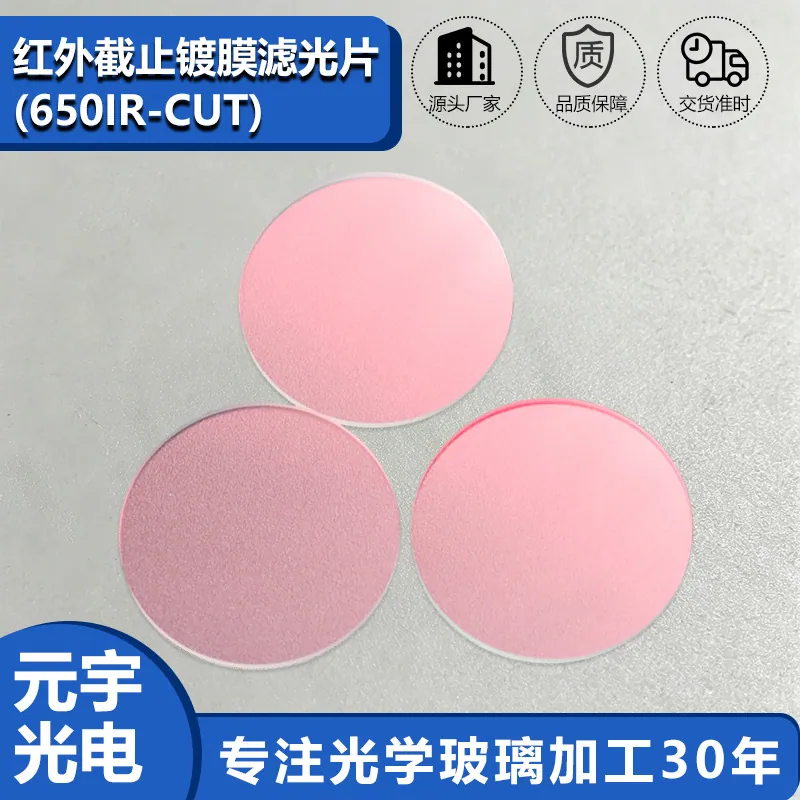
IR Filters in Solar and Photovoltaic Manufacturing
In solar and photovoltaic manufacturing, that translates into a specific set of requirements rather than a general preference for quality. Solar manufacturing combines very large glass areas with aggressive cost targets and 25-year outdoor exposure. Coatings are used to raise transmission and reduce soiling, while glass is used as tooling and protection in the production equipment itself. Durability under ultraviolet, humidity and thermal cycling is the entry ticket.
Coating and deposition considerations
Dichroic IR-cut designs run from roughly twenty to sixty layers of alternating high- and low-index oxides, with the layer thicknesses controlling both the position and the steepness of the edge. Ion-assisted deposition is the standard process because it produces dense layers that do not shift with humidity - an unassisted coating can move several nanometers after a week in a humid room. The residual reflection in the visible band has to be managed, since a strong reflection produces the green or magenta glint familiar on poorly coated camera windows; broadband AR layers are usually added on top of the dichroic stack to suppress it. For Solar and Photovoltaic Manufacturing, also decide whether a hard, hydrophobic outer layer is required, because it changes both the durability and the price of the part.
How IR filters works in practice
An IR filter removes a spectral band the sensor would otherwise record, and it does so in one of two ways. A dichroic filter reflects near-infrared light with a multilayer interference stack, so nothing is absorbed and the part stays cool; a blue or absorptive glass filter removes the same band by absorbing it in the bulk material. Dichroic designs give sharper edges, higher visible transmission and precisely tuneable cut-on wavelengths, but the edge moves with angle. Absorptive glass is angle-insensitive and cheap, but it is thicker, heavier and its cut-on is fixed by chemistry. In Solar and Photovoltaic Manufacturing, the choice usually comes down to how much of the field of view arrives off-axis: a narrow acceptance cone favors a dichroic design, while a wide-angle lens often needs an absorptive or a hybrid solution to avoid color shading across the frame.
The tolerances that actually matter
An IR filter is specified by its curve, so the tolerances that matter are spectral. A typical commercial part holds the cut-on wavelength to plus or minus five nanometers and the visible transmission to within a few percent of nominal; precision imaging parts tighten the wavelength to two nanometers and also constrain the slope of the transition. All of these numbers are only meaningful at a stated angle of incidence, and the acceptance angle belongs on the drawing next to the spectral tolerance. Mechanical tolerances follow the mounting: thickness to plus or minus 0.02 mm for a drop-in window, outline to plus or minus 0.05 mm, and a chamfer on every edge. In Solar and Photovoltaic Manufacturing, the specification most often forgotten is the permitted variation of color across the aperture, which is what a user actually notices when a wide lens produces a green frame edge.
Design rules that reduce cost
The design decisions that matter are the cut-on wavelength, the acceptance angle and the mounting. Place the cut-on where the sensor's quantum efficiency falls and its NIR sensitivity rises - most silicon sensors need the edge between 650 and 680 nm - and then decide how much of the aperture range must hold color accuracy. If the lens is fast or wide, either accept a wider transition or add an absorptive element. Leave a clear margin of at least 0.5 mm for mounting and a chamfer on both edges. Where the filter sits behind the lens rather than in front of it, remember that the ray bundle is no longer telecentric: the effective angle can exceed thirty degrees even in a modest system, which is exactly where a dichroic design begins to lose color fidelity in Solar and Photovoltaic Manufacturing.
Requirements specific to Solar and Photovoltaic Manufacturing
In solar and photovoltaic manufacturing, that translates into a specific set of requirements rather than a general preference for quality. Solar manufacturing combines very large glass areas with aggressive cost targets and 25-year outdoor exposure. Coatings are used to raise transmission and reduce soiling, while glass is used as tooling and protection in the production equipment itself. Durability under ultraviolet, humidity and thermal cycling is the entry ticket.
- Twenty-five year UV and humidity stability
- Very large coated areas with uniform performance
- Hydrophobic or easy-clean surface behavior
- Cost per square meter under pressure
IEC 61215 and IEC 61730 context for module durability, plus RoHS and REACH declarations for the coated glass.
Selection data at a glance
| Parameter | Typical value | Notes |
|---|---|---|
| IR-cut cut-on | 630-700 nm | Tuned to the sensor response |
| Visible transmission | T ≥ 90 %, R ≤ 1 % | Average 420-620 nm |
| NIR blocking | OD2 - OD4 (1 % - 0.01 %) | 700-1100 nm |
| Edge steepness | 10-30 nm transition | Dichroic designs |
| Angle of incidence | 0-30 deg specified | Passband shifts blue with angle |
| Wavelength tolerance | ± 5 nm standard, ± 2 nm precision | Measured at stated AOI |
| Substrate | B270, D263T, blue glass, sapphire | Absorptive option removes NIR without angle shift |
| Thickness | 0.3-3 mm | 0.55 - 1.1 mm typical for camera windows |
| Environmental | Humidity, salt spray, abrasion tested | MIL-C-48497 / MIL-PRF-13830B |
Frequently asked questions
Why does my image look green at the corners?
That is angular shift. The dichroic edge moves toward shorter wavelengths as the angle of incidence increases, so off-axis rays lose blue light and the frame edges shift color. Solutions are a wider transition, an absorptive element, or moving the filter closer to the stop.
Is absorptive blue glass better than a dichroic coating?
It depends on the acceptance angle and the budget. Blue glass is angle-independent, robust and cheap, but thicker and less controllable in cut-on. A dichroic coating gives a sharper, tuneable edge in a thinner part, at the cost of angle sensitivity.
Do the filters pass humidity and salt spray testing?
Ion-assisted hard oxide coatings do. Every shipment can include humidity, adhesion, abrasion and salt spray results, and the parts are routinely qualified against MIL-style test methods when the application requires it.
Need a quotation for ir filters?
Send your drawing, target specification or coating requirement and an optical engineer will reply within 24 hours with a price and a lead time.
Request a Quote Email an engineer