A decade ago, cutting optical glass meant mechanical dicing or abrasive sawing: chipped edges, coolant slurry, and a grinding-and-polishing step to recover edge quality. Laser-based glass cutting — filamentation, CO2 ablation plus crack propagation, hybrid processes — has steadily taken over flat-glass processing, first in display manufacturing, now across optical component shops. The cuts are fast, kerf-free and often polish-free. But they introduced a vocabulary that mechanical shops never needed: the heat-affected zone, and what it does downstream.
What the heat-affected zone actually is
Every thermal cutting process leaves a band of material near the cut whose structure changed because it got hot and cooled fast. In glass, that means a region of residual stress and sometimes altered density at the cut face. Under polarized light, the zone shows as a bright fringe pattern hugging the edge. It is typically microns to tens of microns deep, invisible to the eye, and mostly harmless — until it is not. Chip formation under handling loads, strength distribution in a thin part, and even the behavior of an edge under coating all trace back to how deep and how stressed that zone is.
Different laser processes produce different zones. Filamentation cutting, which separates glass along a modified internal track, tends to leave the smallest affected band. CO2-based processes, which heat from the surface, produce wider thermal gradients and a more visible chamfer-like change at the cut line. The difference matters when the edge will later carry a coating or when the part is thin enough that edge stress can warp it.
Where it bites: thin parts and coated edges
Two failure patterns recur in real production. First, thin windows — below about half a millimetre — can develop a bow after cutting, as residual stress relaxes asymmetrically. A flat part before cutting, a domed part after, and the interference fringes on the interferometer tell the story. The fix is usually a controlled anneal after cutting, not a better cutter. Second, edges that receive coating — protective edge blackening, conductive edge coatings, or the common case where a coating wraps slightly around the part — inherit the stress field. Coating adhesion at a stressed edge is measurably worse, and edge delamination starts there.
Strength testing closes the loop. Edge strength in glass is statistical; laser-cut edges behave differently from ground edges in Weibull terms, typically with a higher characteristic strength but a distribution shaped by the affected zone. Buyers moving from sawn to laser-cut parts should re-run their strength qualification rather than assume continuity — most of the time the laser edge is better, but the argument should rest on data.
What a good cutting specification contains
- Post-cut heat treatment: whether the process includes stress relief, and what retardance limit the edge meets afterwards.
- Edge geometry: chamfer, roundness and the allowed deviation along the perimeter, since laser edges are not perfectly perpendicular.
- Retardance measurement near the edge, under crossed polarizers, on delivered parts.
- Bow or wavefront requirement after cutting for thin parts, measured at the final thickness.
- Coating coverage rules: what gets coated, what stays bare, and the acceptance criteria at the coating-to-edge boundary.
The sourcing consequence
Laser cutting has quietly changed what "a cut blank" costs and what it can promise: faster turns, cleaner edges, less downstream polishing. But the heat-affected zone means the cutting process and the subsequent anneal and coating steps are coupled in a way the old workflow never was. Component buyers get the best results when they specify the edge as an engineered feature — with measurable criteria — instead of assuming that all cut edges are equivalent. The shops that measure and publish their edge data are the ones whose parts survive the coating line.
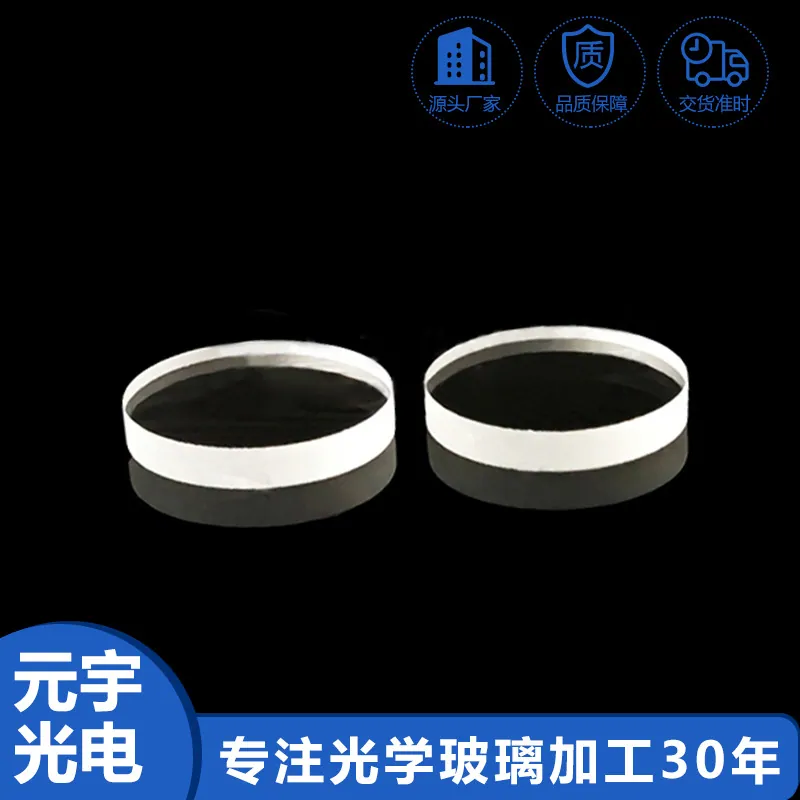
Product page: laser-grade optical glass blanks — specifications, coating options and lead times.