Lens protection windows on an autonomous mobile robot lead a harder life than the same glass inside a fixed machine, and the differences decide both performance and price. The window is cleaned by hand, exposed to dust and washdown, and asked to pass a narrow infrared band with low loss while surviving impacts that no laboratory optic ever sees. This article compares the practical choices for AMR and AGV sensor windows and shows where each trade-off actually pays off.
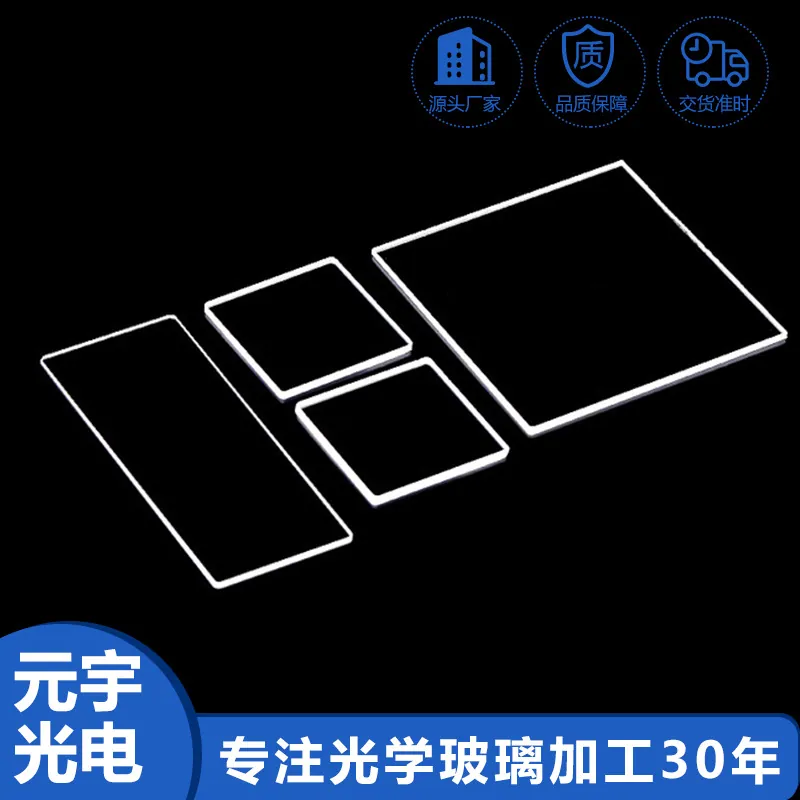
Lens Protection Windows in Autonomous Mobile Robots
In autonomous mobile robots, that translates into a specific set of requirements rather than a general preference for quality. A mobile platform carries several sensors behind the same kind of window: a scanning lidar at 905 nanometres, a time-of-flight camera, a stereo pair in the visible, and increasingly a 1550 nanometre lidar chosen for eye safety. Each of those bands has its own transmission requirement, and a single window covering all of them has to be broadband in the infrared while still transmitting enough visible light for the cameras. The window is also the part of the sensor that gets touched, bumped and washed, so abrasion resistance and easy cleaning are functional requirements rather than finishing touches. A coating that delivers excellent transmission and a water contact angle of 110 degrees is worth very little if it wears off in three months of daily cleaning.
What drives cost and lead time
Cost in a fleet application is driven by volume and by yield, not by exotic material. A robot programme typically needs the same window in thousands of units over several years, so the design has to be manufacturable on a stable process rather than individually optimised. That pushes towards flat round or rectangular windows in standard thicknesses, with a coating that can be run in a repeatable batch. Curved or shaped windows, tight wedge requirements and unusual sizes all break that rhythm and add cost. The second driver is the first article: a qualification window with full transmission and abrasion data is a one-off cost that a fleet programme should absorb once and then amortise, rather than re-run for every design revision.
Substrate and material selection
Substrate choice follows the exposure and the budget. B270 and ultra-clear float glass are adequate for indoor robots and protected outdoor platforms, and they are the cheapest optics that transmit well from the visible through 1700 nanometres. Borosilicate adds thermal stability for platforms that sit in direct sun or operate in cold stores, where a sudden temperature change can fog a window. Sapphire is chosen where the window itself is a wear surface, because its hardness keeps the surface intact through impacts that would pit glass, and the cost is justified by eliminating a replacement cycle rather than by optical performance. Polycarbonate is the other end of the trade: impact-resistant and cheap, but soft, easily scratched and limited in the infrared bands that matter most.
How it compares with the alternatives
Alternatives include leaving the sensor exposed behind a mechanical shroud, using a moulded polymer window, or applying a hard anti-glare etch instead of a coating. Exposed sensors avoid the window entirely and work on platforms that operate in clean environments, but they lose the whole benefit of a sealed optical cavity. Polymer windows are cheap and impact-tolerant and lose on abrasion and on infrared transmission, so they suit visible-only cameras and poorly suit lidar. An anti-glare etch scatters reflected light and helps a visible camera see through the window, while doing nothing for transmission at 905 nanometres. Coated glass remains the default because it solves transmission, sealing and cleaning at the same time, and the trade is between the substrate grade and the coating durability rather than between coated and uncoated.
Coating and deposition considerations
The standard coating for an AMR window is a broadband anti-reflective stack tuned to the sensor bands rather than to the visible average, often with a separate narrowband element for the lidar wavelength, plus a hydrophobic and oleophobic topcoat. That topcoat is the layer that determines the cleaning life of the part: a hard oxide stack alone transmits well but holds fingerprints, and a soft fluoropolymer sheds contamination but wears through. The practical answer is a hard oxide stack with a thin fluorosilane finish, specified to survive a defined number of abrasion cycles rather than to achieve the lowest possible contact angle on day one. Where several sensors share one window, the coating has to be designed for the combined band, and the design should be validated on the assembled module rather than on a witness coupon, because the window is rarely at normal incidence to every sensor behind it.
Requirements specific to Autonomous Mobile Robots
Fleet deployment adds constraints that a single-unit specification never carries. The window has to survive daily cleaning with whatever the site uses, which in food and beverage environments means caustic or acidic agents, and in warehouses means alcohol wipes. Dust ingress matters because a robot working in a dusty aisle will accumulate a film on the window that reduces transmission slowly and unevenly, so the surface has to be easy to clean rather than merely hard. Shock and vibration from the platform are continuous rather than occasional, so mounting geometry and edge chamfer control matter as much as the optical numbers. Where the window is a field-replaceable part, its dimensional tolerances are defined by the module it fits into, and interchangeability across a fleet becomes a specification item in its own right.
- Broadband infrared transmission covering 905 and 1550 nm lidar plus visible cameras
- Hard oxide stack with a fluorosilane finish specified by abrasion cycles
- Caustic, acidic and alcohol cleaning resistance on the exposed face
- Field-replaceable geometry with fleet-wide interchangeability
IEC 60825 context for laser safety in the sensing bands, ISO 10110 drawings, and IP-rated sealing requirements defined by the module rather than by the window.
Selection data at a glance
| Parameter | Typical value | Notes |
|---|---|---|
| Transmission | over 96 % at 905 nm, over 95 % at 1550 nm | Combined band coating |
| Visible transmission | over 92 % average, 420-680 nm | For the camera pair |
| Substrate | B270, ultra-clear, borosilicate, sapphire | Sapphire for wear surfaces |
| Thickness | 0.5-3 mm, 1.1 mm typical | Impact driven |
| Hardness | 9H pencil, steel wool 0000 pass | Hard oxide stack |
| Water contact angle | over 100 degrees after abrasion | Fluorosilane finish |
| Cleaning resistance | alcohol, caustic and acidic agents | Per the site protocol |
| Impact | no chipping over 50 µm after drop test | Chamfer 0.1-0.3 mm |
| Outline tolerance | ± 0.1 mm, sealing groove available | Field replaceable |
Frequently asked questions
Can one window serve both the lidar and the cameras?
Yes, and it is usually the right answer, but the coating has to be designed for the combined band rather than for either sensor alone. A stack tuned only to the visible will lose transmission at 905 nanometres, and a stack tuned only to the lidar will look purple and cost visible range. Specify both bands, and validate the design on the assembled module rather than on a flat witness sample.
Why does the hydrophobic coating wear out before the glass does?
Because the topcoat is a molecular layer a few nanometres thick sitting on top of the hard stack, and mechanical cleaning attacks it first. That is why the durability of the finish should be specified as a number of abrasion cycles with a surviving contact angle, rather than as an initial contact angle measured on a virgin part.
Is sapphire worth the cost on an AMR?
It is worth it where the window is genuinely a wear surface, such as a low-mounted bumper sensor that meets kerbs and pallets. It is not worth it on an elevated sensor that only sees dust and rain. Splitting the specification by sensor position usually gives a better fleet cost than applying one material everywhere.
Need a quotation for lens protection windows?
Send your drawing, target specification or coating requirement and an optical engineer will reply within 24 hours with a price and a lead time.
Request a Quote Email an engineer