The thickness of a dichroic filter used to be an afterthought. A 1.1 mm substrate was standard, 0.7 mm was thin, and anything below half a millimetre was a special request that came with a conversation about yield.
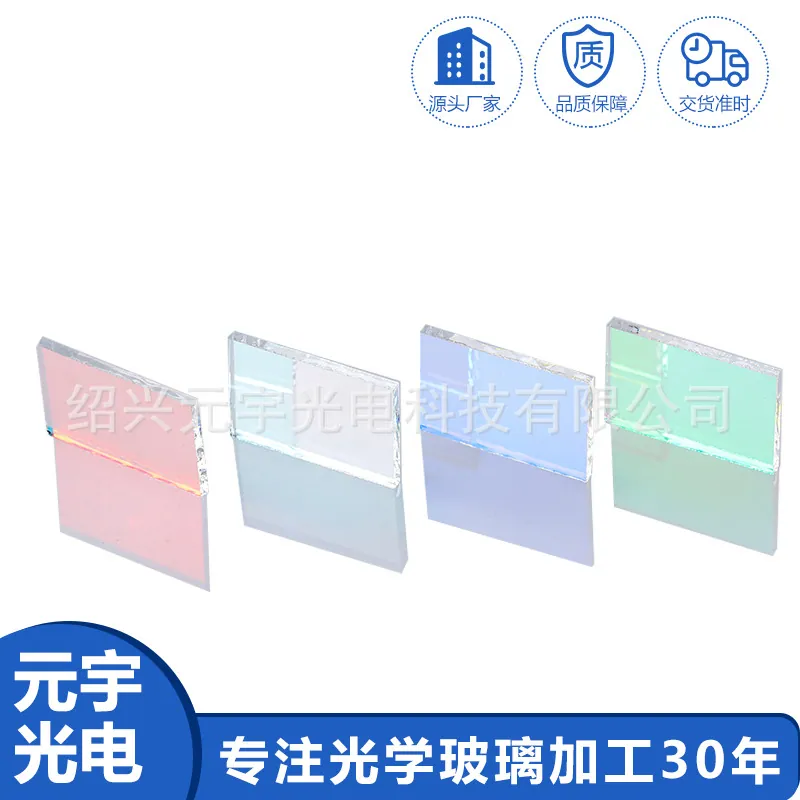
That conversation has become routine. Compact imaging modules, wearable displays and space-constrained sensors are pushing dichroic filters toward 0.21 mm and even thinner substrates, and the parts are now being specified into production programmes rather than sampled for evaluation.
Why thickness became a design variable
Three forces drive the trend, and they act together.
Optical path length. In a converging or diverging beam, a thick filter introduces spherical aberration and, in a beamsplitter cube or a folded path, a lateral image shift. A 1.1 mm filter in an f/2 beam is an optical element; a 0.21 mm filter is nearly a membrane. Designers who need the filter inside a tight path increasingly cannot afford the thickness.
Package height. Wearable and mobile modules are measured in fractions of a millimetre. A stack of filter, sensor cover glass and spacer quickly exceeds the available height if the filter is conventional thickness.
Ghost separation. Thin filters move internal-reflection ghosts closer to the intended image, and in some geometries closer to the sensor's own cover-glass reflection, where they can be managed rather than merely tolerated.
What gets harder when the glass gets thin
The manufacturing consequences are real, and they arrive in a specific order.
Handling. A 0.21 mm part is fragile in a way that changes everything downstream: cleaning, inspection, packing and assembly. Vacuum tools that work on 1 mm glass will crack a thin part; ultrasonic cleaning can fracture edges that were previously robust. Suppliers moving to thin substrates typically redesign fixtures before they redesign coatings.
Flatness under stress. Coating stress deflection scales with the square of the diameter-to-thickness ratio, so reducing thickness from 1.1 mm to 0.21 mm increases stress-induced bow by roughly a factor of twenty-seven at the same aperture. A dichroic that was flat before coating can bowl visibly after it. Managing that requires either lower-stress deposition, a compensating back-side layer, or an acceptance that the part will be mounted flat rather than free-standing — and a specification that reflects the mounting.
Edge quality. Thin glass chips easily at the edge, and a chipped edge is both a mechanical weakness and a scatter source. Laser cutting and precision dicing both work, but the edge finish has to be specified, and the chamfer that a thick part can carry may not be available.
Coating uniformity across a thin, large part. Thin substrates are often processed in large sheets and diced afterward, which is the economical route. The uniformity of the coating across the sheet then becomes a per-part specification: a spectral shift of a few nanometres from centre to edge of the sheet is invisible on a 10 mm part and significant on a 40 mm one.
What buyers should specify differently
The specification for a thin dichroic is not simply the thick-part specification with a smaller number in the thickness field. Five items change:
- Flatness measured in the mounted condition, or with the mounting method stated. Free-state flatness on a 0.21 mm part is close to meaningless.
- Coating stress or bow data, so the assembly design can accommodate it.
- Edge quality and chip tolerance, because thin edges fail differently.
- Spectral uniformity across the delivered aperture, especially for parts diced from a larger sheet.
- Handling and packaging requirements, since damage in transit is a much larger share of yield loss at this thickness.
The supply-chain angle
Thin-glass dichroics favour suppliers with in-house dicing, thin-film stress control and metrology that can measure a part without distorting it. The last point is subtler than it sounds: a contact fixture that flattens a thin filter during measurement will report a flatness the part does not have in service.
Volume economics also shift. Thin substrates are cheaper per unit area, but yield loss and handling cost rise, so the total cost curve is not simply lower. Buyers comparing quotations should compare delivered yield and assembly yield, not piece price.
Where this goes next
The trajectory is toward thinner, larger and more integrated: filters laminated directly onto sensor packages, coated wafers diced after coating, and dichroic functions deposited onto the cover glass itself. Each step removes a component and a handling step, and each step moves more of the risk into the coating process.
For now, 0.21 mm is the working frontier in volume. The parts are available, the specifications are learnable, and the programmes that treat thin glass as a different discipline rather than a thinner version of the old one are the ones shipping without surprises.