Failures in AR coated glass used in biometric and fingerprint recognition tend to follow a small number of patterns, and each pattern has a signature. This article walks through the common failure modes, how to tell them apart with measurements rather than guesswork, and the process or design changes that actually remove the root cause.
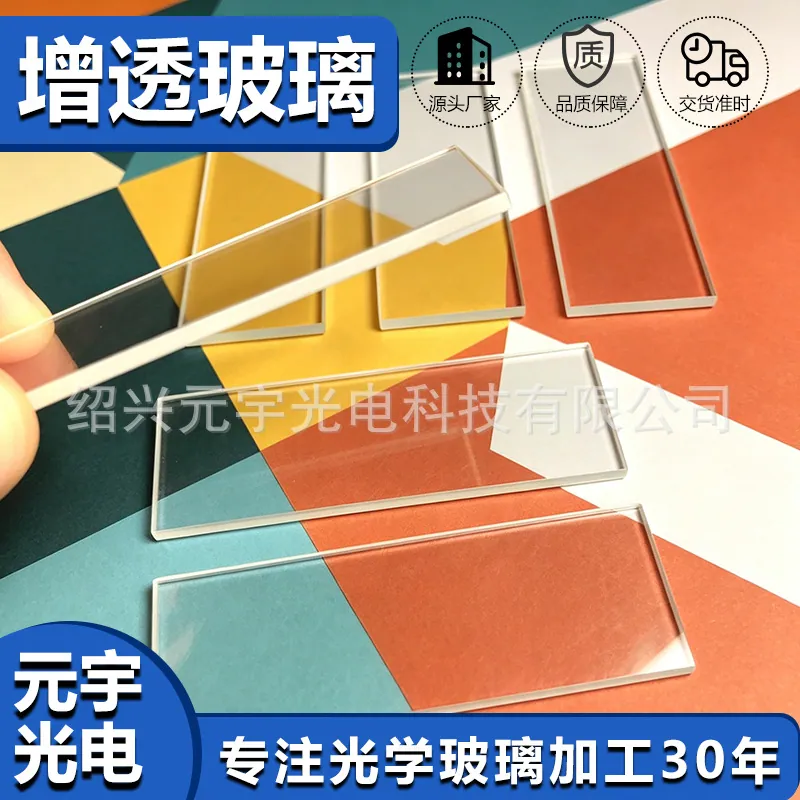
AR Anti-Reflective Glass in Biometric and Fingerprint Recognition
In biometric and fingerprint recognition, that translates into a specific set of requirements rather than a general preference for quality. Biometric systems must separate the live signal from everything else in the scene, which makes spectral filtering the primary function of the optics. Fingerprint and iris systems work at defined wavelengths, often under near-infrared illumination, and a filter that leaks the wrong band will compromise recognition as surely as a dirty sensor.
Coating and deposition considerations
AR stacks are built from alternating low-index silica and higher-index oxides such as niobium, tantalum or titanium oxide, deposited in four, six or more layers to flatten the reflectance curve across the band. Broader bands and lower reflectance both require more layers, and more layers mean tighter process control, because each layer contributes to the interference balance. Ion-assisted deposition is preferred for durability: the resulting films are dense, so they resist moisture, resist abrasion and do not shift color when humidity changes. Hydrophobic and oleophobic top layers are frequently added on touch surfaces, and a conductive or anti-static layer helps where dust retention is a problem. For Biometric and Fingerprint Recognition, the deposition process also determines whether the coating can be applied to both faces in one run or needs two passes.
Design rules that reduce cost
Deciding what to coat is as important as deciding how. Coat both faces whenever possible, because the second surface typically contributes as much reflected light as the first. Choose the band from the light source rather than from habit: a visible-only coating on a sensor window that also passes 850 nm illumination will reflect that illumination back into the system. Keep a clear margin of 0.5 to 1 mm around the aperture for adhesive or gaskets, and specify chamfers so that handling never touches a coated face. Where a display is laminated, confirm that the optical adhesive's index matches the coating design, since a mismatch reintroduces a reflection at an internal interface. In Biometric and Fingerprint Recognition, these details are what separate a part that looks invisible from one that merely measures well.
Common failure modes and how they show up
AR coatings fail in four recognisable ways. Abrasion removes the outermost layer and produces a faint haze that is only visible in glancing light. Delamination appears first at edges and apertures, usually after humidity exposure, and indicates insufficient adhesion preparation or an incompatible cleaning chemistry. Color shift under humidity points to a porous coating deposited without ion assistance. Edge corrosion, more common on laminated or busbar-equipped parts, starts at an exposed edge and creeps inward. In Biometric and Fingerprint Recognition, the practical response is to inspect the failure location: an edge-originated defect is almost always an assembly or cleaning issue, whereas a uniform change across the aperture is a coating process issue.
Inspection and measurement
The primary measurement is spectral reflectance and transmission across the specified band, ideally at several points across the aperture so that thickness uniformity is verified as well as average performance. Haze is measured on a haze meter and matters more than most specifications acknowledge: a coating with excellent reflectance and 1 percent haze will be rejected by the user, because haze is visible at almost any viewing angle. Durability is verified through abrasion, tape adhesion and humidity tests, often against MIL-C-48497 or an equivalent customer standard. In Biometric and Fingerprint Recognition, the incoming inspection that pays for itself is a simple reflection color check under a defined light source, which catches color casts before the glass is bonded into an assembly that cannot be reworked.
Standards, documentation and traceability
AR coated glass is qualified through optical performance specifications plus durability and compliance documentation. Optical acceptance is defined by reflectance, transmission and haze targets over a stated band, with a defined measurement geometry. Durability commonly follows MIL-C-48497 for abrasion, adhesion and humidity, with additional customer-specific tests for outdoor exposure or cleaning regimes. Environmental compliance is documented with RoHS and REACH declarations. In Biometric and Fingerprint Recognition, the standards that most often delay a shipment are the customer's own: a specific cleaning chemical resistance list, a required surface energy for bonding, or an anti-static requirement expressed in surface resistance.
Requirements specific to Biometric and Fingerprint Recognition
In biometric and fingerprint recognition, that translates into a specific set of requirements rather than a general preference for quality. Biometric systems must separate the live signal from everything else in the scene, which makes spectral filtering the primary function of the optics. Fingerprint and iris systems work at defined wavelengths, often under near-infrared illumination, and a filter that leaks the wrong band will compromise recognition as surely as a dirty sensor.
- Tight band-pass or IR-cut definition at the operating wavelength
- Scratch-resistant user-facing surface
- Stable behavior across a wide angle of incidence
- High transmission for low-power illumination
ISO/IEC 19794 context for biometric data quality, ISO 10110 drawings, and RoHS and REACH declarations.
Selection data at a glance
| Parameter | Typical value | Notes |
|---|---|---|
| Reflectance per surface | R ≤ 0.5 % average, R ≤ 0.2 % achievable | 420-680 nm |
| Transmission gain | up to 99 % single side, > 99 % both sides | Versus 92 % uncoated B270 |
| Band options | 400-700, 400-1100, 900-1700 nm, dual band | Broadband or tuned |
| Substrate | B270, ultra-clear, borosilicate, quartz, acrylic | 0.5-12 mm |
| Haze | ≤ 0.3 %, typically ≤ 0.1 % | Haze meter |
| Abrasion | pencil hardness 9H, steel wool 0000 pass | Hard oxide stacks |
| Adhesion | tape test 4B or better | Cross-hatch |
| Environmental | 85/85 humidity, salt spray, UV stable | Outdoor grades available |
| Coating pattern | full face, aperture only, or masked | Margin 0.5-1 mm typical |
Frequently asked questions
What reflectance can an AR coating actually reach?
Under 0.5 percent average per surface is routine, and under 0.2 percent is achievable across the visible band with a multilayer stack. Total transmission above 99 percent is possible when both faces are coated.
Should I coat one side or both?
Both, whenever the budget allows. The uncoated rear surface usually reflects as much light as the front coating removes, so leaving it bare gives up most of the benefit and often introduces visible ghosting.
How durable is the coating on a touch screen?
Hard oxide stacks pass a 9H pencil test and 0000 steel wool abrasion, and top layers can be added for fingerprint resistance. Durability under daily fingerprint oil exposure is normally limited by the cleaning method, not the coating.
Need a quotation for ar anti-reflective glass?
Send your drawing, target specification or coating requirement and an optical engineer will reply within 24 hours with a price and a lead time.
Request a Quote Email an engineer