Broadcast and studio optics put anti-reflective glass where bright, controlled lighting meets the camera: in front of the lens, in the teleprompter beam splitter, and across monitor hoods. The requirement is high transmission with as little ghosting and flare as possible, and the cost of that glass is driven less by the raw material than by the coating stack, the substrate quality and how tightly the spectral band has to be held.
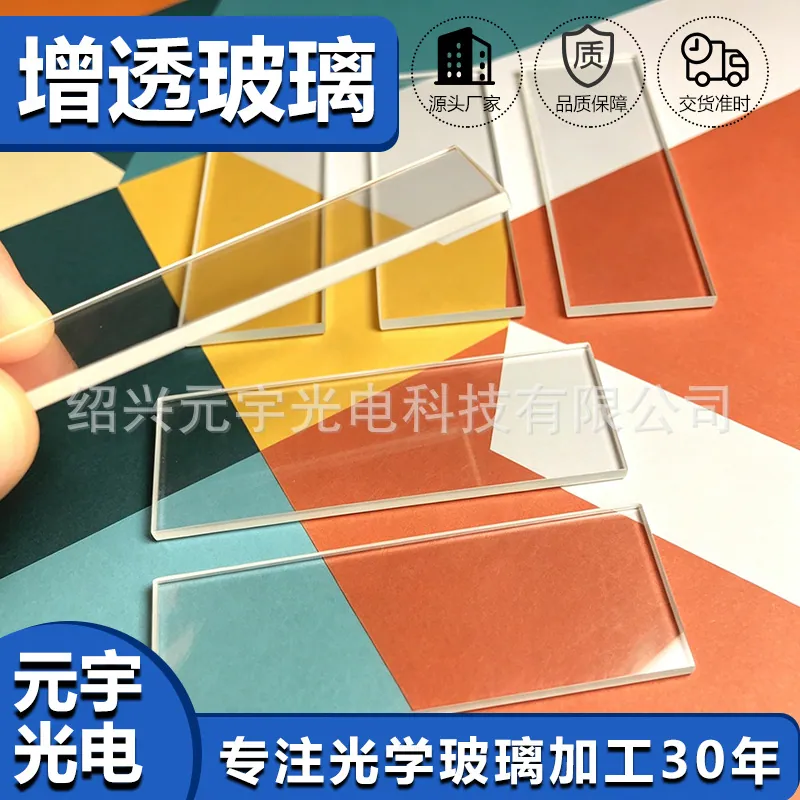
AR Anti-Reflective Glass in Broadcast and Studio Optics
In a broadcast chain the AR glass is the surface the crew sees and the camera does not want to see. In front of a lens it reduces surface reflection so the sensor is not fighting a bright ghost of the studio lights; in a teleprompter it is the beam splitter that lets the talent read script while the camera sees through. Because studio lighting is intense and often includes hard key lights, any residual reflection or coating non-uniformity becomes a visible flare or a bright spot in shot, which is why the AR performance is specified harder here than in most industrial settings.
Handling, cleaning and packaging
AR coatings are softer than the glass they sit on, so handling dominates the practical risk and the cost of rejects. A teleprompter pane is large, thin and constantly wiped by crew, and a single scratch across the talent's eye-line is a reject even if the optical performance is perfect. Cleaning must use the solvent and cloth the coating is rated for, because the wrong wipe hazes a soft broadband stack within a few sessions. Packaging for large panes needs rigid, dust-free flats rather than rolls or bulk, and the handling instruction on the pack is part of the deliverable, not an extra.
The tolerances that actually matter
The tolerances that matter are the residual reflectance across the visible band, the transmission floor, and the uniformity of both across the pane. A teleprompter splitter also cares about the reflected-to-transmitted ratio, because the talent needs enough script brightness while the camera keeps a clean image. Flatness matters for large panes that sit in a converging beam, where a bow introduces a focus shift or a visible warp, but for a flat front-of-lens window the figure is secondary to the coating. Colour neutrality matters in broadcast more than in monochrome work, because a coating tint shifts skin tones on air.
What drives cost and lead time
Cost is driven by the coating stack and the substrate size. A broadband visible AR with four or more layers costs more than a simple two-layer coat, and holding tight residual reflectance across a wide band raises the reject rate. Large teleprompter panes are expensive simply because the substrate is big and a single defect scraps the whole piece, so yield, not material, sets the price. Lead time follows the coating queue and the metrology: measuring uniformity across a large pane takes longer than on a small window, and any requirement for a spectral curve per pane extends the schedule. Standard sizes and a standard visible-band coating are the reliable way to cut both cost and wait.
Substrate and material selection
The substrate is chosen for optical clarity, low inherent colour and the size the application needs. A low-iron glass gives the neutral colour broadcast demands and avoids the green cast of ordinary float glass on camera, while a higher-grade optical crown is used where the figure or homogeneity must be tighter. For very large panes the practical limit is the available blank size and the handling risk, so the substrate choice is often dictated by what can be made and moved without defect rather than by the ultimate optical grade. The coating and the substrate have to be specified together, because a perfect coat on a tinted substrate still shifts the on-air colour.
Common failure modes and how they show up
The common failures are coating haze from wrong-solvent wiping, which shows as a soft flare that creeps in over sessions, and edge or corner chips from handling large thin panes, which propagate into cracks under the constant thermal and mechanical load of a studio. Non-uniformity appears as a bright or dark patch in shot that moves with camera angle, and is usually a coating-thickness variation across a large pane. Delamination is rare but catastrophic, showing as a milky region that cannot be cleaned. Most of these are handling and cleaning problems rather than material faults, which is why the pack instructions and the crew training matter as much as the spec.
Requirements specific to Broadcast and Studio Optics
Broadcast and studio use adds high transmission, low ghosting and colour neutrality under intense lighting to the usual AR-glass requirements. Specify a broadband visible coating with a tight residual reflectance and a neutral tint so skin tones stay true, choose a low-iron substrate for large panes, and hold the reflected-to-transmitted ratio where the glass is a teleprompter splitter. Treat the coating as the soft part: rate it for the solvent the crew will actually use, pack it in rigid dust-free flats, and put the handling instruction on the pack, because most rejects are handling and cleaning damage rather than specification failures.
- Broadband visible AR with tight residual reflectance
- Neutral tint low-iron substrate for true colour
- Splitter ratio held where used as teleprompter glass
- Coating rated for the solvent the crew actually uses
- Rigid dust-free flats and on-pack handling instruction
Framework references: optical coating spectral performance and substrate quality are generally described using the terminology in ISO 10110; colour neutrality and reflectance targets for broadcast should be confirmed against the current issue of the relevant standard and the production's own on-air colour specification rather than a generic AR datasheet.
Selection data at a glance
| Parameter | Typical value | Notes |
|---|---|---|
| Coating | Broadband visible AR | Residual reflectance |
| Substrate | Low-iron, neutral | On-air colour |
| Splitter ratio | Held for prompter use | Script vs image |
| Size | Standard pane first | Yield sets price |
| Cleaning | Rated solvent only | Avoids haze |
| Pack | Rigid dust-free flat | Handling rejects |
Frequently asked questions
Why does my teleprompter glass develop a flare after a few sessions?
Almost always wrong-solvent wiping of a soft broadband AR coat, which hazes the surface and raises reflection. Use only the solvent and cloth the coating is rated for, and keep the handling instruction on the pack so crew do not reach for a generic cleaner.
Do I need an optical-crown substrate for a studio front window?
Not usually. A low-iron float glass gives the neutral colour broadcast needs at far lower cost; reserve the higher optical grade for cases where the figure or homogeneity must be tighter than float glass allows.
Why is a large AR pane so expensive relative to a small window?
Because a single defect scraps the whole piece, so yield rather than material sets the price, and measuring coating uniformity across a large pane takes longer. Standard sizes and a standard visible-band coat are the reliable way to bring the cost down.
Need a quotation for ar anti-reflective glass?
Send your drawing, target specification or coating requirement and an optical engineer will reply within 24 hours with a price and a lead time.
Request a Quote Email an engineer