There is always more than one way to solve the optical problem in drone and UAV imaging payloads, and the options are not equally good at everything. This article compares AR coated glass against the materials, processes and design approaches it competes with, on the criteria that matter commercially: performance, durability, unit cost and lead time.
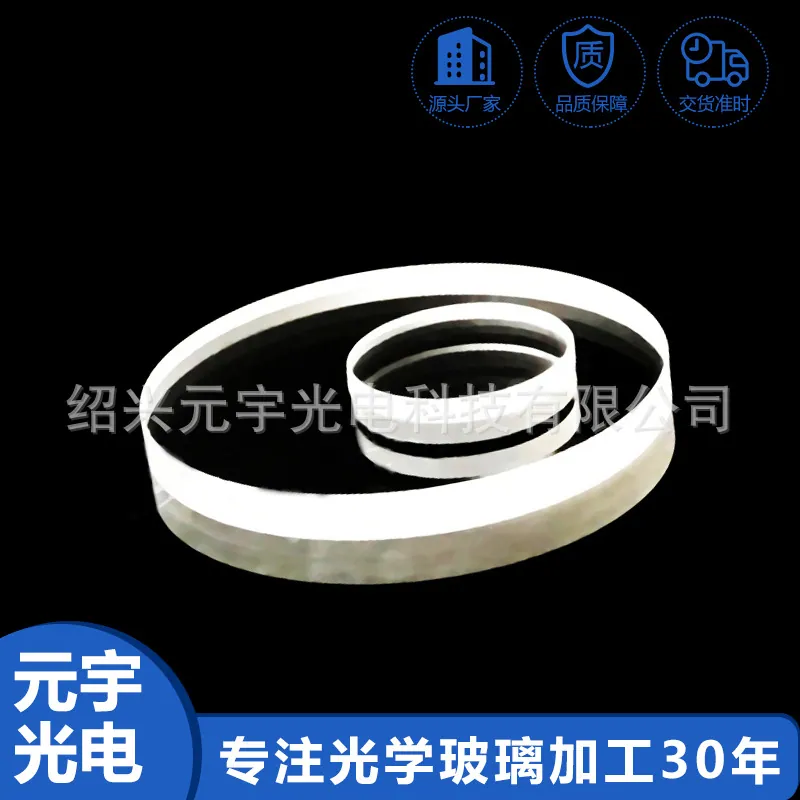
AR Anti-Reflective Glass in Drone and UAV Imaging Payloads
In drone and UAV imaging payloads, that translates into a specific set of requirements rather than a general preference for quality. Airborne imaging payloads trade weight against durability on every design decision. A gimbal-mounted camera window must be light enough not to affect flight time, flat enough not to distort a long lens, and robust enough to survive landing and dust. Multispectral agricultural payloads add the complication of several narrow bands in one small assembly.
The tolerances that actually matter
AR specifications are photometric rather than dimensional. The useful numbers are average reflectance across a stated band, maximum reflectance at the worst wavelength, transmission, haze, and the residual color of the reflection. Average reflectance below 0.5 percent per surface is a normal industrial specification, and below 0.2 percent is achievable with more layers; haze should stay under 0.3 percent, and ideally under 0.1 percent, because haze is what an observer perceives as a gray film. Dimensional tolerances - outline, thickness, chamfer and edge quality - follow the housing. In Drone and UAV Imaging Payloads, the specification item most often missed is the color of the residual reflection: a coating that meets every photometric target can still read visibly blue or green, and for a display or an architectural window that color is the first thing a customer sees.
How it compares with the alternatives
Alternatives to coating include using a lower-index substrate, laminating a glass to an index-matched adhesive, using an etched or textured anti-glare surface, and simply accepting the reflection. Etched anti-glare glass scatters light rather than suppressing it, which is excellent for readability in bright environments and poor for imaging or transmission. Index matching by lamination works well within a stack but does nothing for the outermost surface. Uncoated glass is often acceptable for a mechanical window and rarely acceptable for anything a user looks through or a sensor looks through. In Drone and UAV Imaging Payloads, the deciding question is whether the system needs more transmitted light or less reflected light - they are related but not identical, and anti-glare treatment solves the second at the cost of the first.
Substrate and material selection
The substrate determines what the coating must cope with. B270 and ultra-clear float glass are the standard carriers for displays and instrument windows, offering high transmission at low cost. Borosilicate adds thermal stability, which matters when the glass is tempered, laminated or exposed to heat. Quartz and fused silica extend the band into the ultraviolet and are used where the coating must survive higher energy. Acrylic and polycarbonate are coated when weight matters more than scratch resistance, but they require low-temperature deposition and generally cannot accept the hardest oxide stacks. In Drone and UAV Imaging Payloads, the material also sets the available thickness range, and thin substrates below 1 mm need care both in coating, where warp is a risk, and in assembly, where clamping stress will show up as optical distortion.
What drives cost and lead time
The cost of an AR coating scales with the number of layers, the area coated and whether one or both faces are treated. A four-layer broadband stack on one face is the economical baseline; pushing average reflectance below 0.2 percent, extending the band, or adding hydrophobic and anti-static functionality each add layers and raise the sensitivity of the run. Coating both faces roughly doubles the process cost but usually costs less than two single-sided parts. Patterned coatings, apertures and masked areas add a lithography or masking step whose cost is dominated by the mask. In Drone and UAV Imaging Payloads, the cheapest improvement is almost always to coat the second surface, since an uncoated rear face often contributes more reflected light than the front coating removes.
Requirements specific to Drone and UAV Imaging Payloads
In drone and UAV imaging payloads, that translates into a specific set of requirements rather than a general preference for quality. Airborne imaging payloads trade weight against durability on every design decision. A gimbal-mounted camera window must be light enough not to affect flight time, flat enough not to distort a long lens, and robust enough to survive landing and dust. Multispectral agricultural payloads add the complication of several narrow bands in one small assembly.
- Low weight with thin substrates
- Flatness and low wedge for long focal lengths
- Multispectral band accuracy where required
- Dust, salt and humidity resistance
Airworthiness documentation for commercial operations, ISO 10110 drawings, and RoHS and REACH declarations.
Selection data at a glance
| Parameter | Typical value | Notes |
|---|---|---|
| Reflectance per surface | R ≤ 0.5 % average, R ≤ 0.2 % achievable | 420-680 nm |
| Transmission gain | up to 99 % single side, > 99 % both sides | Versus 92 % uncoated B270 |
| Band options | 400-700, 400-1100, 900-1700 nm, dual band | Broadband or tuned |
| Substrate | B270, ultra-clear, borosilicate, quartz, acrylic | 0.5-12 mm |
| Haze | ≤ 0.3 %, typically ≤ 0.1 % | Haze meter |
| Abrasion | pencil hardness 9H, steel wool 0000 pass | Hard oxide stacks |
| Adhesion | tape test 4B or better | Cross-hatch |
| Environmental | 85/85 humidity, salt spray, UV stable | Outdoor grades available |
| Coating pattern | full face, aperture only, or masked | Margin 0.5-1 mm typical |
Frequently asked questions
Should I coat one side or both?
Both, whenever the budget allows. The uncoated rear surface usually reflects as much light as the front coating removes, so leaving it bare gives up most of the benefit and often introduces visible ghosting.
How durable is the coating on a touch screen?
Hard oxide stacks pass a 9H pencil test and 0000 steel wool abrasion, and top layers can be added for fingerprint resistance. Durability under daily fingerprint oil exposure is normally limited by the cleaning method, not the coating.
Can you coat heat-treated or tempered glass?
Yes, but the coating must be applied after tempering, because the tempering cycle will damage most thin-film stacks. If a coated part must subsequently be tempered, the coating design has to be selected for thermal stability.
Need a quotation for ar anti-reflective glass?
Send your drawing, target specification or coating requirement and an optical engineer will reply within 24 hours with a price and a lead time.
Request a Quote Email an engineer