Specifying AR coated glass for scientific and laboratory instrumentation is largely a matter of deciding which three numbers actually govern the application and letting the rest follow. This guide walks through the parameters that belong on the drawing, the tolerances that genuinely change the price, and the specification items that are routinely left out and then argued about at first article.
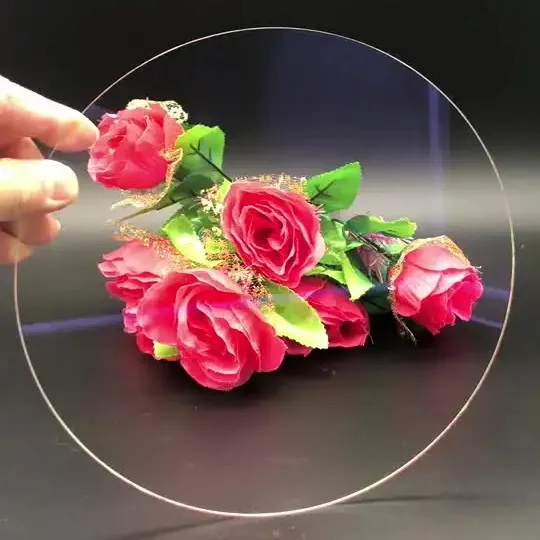
AR Anti-Reflective Glass in Scientific and Laboratory Instrumentation
In scientific and laboratory instrumentation, that translates into a specific set of requirements rather than a general preference for quality. Laboratory instruments are judged on reproducibility, so their optics must be documented and their performance must not drift between measurement campaigns. Many instruments are calibrated against a reference path, which means a small change in a window or filter shifts every reading rather than producing an obvious failure.
The tolerances that actually matter
AR specifications are photometric rather than dimensional. The useful numbers are average reflectance across a stated band, maximum reflectance at the worst wavelength, transmission, haze, and the residual color of the reflection. Average reflectance below 0.5 percent per surface is a normal industrial specification, and below 0.2 percent is achievable with more layers; haze should stay under 0.3 percent, and ideally under 0.1 percent, because haze is what an observer perceives as a gray film. Dimensional tolerances - outline, thickness, chamfer and edge quality - follow the housing. In Scientific and Laboratory Instrumentation, the specification item most often missed is the color of the residual reflection: a coating that meets every photometric target can still read visibly blue or green, and for a display or an architectural window that color is the first thing a customer sees.
Design rules that reduce cost
Deciding what to coat is as important as deciding how. Coat both faces whenever possible, because the second surface typically contributes as much reflected light as the first. Choose the band from the light source rather than from habit: a visible-only coating on a sensor window that also passes 850 nm illumination will reflect that illumination back into the system. Keep a clear margin of 0.5 to 1 mm around the aperture for adhesive or gaskets, and specify chamfers so that handling never touches a coated face. Where a display is laminated, confirm that the optical adhesive's index matches the coating design, since a mismatch reintroduces a reflection at an internal interface. In Scientific and Laboratory Instrumentation, these details are what separate a part that looks invisible from one that merely measures well.
Coating and deposition considerations
AR stacks are built from alternating low-index silica and higher-index oxides such as niobium, tantalum or titanium oxide, deposited in four, six or more layers to flatten the reflectance curve across the band. Broader bands and lower reflectance both require more layers, and more layers mean tighter process control, because each layer contributes to the interference balance. Ion-assisted deposition is preferred for durability: the resulting films are dense, so they resist moisture, resist abrasion and do not shift color when humidity changes. Hydrophobic and oleophobic top layers are frequently added on touch surfaces, and a conductive or anti-static layer helps where dust retention is a problem. For Scientific and Laboratory Instrumentation, the deposition process also determines whether the coating can be applied to both faces in one run or needs two passes.
How AR coated glass works in practice
An anti-reflective coating reduces the light that bounces off a glass surface instead of passing through it. Uncoated optical glass reflects roughly four percent per surface, which means a two-sided window can lose almost eight percent of the light and, worse for a display or a camera, that reflected light comes back as glare and ghost images. A single-layer magnesium fluoride coating reduces each surface to about one and a half percent, and a multilayer broadband design brings it under half a percent across the visible band. The result is both more transmitted light and a much darker, more neutral residual reflection. In Scientific and Laboratory Instrumentation, that combination is what turns a piece of glass into a window that appears to disappear - the visual signature of a properly coated part is that the viewer notices the object behind it rather than the glass itself.
Requirements specific to Scientific and Laboratory Instrumentation
In scientific and laboratory instrumentation, that translates into a specific set of requirements rather than a general preference for quality. Laboratory instruments are judged on reproducibility, so their optics must be documented and their performance must not drift between measurement campaigns. Many instruments are calibrated against a reference path, which means a small change in a window or filter shifts every reading rather than producing an obvious failure.
- Documented and stable transmission curves
- Batch-to-batch consistency for calibration validity
- Chemical resistance to laboratory solvents
- Precision surface quality for interferometric paths
ISO/IEC 17025 context for testing laboratories, ISO 10110 drawings, and full material and coating documentation.
Selection data at a glance
| Parameter | Typical value | Notes |
|---|---|---|
| Reflectance per surface | R ≤ 0.5 % average, R ≤ 0.2 % achievable | 420-680 nm |
| Transmission gain | up to 99 % single side, > 99 % both sides | Versus 92 % uncoated B270 |
| Band options | 400-700, 400-1100, 900-1700 nm, dual band | Broadband or tuned |
| Substrate | B270, ultra-clear, borosilicate, quartz, acrylic | 0.5-12 mm |
| Haze | ≤ 0.3 %, typically ≤ 0.1 % | Haze meter |
| Abrasion | pencil hardness 9H, steel wool 0000 pass | Hard oxide stacks |
| Adhesion | tape test 4B or better | Cross-hatch |
| Environmental | 85/85 humidity, salt spray, UV stable | Outdoor grades available |
| Coating pattern | full face, aperture only, or masked | Margin 0.5-1 mm typical |
Frequently asked questions
Can you coat heat-treated or tempered glass?
Yes, but the coating must be applied after tempering, because the tempering cycle will damage most thin-film stacks. If a coated part must subsequently be tempered, the coating design has to be selected for thermal stability.
Why does the reflection look blue or green?
Because the stack balances reflectance across the band rather than at every wavelength identically. The residual color can be tuned to neutral, but doing so usually requires more layers, so specify the acceptable residual color explicitly.
Do you offer anti-glare as well as anti-reflective treatment?
Yes. Anti-reflective coating maximises transmitted light while anti-glare etching scatters reflected light for readability. Many display products combine a coated front face with an etched surface where the customer wants both.
Need a quotation for ar anti-reflective glass?
Send your drawing, target specification or coating requirement and an optical engineer will reply within 24 hours with a price and a lead time.
Request a Quote Email an engineer