AR Anti-Reflective Glass covers a wider range of options than most drawings imply, and the differences between them decide both performance and price. This article compares the practical choices available for industrial laser processing - substrate, coating process, thickness and tolerance - and shows where each trade-off pays off and where it does not.
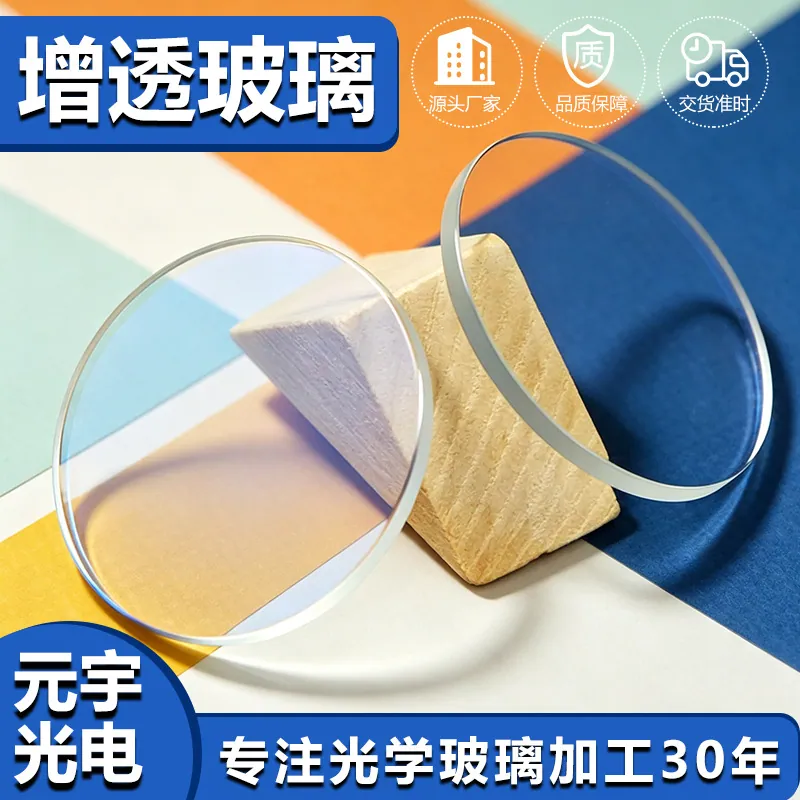
AR Anti-Reflective Glass in Industrial Laser Processing
In industrial laser processing, that translates into a specific set of requirements rather than a general preference for quality. Laser systems put the highest energy density of any application on the coatings and windows in their beam path. Damage threshold, absorption and thermal lensing decide whether a machine holds focus shift across a shift of continuous operation, and any coating failure is an immediate production stoppage.
Coating and deposition considerations
AR stacks are built from alternating low-index silica and higher-index oxides such as niobium, tantalum or titanium oxide, deposited in four, six or more layers to flatten the reflectance curve across the band. Broader bands and lower reflectance both require more layers, and more layers mean tighter process control, because each layer contributes to the interference balance. Ion-assisted deposition is preferred for durability: the resulting films are dense, so they resist moisture, resist abrasion and do not shift color when humidity changes. Hydrophobic and oleophobic top layers are frequently added on touch surfaces, and a conductive or anti-static layer helps where dust retention is a problem. For Industrial Laser Processing, the deposition process also determines whether the coating can be applied to both faces in one run or needs two passes.
What drives cost and lead time
The cost of an AR coating scales with the number of layers, the area coated and whether one or both faces are treated. A four-layer broadband stack on one face is the economical baseline; pushing average reflectance below 0.2 percent, extending the band, or adding hydrophobic and anti-static functionality each add layers and raise the sensitivity of the run. Coating both faces roughly doubles the process cost but usually costs less than two single-sided parts. Patterned coatings, apertures and masked areas add a lithography or masking step whose cost is dominated by the mask. In Industrial Laser Processing, the cheapest improvement is almost always to coat the second surface, since an uncoated rear face often contributes more reflected light than the front coating removes.
Substrate and material selection
The substrate determines what the coating must cope with. B270 and ultra-clear float glass are the standard carriers for displays and instrument windows, offering high transmission at low cost. Borosilicate adds thermal stability, which matters when the glass is tempered, laminated or exposed to heat. Quartz and fused silica extend the band into the ultraviolet and are used where the coating must survive higher energy. Acrylic and polycarbonate are coated when weight matters more than scratch resistance, but they require low-temperature deposition and generally cannot accept the hardest oxide stacks. In Industrial Laser Processing, the material also sets the available thickness range, and thin substrates below 1 mm need care both in coating, where warp is a risk, and in assembly, where clamping stress will show up as optical distortion.
How it compares with the alternatives
Alternatives to coating include using a lower-index substrate, laminating a glass to an index-matched adhesive, using an etched or textured anti-glare surface, and simply accepting the reflection. Etched anti-glare glass scatters light rather than suppressing it, which is excellent for readability in bright environments and poor for imaging or transmission. Index matching by lamination works well within a stack but does nothing for the outermost surface. Uncoated glass is often acceptable for a mechanical window and rarely acceptable for anything a user looks through or a sensor looks through. In Industrial Laser Processing, the deciding question is whether the system needs more transmitted light or less reflected light - they are related but not identical, and anti-glare treatment solves the second at the cost of the first.
Inspection and measurement
The primary measurement is spectral reflectance and transmission across the specified band, ideally at several points across the aperture so that thickness uniformity is verified as well as average performance. Haze is measured on a haze meter and matters more than most specifications acknowledge: a coating with excellent reflectance and 1 percent haze will be rejected by the user, because haze is visible at almost any viewing angle. Durability is verified through abrasion, tape adhesion and humidity tests, often against MIL-C-48497 or an equivalent customer standard. In Industrial Laser Processing, the incoming inspection that pays for itself is a simple reflection color check under a defined light source, which catches color casts before the glass is bonded into an assembly that cannot be reworked.
Requirements specific to Industrial Laser Processing
In industrial laser processing, that translates into a specific set of requirements rather than a general preference for quality. Laser systems put the highest energy density of any application on the coatings and windows in their beam path. Damage threshold, absorption and thermal lensing decide whether a machine holds focus shift across a shift of continuous operation, and any coating failure is an immediate production stoppage.
- Laser damage threshold at the operating wavelength and pulse length
- Low absorption to limit thermal lensing
- Quartz or fused silica substrates
- Precise transmitted wavefront for focus stability
ISO 11551 and ISO 21254 damage threshold test methods, ISO 10110 drawings, and laser safety documentation for the finished system.
Selection data at a glance
| Parameter | Typical value | Notes |
|---|---|---|
| Reflectance per surface | R ≤ 0.5 % average, R ≤ 0.2 % achievable | 420-680 nm |
| Transmission gain | up to 99 % single side, > 99 % both sides | Versus 92 % uncoated B270 |
| Band options | 400-700, 400-1100, 900-1700 nm, dual band | Broadband or tuned |
| Substrate | B270, ultra-clear, borosilicate, quartz, acrylic | 0.5-12 mm |
| Haze | ≤ 0.3 %, typically ≤ 0.1 % | Haze meter |
| Abrasion | pencil hardness 9H, steel wool 0000 pass | Hard oxide stacks |
| Adhesion | tape test 4B or better | Cross-hatch |
| Environmental | 85/85 humidity, salt spray, UV stable | Outdoor grades available |
| Coating pattern | full face, aperture only, or masked | Margin 0.5-1 mm typical |
Frequently asked questions
Why does the reflection look blue or green?
Because the stack balances reflectance across the band rather than at every wavelength identically. The residual color can be tuned to neutral, but doing so usually requires more layers, so specify the acceptable residual color explicitly.
Do you offer anti-glare as well as anti-reflective treatment?
Yes. Anti-reflective coating maximises transmitted light while anti-glare etching scatters reflected light for readability. Many display products combine a coated front face with an etched surface where the customer wants both.
What reflectance can an AR coating actually reach?
Under 0.5 percent average per surface is routine, and under 0.2 percent is achievable across the visible band with a multilayer stack. Total transmission above 99 percent is possible when both faces are coated.
Need a quotation for ar anti-reflective glass?
Send your drawing, target specification or coating requirement and an optical engineer will reply within 24 hours with a price and a lead time.
Request a Quote Email an engineer