Solar simulators and PV metrology benches project a calibrated spectrum onto a cell or module and read back the response, and the front window or integrating-sphere port in that path is an AR-coated glass that decides how much of the lamp actually reaches the device under test. The coating has to hold a low residual reflection across the simulator band without adding spectral artefacts, because any Fresnel bounce or coating non-uniformity becomes a direct error in the measured current or quantum efficiency. This guide sets out the tolerances and coating rules optical engineers should put on the drawing for AR glass in solar-simulator and PV-characterisation duty.
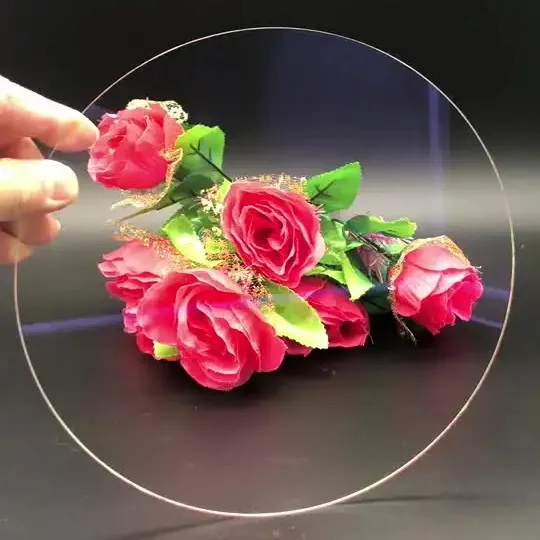
AR Anti-Reflective Glass in Solar Simulators and PV Metrology
In a solar simulator the AR window sits between the source and the test device, so its residual reflection is subtracted from every measurement and its spectral flatness shapes the effective spectrum. The glass has to stay uniform across the full clear aperture and survive the lamp heat and the cleaning cycle of a production or lab bench, because a hazed or non-uniform coating reads straight through as a wrong short-circuit current. The material and coating choice is therefore as much about long-term spectral stability as about the starting transmission.
The tolerances that actually matter
For a simulator window the surface form and parallelism control ghost foci and beam walk that shift the illuminated area, and coating uniformity across the aperture controls how flat the effective spectrum is. Scratch-dig and localised defects are held because a scatter site becomes a local hot spot under a concentrated beam. The tolerances that matter are the ones that move the spectrum or the illuminated area, not the generic catalogue limits.
Design rules that reduce cost
Cost drops when the aperture is sized to the beam footprint and the AR band is matched to the simulator's lamp-and-filter output rather than specified broadband across the whole solar spectrum. Specifying a forgiving substrate thickness and a standard aspect ratio lets the part be cut from stock sheet, and calling out the AR to the band the instrument actually uses keeps the deposition short. The cheap window is the one whose tolerance budget was written for the actual bench, not copied from a display catalogue.
Coating and deposition considerations
The coating is a broadband dielectric AR stack tuned to the simulator band, often extending from the UV-visible into the near infrared for quantum-efficiency work, and it must not fluoresce or absorb inside that band. Dense, well-adhered layers are preferred over soft coatings that fog or peel under lamp heat and repeated cleaning, and the stack is designed for the actual angle of incidence in the port. State the design angle and the band over which the residual reflection is guaranteed, because an AR coating tuned at normal incidence behaves differently on a tilted port.
How AR coated glass works in practice
In use the window passes the lamp spectrum to the device while the AR stack suppresses the two Fresnel surfaces that would otherwise throw ghost beams and bias the reading. A low, uniform residual reflection across the band is the number that decides measurement uncertainty, so the component is qualified against the bench's spectral and beam-homogeneity targets rather than a generic transmission figure. A window that meets the spec holds that balance through a cleaning cycle; one that was under-specified starts leaking spectral error the moment it is put on a production line.
Requirements specific to AR-Coated Optics for Solar Simulators and PV Metrology
Simulator and metrology duty puts the AR window inside the measurement path, so coating uniformity and spectral stability lead the specification. Choose a robust substrate, tune the AR stack to the instrument's actual band and angle of incidence, and control flatness, parallelism and surface quality for a clean beam. Qualify the part against the bench's spectral and homogeneity targets rather than a generic transmission number, because a window that looks right on a sample can still bias the current reading in service.
- AR band matched to lamp-and-filter output, not full solar spectrum
- Coating uniformity controlled across clear aperture
- Flatness and parallelism held for clean beam path
- Dense, cleanable coating resistant to lamp heat
- Design angle of incidence stated for the port
- No fluorescence or in-band absorption
Framework references: surface form, parallelism, scratch-dig and coating uniformity per ISO 10110, and environmental durability per the relevant instrument or equipment rule set. Environmental declarations such as RoHS are the supplier's to state against the current official text, not to be assumed for a component used in a measurement bench.
Selection data at a glance
| Parameter | Typical value | Notes |
|---|---|---|
| Substrate | Stable, cleanable glass | Per bench |
| AR band | Tuned to simulator output | UV-NIR |
| Residual R | Low and uniform | Band |
| Flatness | Tight over aperture | Beam |
| Parallelism | Controlled | No walk |
| Durability | Heat and clean cycled | Qualified |
Frequently asked questions
Why does coating uniformity matter more than peak transmission here?
Because the window is in the measurement path: a non-uniform AR coating makes the effective spectrum different across the aperture, which biases the measured current or QE directly. Peak transmission on a sample spot does not capture that spatial error, so uniformity across the whole clear aperture is the figure that protects the measurement.
Should the AR coating cover the whole solar spectrum?
Only if the instrument uses it. Specifying broadband AR across the entire AM1.5G range when the bench works in a narrower band only lengthens the deposition and adds cost. Match the coating to the lamp-and-filter output the tool actually delivers and guarantee the residual reflection over that band.
What tolerance matters most for measurement accuracy?
Surface form and parallelism, because both move or distort the beam on the device under test. A window held flat and parallel keeps the illuminated area and the effective spectrum stable; a lax one introduces ghost foci and beam walk that read as a wrong result.
Need a quotation for ar anti-reflective glass?
Send your drawing, target specification or coating requirement and an optical engineer will reply within 24 hours with a price and a lead time.
Request a Quote Email an engineer