Exterior vehicle lighting has moved from a sealed bulb behind a plain lens to LED headlamp projectors, daytime-running-light (DRL) light pipes and sensor covers that all sit behind coated glass. The optical window in that path has to pass visible light with low loss, survive road salt, stone impact and years of UV, and keep its coating intact through car-wash chemicals. This article works through the material, coating and tolerance trade-offs that decide whether a headlight or DRL optic performs and lasts.
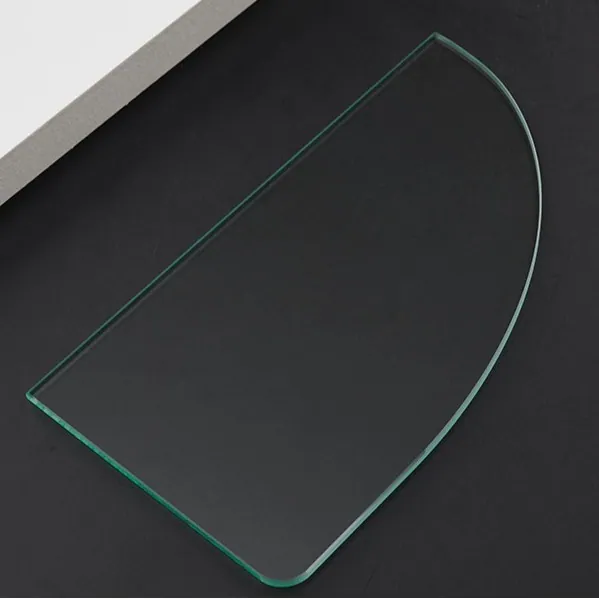
AR Anti-Reflective Glass in Vehicle Headlight and DRL Optics
A modern headlamp is a projector: an LED or laser source, a faceted reflector or lens array, and a front cover glass that the beam passes through on the way to the road. DRLs are often a light pipe or a thin illuminated strip behind the same kind of glass, and front camera or lidar covers share the aperture. The cover glass must transmit the visible band (roughly 420-700 nm) with minimal reflection, because every percent lost at the surface is output the lamp has to make up with current, and any ghost reflection can reach oncoming drivers. The duty is the road environment, not a sealed interior, so the coating lives outside in salt, grit and sunlight rather than in cabin air.
How it compares with the alternatives
An uncoated glass cover reflects about four percent per surface, so a projector lens with no AR loses roughly eight percent of the beam and adds a ghost that the reflector can throw back into the road pattern. Polycarbonate is light and impact-tolerant but scratches and yellows, and it transmits poorly where a near-UV or blue LED sits, so it suits a non-imaging DRL diffuser more than a projector. Hard-coated polymer is better but still softer than glass. Coated glass remains the default for any lens that must hold output and beam shape, because it solves transmission and surface reflection at once and the substrate already handles the thermal load.
Coating and deposition considerations
The stack is a broadband visible anti-reflection coating built from alternating low-index silica and higher-index oxides, tuned across the visible rather than to a single line. For a projector lens both faces may carry a functional layer, because the second surface returns as much light as the first. The top of the stack must be a hard inorganic layer: a soft fluoropolymer finish would shed water on day one and wear through after a few wash seasons, which is the common way a headlight optic ages badly. State on the drawing which face carries the coating, and design the band to cover the LED's actual emission rather than a generic visible average, because a blue-biased source needs the AR centred where the light is.
What drives cost and lead time
Cost follows substrate grade, coating layers and shape. Ultra-clear float glass is the cheapest optic that transmits well; B270 or a low-iron melt improves clarity for a premium lamp; borosilicate resists thermal shock on position lamps that run hot. Curved or aspheric projector elements cost more than flat DRL covers because deposition uniformity across a curved part drives tooling and yield, and a large lens is a different run from a small one. The other driver is first-article qualification: a weathering, abrasion and adhesion report is a one-off cost a lighting programme should absorb once and then amortise across the volume, rather than re-run for every revision.
Substrate and material selection
Substrate choice tracks the lamp's duty. Ultra-clear float glass is adequate for most DRL covers and many reflector lenses. B270 or a low-iron melt reduces iron-induced tint and lifts transmission for a high-output projector where every percent counts. Borosilicate is chosen where the part runs hot or sees thermal shock, such as a position lamp close to the source. Sapphire is reserved for a genuine wear surface, such as a low-mounted cover that meets kerbs, because its hardness keeps the surface intact through impacts that would pit glass; its cost is justified by removing a replacement cycle, not by optical gain. Thickness is set by impact and mounting, not by transmission.
Requirements specific to Vehicle Headlight and DRL Optics
Exterior automotive use adds a weathering regime that interior optics never see: thermal cycling across the full under-hood and ambient range, humidity, salt spray, UV and abrasive cleaning. The coating must not yellow, because a yellowing top layer is the visible failure that reads as haze, and it must hold adhesion through stone impact and car-wash chemicals. Photometric regulations (framework: ECE/SAE regional requirements) define the beam and DRL output the glass must not compromise, so transmission and reflection are specified against that budget. Process controls usually follow IATF 16949 with a PPAP first article, and the visible AR is qualified for the road rather than treated as cosmetic.
- Broadband visible AR (420-700 nm) with low average reflectance
- Automotive exterior durability: thermal cycle, humidity, salt spray, UV, abrasion
- Substrate grade matched to lamp duty (float, B270, borosilicate)
- Defined coating face and first-article weathering data
Framework references: ISO 10110 drawings, IATF 16949 process controls with PPAP documentation, and regional photometric regulations (ECE/SAE) that set beam and DRL requirements. Coating durability regimes (thermal cycling, humidity, salt spray, abrasion) follow the applicable automotive qualification specification; confirm against the current official text rather than a single value.
Selection data at a glance
| Parameter | Typical value | Notes |
|---|---|---|
| Visible transmission | over 92 % average (typical) | 420-700 nm |
| Reflectance | 0.5 % average, 1 % peak | Visible AR |
| Substrate | ultra-clear float, B270, borosilicate | Per lamp duty |
| Thickness | 0.7-3 mm typical | Impact driven |
| Surface form | PV 0.5 um standard | Per ISO 10110-5 |
| Hardness | 9H pencil, steel-wool pass | Hard oxide stack |
| Environmental | thermal cycle, 85/85, salt spray | Automotive grade |
Frequently asked questions
Does a headlight lens need AR on both faces?
The projector lens loses about four percent per surface, so coating both faces lifts output and removes the ghost reflection that a single-face coating leaves. A simple DRL cover may need only the exposed face, but the design band decides, and a two-face stack is common on any lens that must hold beam shape.
Will the coating yellow in sunlight?
A dense oxide stack is UV-stable; yellowing comes from a soft polymer topcoat breaking down. Specifying a hard inorganic top layer avoids the common failure, which is why the durability requirement is written as a weathering test rather than as an initial colour reading.
Why does substrate grade matter for a headlight?
Ultra-clear float already transmits well; B270 reduces iron-induced tint for premium output, and borosilicate resists thermal shock on position lamps that run hot. Match the grade to the lamp's duty rather than defaulting to the cheapest glass, because the substrate sets both clarity and survival.
Need a quotation for ar anti-reflective glass?
Send your drawing, target specification or coating requirement and an optical engineer will reply within 24 hours with a price and a lead time.
Request a Quote Email an engineer