Head-up displays have been available in luxury vehicles for decades, but the augmented-reality variant — the one that overlays navigation arrows and lane markings onto the actual road at a believable distance — has until recently been a flagship feature. That is changing. AR-HUD is now specified on mid-range platforms in several markets, and the optical component at the centre of the system is making the same transition from hand-built sample to automotive volume part.
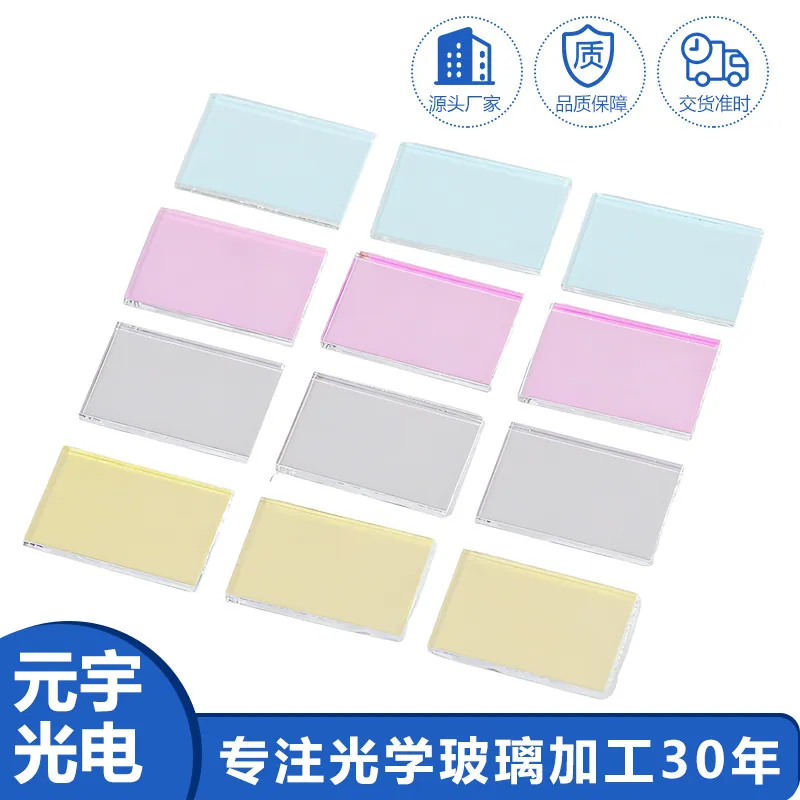
That transition changes almost everything about how the combiner is bought.
What the combiner does, and why it is hard
An AR-HUD projects an image from a picture-generation unit onto a combiner, which reflects it toward the driver while transmitting the outside world. The combiner therefore has to do two jobs at once: reflect a narrow band of visible light with high efficiency and low distortion, and transmit the rest of the scene with high clarity and no visible tint.
The two jobs fight each other. Every layer that improves reflection in the projection band adds some residual ripple in transmission. Every degree of curvature that helps the virtual image focus introduces angle variation across the aperture, which shifts the spectral edge. And because the driver looks through the combiner at the road, any haze, scatter or colour cast is immediately visible in a way that a camera sensor would tolerate.
The conventional solution is a dichroic coating on a curved or flat glass substrate, sometimes laminated into the windshield, sometimes a separate combiner plate. Both approaches are now under cost pressure.
Why volume changes the specification
A sample combiner is judged on its best-case performance. A production combiner is judged on the distribution.
- Angle tolerance matters more than peak efficiency. In a sample, the design angle is the measured angle. In production, the driver's eye box moves, the windshield curvature varies, and the combiner mounting has tolerance. The specification has to hold across that envelope, not just at the design point.
- Colour shift becomes a customer-visible defect. A few nanometres of edge drift between parts reads as a colour difference between vehicles — and it is the kind of defect that shows up in dealer audits rather than on a bench.
- Environmental durability is non-negotiable. Automotive qualification includes damp heat, thermal shock and abrasion. A coating that passes an optical test but delaminates after a summer in a parked car is a recall.
- Cost per part is now the design driver. Thinner substrates, fewer layers, larger coating batches and near-net-shape glass all move in the same direction: less material, less polishing, more parts per chamber run.
The thinner-substrate trend
The most visible change on the optics side is thickness. Combiners have migrated from millimetre-scale glass toward thin, sometimes chemically strengthened sheet, because thin glass reduces weight, reduces ghost-image separation and integrates more easily into laminated windshields.
Thin glass creates its own problems. It is harder to hold flat during coating, thermal distortion during deposition is more pronounced, and the coating stress that a thick substrate would simply absorb can now bow the part enough to shift the reflected image. Suppliers who have moved to thin combiners have had to re-engineer their mounting fixtures and their stress compensation together, not separately.
What this means for buyers and for the supply chain
For tier-one suppliers, the practical implication is that the combiner is no longer a catalogue purchase. It is a co-designed part with a specification that has to be negotiated between the optical designer, the coating house and the vehicle integrator — and the earlier the coating house is in that conversation, the fewer iterations the programme needs.
For coating suppliers, the shift means automotive-grade process control: documented change control, statistical process data per lot, and the ability to hold a spectral window for the life of a vehicle platform that may run seven years. That is a different discipline from producing excellent prototypes.
The market direction is clear enough. AR-HUD is following the path of every other automotive optical feature: premium first, mid-range next, and eventually a standard fitment with a cost target that only a mature supply chain can meet. The suppliers who treat the combiner as an automotive part today — with the documentation, durability and process control that implies — will be the ones quoting on the platforms that matter in 2028.