Optical Blue Glass covers a wider range of options than most drawings imply, and the differences between them decide both performance and price. This article compares the practical choices available for aerospace and defense optics - substrate, coating process, thickness and tolerance - and shows where each trade-off pays off and where it does not.
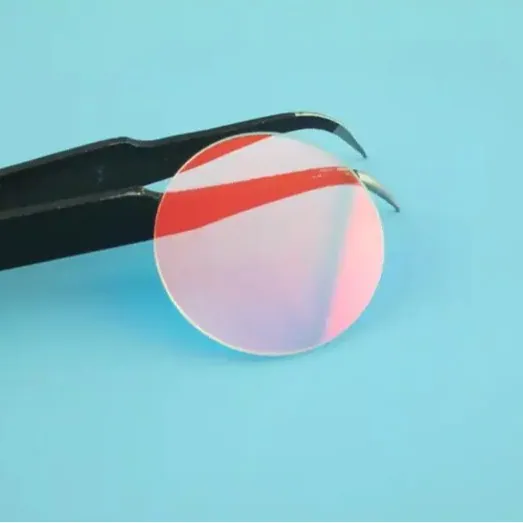
Optical Blue Glass in Aerospace and Defense Optics
In aerospace and defense optics, that translates into a specific set of requirements rather than a general preference for quality. Aerospace optics are qualified against thermal vacuum, vibration, shock and radiation environments, and once qualified they are difficult to change, which makes documentation and reproducibility the dominant requirement. Weight is critical, coatings must survive without moisture uptake, and every part carries a certification trail.
Substrate and material selection
Blue glass is a family rather than a single product. Copper-ion-doped and phosphate-based grades give different transmittances, different cut-on positions and different color casts, and each supplier's designation behaves slightly differently, so the grade must be specified by transmission curve rather than by name. Thickness is a design variable as well as a mechanical one, because absorption scales with path length: a 0.3 mm plate blocks less near infrared than a 0.55 mm plate of the same grade, so thinning a part to fit a module changes its optical performance. In Aerospace and Defense Optics, the sensible specification is a transmission requirement at the operating thickness, plus a permitted tolerance on that thickness, because the two interact and cannot be fixed independently after the design is frozen.
How it compares with the alternatives
The alternatives are a dichroic coated filter, an absorptive dye film and software correction. A dichroic filter is thinner and can be tuned more precisely, but its edge shifts with angle, which matters in wide-angle systems. A dye film is cheaper and thinner still but degrades under UV and heat. Software correction removes obvious infrared bleed but cannot restore color accuracy across a wide field. Blue glass sits between these options: angle-stable, robust, slightly thicker and more expensive than a film. In Aerospace and Defense Optics, the deciding factor is usually mechanical depth - if the module can accommodate a third of a millimeter of glass, blue glass or a hybrid part is normally the most predictable solution.
Coating and deposition considerations
Blue glass can be supplied bare, with an anti-reflective layer on one or both faces, or with a dichroic coating that adds a sharper edge on top of the absorptive behavior. Bare glass is the cheapest and is often adequate, but its four percent surface reflection costs transmission and produces flare in a module where the filter sits directly above the sensor. A broadband AR coating on both faces recovers most of that light. Adding a dichroic layer makes the transition steeper and reduces the thickness needed, which is how modules have become thinner over time. In Aerospace and Defense Optics, the choice between bare, AR-coated and hybrid parts is usually settled by tolerance to flare and by the thickness available in the mechanical envelope.
What drives cost and lead time
Blue glass is inexpensive material but expensive handling. The glass itself is a small share of the part price; what drives cost is thickness control at fine tolerances, the dicing process and the yield of thin, brittle parts. Adding an AR coating or a dichroic layer changes the part from a commodity to a coated optic and multiplies the price, which is why bare absorptive filters survive in designs long after a coating would be optically preferable. Very thin parts under 0.3 mm are the most expensive of all, because handling losses and inspection time rise faster than the material gets cheaper. In Aerospace and Defense Optics, the cheapest specification is usually a slightly thicker part with a relaxed flatness, which is worth testing before the requirement is frozen.
Common failure modes and how they show up
The characteristic failures are mechanical rather than spectral: edge chips that propagate into a crack, wedge or warp after bonding, and surface scratches from handling. Spectral problems, when they occur, come from a thickness deviation rather than from the material itself, since absorption is a bulk property and cannot delaminate or bleach. Where the part is AR-coated, coating defects such as pinholes or adhesion loss become possible, which is the opposite trade to a dichroic filter. In Aerospace and Defense Optics, a failure that appears only in finished modules but never in bare components usually points at the bonding process - adhesive thickness, cure shrinkage or clamping stress - rather than at the glass.
Requirements specific to Aerospace and Defense Optics
In aerospace and defense optics, that translates into a specific set of requirements rather than a general preference for quality. Aerospace optics are qualified against thermal vacuum, vibration, shock and radiation environments, and once qualified they are difficult to change, which makes documentation and reproducibility the dominant requirement. Weight is critical, coatings must survive without moisture uptake, and every part carries a certification trail.
- Thermal vacuum and vibration survival
- Low weight with high specific stiffness
- Coating stability with no moisture shift
- Full first-article and process documentation
AS9100 quality systems, MIL specifications for coatings and surface quality, and customer-specific environmental qualification protocols.
Selection data at a glance
| Parameter | Typical value | Notes |
|---|---|---|
| Type | absorptive NIR filter, uncoated or dichroic-coated | Hybrid keeps the edge sharp |
| Thickness | 0.21 - 0.55 mm common, up to 3 mm | Thin grades for camera modules |
| Visible transmission | T ≥ 90 % average | 420-620 nm |
| NIR blocking | OD2 - OD4 to 1100 nm | Depth set by thickness and grade |
| Cut-on shift with angle | negligible | The main reason blue glass is used |
| Thickness tolerance | ± 0.02 mm | Critical for bonded stacks |
| Flatness | λ/4 typical, λ/10 on request | Measured on 633 nm |
| Edge chips | ≤ 0.05 mm, laser-cut edges available | Laser cutting avoids micro-cracks |
| Environmental | humidity and temperature cycling stable | Absorptive color cannot delaminate |
Frequently asked questions
Why choose blue glass instead of a coated IR-cut filter?
Because its cut-on does not shift with the angle of incidence. In a wide-angle or fast lens system a dichroic coating colors the frame edges, while blue glass keeps the spectrum consistent across the field.
What thickness should I specify?
Enough to reach the blocking depth the sensor needs. Absorption scales with path length, so a thinner part blocks less near infrared - thinner parts often need a stronger grade or a dichroic layer added on one face.
Does blue glass need an AR coating?
It benefits from one. Bare glass reflects about four percent per surface, which costs transmission and creates flare directly above the sensor. Broadband AR on both faces is common in camera modules.
Need a quotation for optical blue glass?
Send your drawing, target specification or coating requirement and an optical engineer will reply within 24 hours with a price and a lead time.
Request a Quote Email an engineer