Failures in optical blue glass used in industrial laser processing tend to follow a small number of patterns, and each pattern has a signature. This article walks through the common failure modes, how to tell them apart with measurements rather than guesswork, and the process or design changes that actually remove the root cause.
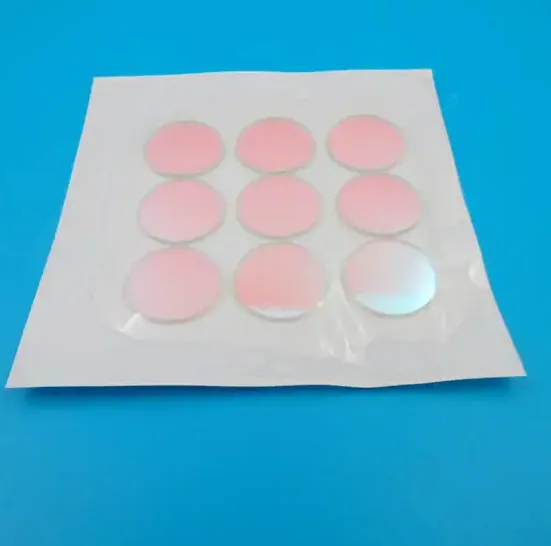
Optical Blue Glass in Industrial Laser Processing
In industrial laser processing, that translates into a specific set of requirements rather than a general preference for quality. Laser systems put the highest energy density of any application on the coatings and windows in their beam path. Damage threshold, absorption and thermal lensing decide whether a machine holds focus shift across a shift of continuous operation, and any coating failure is an immediate production stoppage.
Coating and deposition considerations
Blue glass can be supplied bare, with an anti-reflective layer on one or both faces, or with a dichroic coating that adds a sharper edge on top of the absorptive behavior. Bare glass is the cheapest and is often adequate, but its four percent surface reflection costs transmission and produces flare in a module where the filter sits directly above the sensor. A broadband AR coating on both faces recovers most of that light. Adding a dichroic layer makes the transition steeper and reduces the thickness needed, which is how modules have become thinner over time. In Industrial Laser Processing, the choice between bare, AR-coated and hybrid parts is usually settled by tolerance to flare and by the thickness available in the mechanical envelope.
Design rules that reduce cost
Designing with blue glass is about thickness, bonding and field of view. Choose the thickness from the absorption requirement, not from what is available, and remember that a thinner part needs a stronger grade or a dichroic assist. Keep the mounting margin clear and specify a chamfer so that retention never touches the optical face. If the part will be bonded, state the adhesive class and the cure temperature, because both affect the final stack. Consider whether the module needs an AR coating on the sensor-facing side: it is often the difference between acceptable flare and a visible ghost. In Industrial Laser Processing, a wide-angle system is the case where blue glass earns its cost, because the alternative - a pure dichroic coating - would color-shift the frame edges.
Common failure modes and how they show up
The characteristic failures are mechanical rather than spectral: edge chips that propagate into a crack, wedge or warp after bonding, and surface scratches from handling. Spectral problems, when they occur, come from a thickness deviation rather than from the material itself, since absorption is a bulk property and cannot delaminate or bleach. Where the part is AR-coated, coating defects such as pinholes or adhesion loss become possible, which is the opposite trade to a dichroic filter. In Industrial Laser Processing, a failure that appears only in finished modules but never in bare components usually points at the bonding process - adhesive thickness, cure shrinkage or clamping stress - rather than at the glass.
Inspection and measurement
Inspection focuses on the spectral curve at the actual part thickness, together with the physical attributes that matter in a bonded stack. Transmission from 350 to 1100 nm confirms the cut-on and the blocking depth; thickness is measured on every part because absorption depends on it; flatness, parallelism and edge condition are checked because the part is normally bonded or potted. Surface quality follows the usual scratch-dig conventions, and where the part is AR-coated, reflectivity and adhesion are measured as well. In Industrial Laser Processing, a measurement that repays its cost is a repeated transmission check after the thermal cycle the assembly will experience, because a bonded stack can shift performance even when neither the glass nor the adhesive changed.
How optical blue glass works in practice
Optical blue glass is the absorptive answer to the same problem a dichroic IR-cut coating solves: removing near-infrared light before it reaches a silicon sensor. Instead of reflecting the band with an interference stack, the glass absorbs it in the bulk material, which means the cut-on wavelength does not move when light arrives at an angle. That single property is why blue glass dominated phone camera modules for years and why it remains the standard where the ray bundle is wide or the module is thin. Modern parts are frequently hybrids: a thin piece of absorptive glass that does the heavy lifting in the near infrared, with a dichroic coating on one face to sharpen the transition. In Industrial Laser Processing, the practical appeal is that the part keeps its color specification across a wide field of view, something no pure coating can do.
Requirements specific to Industrial Laser Processing
In industrial laser processing, that translates into a specific set of requirements rather than a general preference for quality. Laser systems put the highest energy density of any application on the coatings and windows in their beam path. Damage threshold, absorption and thermal lensing decide whether a machine holds focus shift across a shift of continuous operation, and any coating failure is an immediate production stoppage.
- Laser damage threshold at the operating wavelength and pulse length
- Low absorption to limit thermal lensing
- Quartz or fused silica substrates
- Precise transmitted wavefront for focus stability
ISO 11551 and ISO 21254 damage threshold test methods, ISO 10110 drawings, and laser safety documentation for the finished system.
Selection data at a glance
| Parameter | Typical value | Notes |
|---|---|---|
| Type | absorptive NIR filter, uncoated or dichroic-coated | Hybrid keeps the edge sharp |
| Thickness | 0.21 - 0.55 mm common, up to 3 mm | Thin grades for camera modules |
| Visible transmission | T ≥ 90 % average | 420-620 nm |
| NIR blocking | OD2 - OD4 to 1100 nm | Depth set by thickness and grade |
| Cut-on shift with angle | negligible | The main reason blue glass is used |
| Thickness tolerance | ± 0.02 mm | Critical for bonded stacks |
| Flatness | λ/4 typical, λ/10 on request | Measured on 633 nm |
| Edge chips | ≤ 0.05 mm, laser-cut edges available | Laser cutting avoids micro-cracks |
| Environmental | humidity and temperature cycling stable | Absorptive color cannot delaminate |
Frequently asked questions
How does it behave through temperature cycling?
The absorptive color itself is stable, because absorption is a bulk property. Failures in thermal cycling usually originate at the bonded edge or from a thickness-related stress, not from the glass changing color.
Is blue glass available in hybrid form?
Yes. Combining an absorptive substrate with a dichroic coating on one face gives a deeper, sharper cut-on in a thinner part than either approach alone, which is how modern thin camera modules are built.
Why choose blue glass instead of a coated IR-cut filter?
Because its cut-on does not shift with the angle of incidence. In a wide-angle or fast lens system a dichroic coating colors the frame edges, while blue glass keeps the spectrum consistent across the field.
Need a quotation for optical blue glass?
Send your drawing, target specification or coating requirement and an optical engineer will reply within 24 hours with a price and a lead time.
Request a Quote Email an engineer