Specifying optical blue glass for optical communication and datacoms is largely a matter of deciding which three numbers actually govern the application and letting the rest follow. This guide walks through the parameters that belong on the drawing, the tolerances that genuinely change the price, and the specification items that are routinely left out and then argued about at first article.
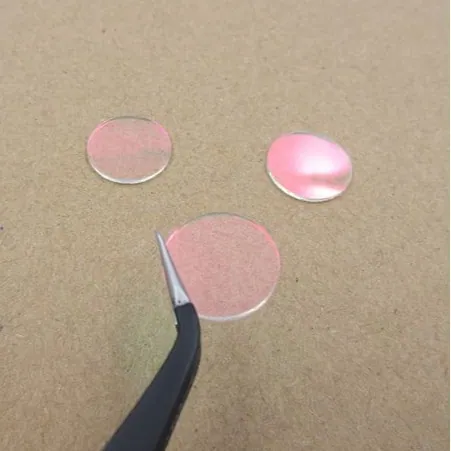
Optical Blue Glass in Optical Communication and Datacoms
In optical communication and datacoms, that translates into a specific set of requirements rather than a general preference for quality. Telecom optics are specified at telecom tolerances: a filter that drifts by a fraction of a nanometer can move a channel out of band, and a component that degrades over twenty years of continuous operation is a warranty problem. Environmental stability, thermal coefficient control and consistency between production lots matter more than headline performance.
The tolerances that actually matter
Because blue glass works by absorption, its tolerances are dominated by thickness and by the transmission curve at that thickness. A thickness tolerance of plus or minus 0.02 mm is normal and is not merely mechanical - it protects the spectral specification. Flatness and parallelism matter for the same reason they matter on any window: a wedge will steer the beam and a curved surface will change focus in a bonded stack. Chamfer and edge quality become critical when the part is bonded, since a chipped edge under adhesive creates a stress riser. In Optical Communication and Datacoms, whether the part is bonded between lens elements or sits as an external window changes which tolerances dominate, and the drawing should say which of the two it is.
Design rules that reduce cost
Designing with blue glass is about thickness, bonding and field of view. Choose the thickness from the absorption requirement, not from what is available, and remember that a thinner part needs a stronger grade or a dichroic assist. Keep the mounting margin clear and specify a chamfer so that retention never touches the optical face. If the part will be bonded, state the adhesive class and the cure temperature, because both affect the final stack. Consider whether the module needs an AR coating on the sensor-facing side: it is often the difference between acceptable flare and a visible ghost. In Optical Communication and Datacoms, a wide-angle system is the case where blue glass earns its cost, because the alternative - a pure dichroic coating - would color-shift the frame edges.
Coating and deposition considerations
Blue glass can be supplied bare, with an anti-reflective layer on one or both faces, or with a dichroic coating that adds a sharper edge on top of the absorptive behavior. Bare glass is the cheapest and is often adequate, but its four percent surface reflection costs transmission and produces flare in a module where the filter sits directly above the sensor. A broadband AR coating on both faces recovers most of that light. Adding a dichroic layer makes the transition steeper and reduces the thickness needed, which is how modules have become thinner over time. In Optical Communication and Datacoms, the choice between bare, AR-coated and hybrid parts is usually settled by tolerance to flare and by the thickness available in the mechanical envelope.
How optical blue glass works in practice
Optical blue glass is the absorptive answer to the same problem a dichroic IR-cut coating solves: removing near-infrared light before it reaches a silicon sensor. Instead of reflecting the band with an interference stack, the glass absorbs it in the bulk material, which means the cut-on wavelength does not move when light arrives at an angle. That single property is why blue glass dominated phone camera modules for years and why it remains the standard where the ray bundle is wide or the module is thin. Modern parts are frequently hybrids: a thin piece of absorptive glass that does the heavy lifting in the near infrared, with a dichroic coating on one face to sharpen the transition. In Optical Communication and Datacoms, the practical appeal is that the part keeps its color specification across a wide field of view, something no pure coating can do.
Requirements specific to Optical Communication and Datacoms
In optical communication and datacoms, that translates into a specific set of requirements rather than a general preference for quality. Telecom optics are specified at telecom tolerances: a filter that drifts by a fraction of a nanometer can move a channel out of band, and a component that degrades over twenty years of continuous operation is a warranty problem. Environmental stability, thermal coefficient control and consistency between production lots matter more than headline performance.
- Wavelength stability over temperature and humidity
- Ultra-low insertion loss with tight tolerance control
- Consistency between production lots
- Twenty-year service life documentation
Telcordia-style reliability expectations, ISO 10110 drawings, and full material declarations for the module manufacturer.
Selection data at a glance
| Parameter | Typical value | Notes |
|---|---|---|
| Type | absorptive NIR filter, uncoated or dichroic-coated | Hybrid keeps the edge sharp |
| Thickness | 0.21 - 0.55 mm common, up to 3 mm | Thin grades for camera modules |
| Visible transmission | T ≥ 90 % average | 420-620 nm |
| NIR blocking | OD2 - OD4 to 1100 nm | Depth set by thickness and grade |
| Cut-on shift with angle | negligible | The main reason blue glass is used |
| Thickness tolerance | ± 0.02 mm | Critical for bonded stacks |
| Flatness | λ/4 typical, λ/10 on request | Measured on 633 nm |
| Edge chips | ≤ 0.05 mm, laser-cut edges available | Laser cutting avoids micro-cracks |
| Environmental | humidity and temperature cycling stable | Absorptive color cannot delaminate |
Frequently asked questions
What thickness should I specify?
Enough to reach the blocking depth the sensor needs. Absorption scales with path length, so a thinner part blocks less near infrared - thinner parts often need a stronger grade or a dichroic layer added on one face.
Does blue glass need an AR coating?
It benefits from one. Bare glass reflects about four percent per surface, which costs transmission and creates flare directly above the sensor. Broadband AR on both faces is common in camera modules.
Can the glass be cut to a complex outline?
Yes. Complex outlines and small apertures are normally produced by laser cutting, which also leaves a cleaner edge than mechanical dicing and reduces the propagation of micro-cracks in thin parts.
Need a quotation for optical blue glass?
Send your drawing, target specification or coating requirement and an optical engineer will reply within 24 hours with a price and a lead time.
Request a Quote Email an engineer