The protective window is the cheapest part in a laser processing head and the only one designed to be destroyed. That has always made it a low-attention item — until the process changed, and the window became the part that limits uptime.
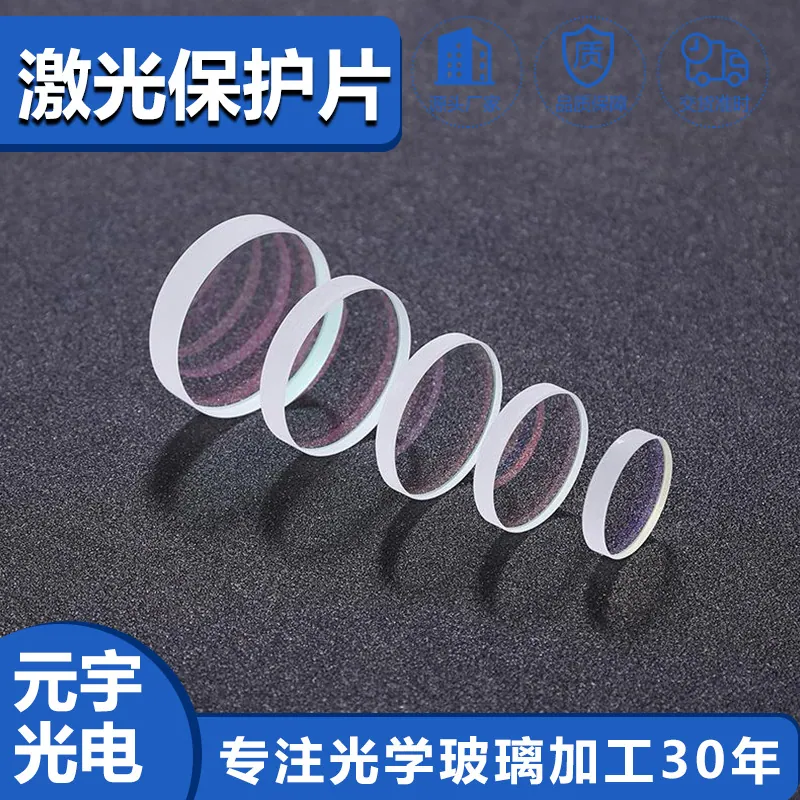
Two changes are driving the current re-specification. Copper and aluminium welding with blue laser sources has moved from laboratory demonstrations into production cells, because shorter wavelength absorption in copper is dramatically higher than at 1064 nm and the process becomes far more stable. At the same time, high-brightness IR welding for busbars, battery tabs and hairpin motors runs at power densities that punish any contamination on the optics.
The coating is no longer interchangeable
A window AR-coated for 1064 nm is not usable on a 450 nm source. At blue wavelengths the coating design, the material dispersion and the layer thicknesses are all different, and a mismatched window can lose a double-digit percentage of the delivered power before the beam reaches the workpiece. Suppliers that treat "AR coated" as a single SKU will hand you a part that measures well at 1064 nm and fails at 450 nm.
The same applies at the other end: a window optimised for 450 nm will not serve a 2 µm source. Wavelength, bandwidth and angle of incidence belong on the drawing.
Substrate choice is a thermal decision
Fused silica remains the default for IR welding windows: low absorption, good thermal shock resistance, and a damage threshold that comfortably exceeds typical spatter energy. Sapphire offers higher thermal conductivity and better scratch resistance, which helps in heavy-spatter environments, but its birefringence and cost rule it out for polarisation-sensitive paths. For blue-laser cells running at moderate power with aggressive spatter, the choice often comes down to how often the operator cleans the window rather than to the coating itself.
Thickness matters more than buyers expect. A thinner window reduces thermal lensing and absorption path length; a thicker one survives handling and clamping better. Anything from 1 mm to 3 mm is routine, and the correct answer depends on the mount, not on habit.
Consumable economics, stated plainly
A single contaminated window that passes a spatter event can take out a focus lens worth two orders of magnitude more. That asymmetry is the whole argument for treating the window as a scheduled consumable rather than a replace-on-failure item. Practical cadence in high-spatter cells: inspect at shift start, replace at the first sign of pitting or haze, and log the interval. When the interval starts shrinking, the process is drifting — gas flow, focal position, or material batch — and the window is telling you before the scrap rate does.
Specification checklist
- Wavelength and bandwidth of the source, plus the angle of incidence.
- Required transmittance at the working wavelength, measured, not calculated.
- LIDT value with test conditions.
- Substrate material and thickness, with flatness and surface quality grades.
- Coating on one face or both, and which face faces the process.
- Cleaning and handling instructions that the cell operator will actually follow.
The window is a small part of the bill of materials. In a cell running three shifts, it is a large part of the uptime.