Banknote and document authentication depends on making security features visible against a controlled background, and a colour filter is what separates the feature's response from the surrounding print. Because the illumination is usually fixed by the reader design, the filter's job is to pass the band where the feature responds and reject everything else, with enough repeatability that every reader in a fleet agrees on what it sees.
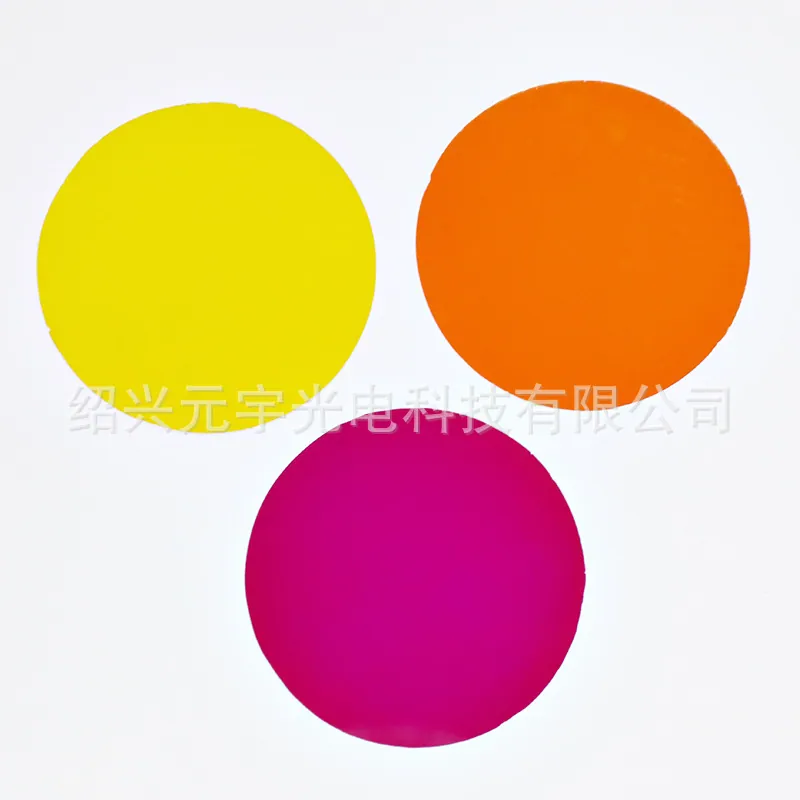
Coated Color Filters in Banknote and Document Authentication
In a verification reader the document is lit by a known source and imaged through a colour filter chosen to match the ink or thread response. The filter turns a subtle difference in reflectance or fluorescence into a strong contrast difference at the sensor, so the same note that looks uniform to the eye shows a clear feature under the reader. The filter therefore has to be matched to both the illumination and the feature's spectral signature, and small shifts in either side of that match degrade the result. In a fleet of readers the filter is also the cheapest component to standardise, which is why its tolerances are worth holding tightly even on a low-cost device.
The tolerances that actually matter
The tolerances that decide whether two readers agree are the cut-on and cut-off wavelengths and the peak transmission inside the pass band. A shift of a few nanometres in the edge can change how much of the feature's response is passed and how much of the background leaks through, which changes the measured contrast. The out-of-band blocking depth matters just as much, because a filter that leaks a little in the wrong band lets background print through and erodes the signal. Surface flatness and wedge are usually secondary for a near-collimated reader, but angular dependence matters if the filter sits at a steep incidence, since a coloured-glass or interference filter shifts its band with angle.
Design rules that reduce cost
Cost is reduced by choosing a filter technology that meets the band without over-specifying it. A dyed or coated colour-glass filter is cheaper and more angularly stable than a hard multilayer interference filter for a wide band, while a multilayer is the only way to get a very narrow band or a steep edge. Standardising on a few catalogue bands across a product line lets the same filter be bought in volume, and fixing the physical size to a stock square or disc avoids custom edging. The cheapest robust filter is the one whose band, size and coating are already in the supplier's standard range rather than a bespoke stack built for a single model.
Coating and deposition considerations
Coating choices hinge on band shape and environmental life. An interference stack gives the steepest edges and the deepest blocking but is angle-sensitive and can shift with temperature, so it has to be specified against the actual incidence and operating temperature of the reader. A coated colour-glass filter is more forgiving on angle and cost but has softer edges and a more limited band, which is acceptable where the illumination already narrows the spectrum. Hardness and cleanability matter in field devices that get handled and wiped, and any coating must survive the approved cleaning solvent without the blocking band recovering. The coating should be agreed against the reader's measured illumination spectrum rather than a nominal LED bin, because LED centre wavelength varies part to part.
How coated color filter glass works in practice
In practice the filter is mounted close to the sensor or the illumination path and is the component that defines the effective pass band of the whole reader. The reader designer sets the illumination, the filter sets what reaches the sensor, and the firmware decides on the contrast threshold. Because the filter is the spectral gate, its batch-to-batch consistency is what keeps the threshold stable across a fleet, which is why incoming inspection against a spectral target matters more than a pretty datasheet. A reader that calibrates its threshold per unit can tolerate more filter variation, but a reader that ships with a fixed threshold cannot, and the filter tolerance has to match that choice.
Requirements specific to Banknote and Document Authentication
A verification reader adds fleet repeatability and illumination control to the usual colour-filter requirements. Match the filter band to the actual measured illumination spectrum rather than a nominal LED, hold the cut-on, cut-off and out-of-band blocking tightly enough that every reader in the fleet agrees, and choose the filter technology against the band steepness the feature needs rather than over-specifying a multilayer. Confirm the coating's angular and temperature shift against the real incidence and operating range, and specify cleaning and blocking recovery against the approved solvent used in the field.
- Filter band matched to measured illumination, not nominal LED
- Cut-on, cut-off and blocking held for fleet repeatability
- Technology chosen against band steepness actually needed
- Angular and temperature shift specified against real use
- Incoming spectral inspection against a fixed target
Framework references: optical filter spectral and environmental performance is commonly described using the terminology in ISO 10110 for substrate quality and the relevant IEC or manufacturer spectral-tolerance conventions for interference coatings. Band edges and blocking should be confirmed against the current issue of the applicable standard and against the reader's own illumination measurement rather than a supplier's nominal curve.
Selection data at a glance
| Parameter | Typical value | Notes |
|---|---|---|
| Pass band | Matched to feature + illuminant | Contrast at sensor |
| Edge tolerance | Few nm for fleet agreement | Repeatability |
| Out-of-band | Deep blocking required | Kills background leak |
| Technology | Glass vs multilayer | Steepness vs cost |
| Angle / temp | Specified vs real use | Band stability |
| Incoming check | Spectral target per lot | Fleet consistency |
Frequently asked questions
Should I use a colour-glass or an interference filter?
A colour-glass or coated-glass filter is cheaper and more angle-stable for a wide band, which suits most document features. Choose a hard multilayer interference filter only when you need a very narrow band or a steep edge that glass cannot deliver, and then specify it against the real incidence angle.
Why do two readers of the same model disagree?
Often the filter band has drifted relative to the illumination, or the firmware threshold was fixed against a nominal LED rather than the measured spectrum. Tightening the filter's edge and blocking tolerances and calibrating against the actual light source usually resolves the disagreement.
Does the filter need to be flat and parallel like an imaging optic?
Usually not for a near-collimated reader, where surface flatness and wedge are secondary. The spectral edges, blocking and angular shift matter far more, so hold those tightly and relax the figure unless the filter sits in a fast converging beam.
Need a quotation for coated color filters?
Send your drawing, target specification or coating requirement and an optical engineer will reply within 24 hours with a price and a lead time.
Request a Quote Email an engineer