Cryostats, dilution refrigerators, superconducting detectors and cold-stop astronomy all look through quartz or crystal windows that must survive from 4 K to 77 K and back, often hundreds of times, without cracking, fogging or twisting the beam. The failure modes at cryogenic temperature are thermal shock, birefringence and outgassing, none of which a room-temperature certificate catches. This article notes the design trends and the sourcing choices behind low-temperature optics.
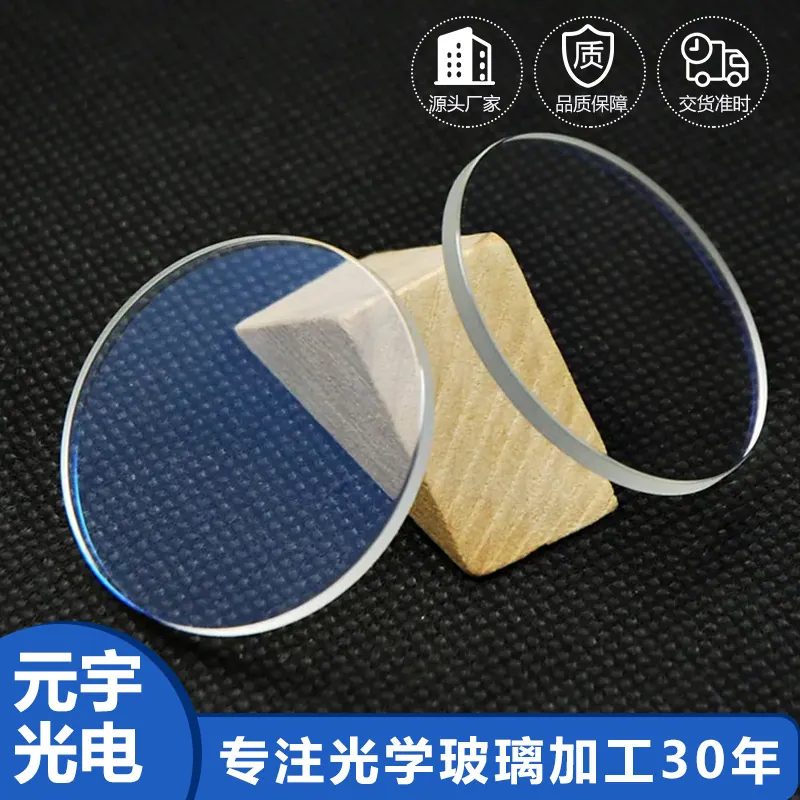
Optical Quartz and Crystal Glass in Cryogenic and Low-Temperature Optics
A cold instrument has a window on its sample chamber, detector package or radiation shield, and that window must stay transparent and dimensionally stable across a temperature span of roughly 300 K down to a few kelvin. Fused quartz is common because its coefficient of thermal expansion is tiny and it survives the cycle; crystalline parts such as sapphire, calcium fluoride or magnesium fluoride extend the band into the infrared or improve hardness, but they are birefringent and must be oriented deliberately. The optical problem at cryo is not surface reflection but thermal shock on cool-down, stress at the seal, and beam rotation from an unmarked crystal cut, so the specification moves to the cold state rather than to a room-temperature quality certificate.
How quartz and crystal glass works in practice
Fused quartz transmits from the deep ultraviolet through the near infrared and its low expansion is why it survives cool-down without cracking. Sapphire is hard and broad-band but birefringent; calcium fluoride and magnesium fluoride reach further into the infrared and are softer. The window's job is to pass the sensing or imaging band while staying mechanically part of a vacuum seal, so the material is chosen first by band and by how it behaves at temperature, then by hardness and cost. A bare polished surface is often acceptable because the reflectance penalty at cryo wavelengths is modest and a mismatched coating can cost more than it saves.
Design rules that reduce cost
Use the thinnest window that meets the mechanical and sealing need, because a thinner part cools faster and costs less material, and keep the design isotropic where birefringence would disturb the image. Where a crystalline window is required, orient the cut deliberately and mark that orientation on the part rather than leaving it to chance. Skip the anti-reflection coating unless the budget truly needs it, and spend the money on surface finish and thickness control, which help every wavelength in the band at once. Standard apertures and grades are cheaper than custom cuts, and the saving is in avoiding exotic orientation and special polishing.
Standards, documentation and traceability
The order carries a material certificate covering hydroxyl content for quartz, CTE data, and a birefringence measurement for crystalline parts. A cryo-cycle test record shows the part survived the required number of cool-downs without leak or fracture, and a batch identifier links the window to both certificates and to the process run. Vacuum compatibility, including outgassing class, is documented because a cold surface condenses anything that off-gasses. These are lot records, not a single incoming certificate, because the cold behaviour is what the instrument depends on and the failure is expensive to reach.
What drives cost and lead time
Cost follows clear aperture, grade and special cutting. A large low-birefringence crystal or a wide quartz window costs more than a small one, and a custom orientation cut adds both time and yield risk. Cryo qualification testing, including repeated cycles and a leak check, is a one-off that dominates lead time on a low-volume order. Special crystals with long mill lead and tight homogeneity are the items to order early, while standard quartz can often be sourced from stock. The trade is between aperture and schedule more than between materials.
Handling, cleaning and packaging
Cryo windows are cleaned to a particle standard and handled lint-free, because contamination that would be cosmetic at room temperature freezes, outgasses and can short a cold detector. Edges are chamfered and the part is packed so the optical face never touches a surface, with the orientation mark visible so the assembler seats it correctly. The handling discipline is part of the lot record, because a window that arrives clean but is wiped with the wrong cloth on the bench can fail the vacuum it was qualified for.
Requirements specific to Cryogenic and Low-Temperature Optics
The window must survive 4 to 77 K and repeated cycles, hold a low expansion matched to its metal flange, and present controlled birefringence where the beam must not rotate. It is vacuum-compatible and low outgassing, sealed to a cold flange, and coated for anti-reflection only where the band demands it. The CTE of the substrate and the flange are specified together, because a mismatch either cracks the window or leaks the vacuum on cool-down, and the orientation of any crystalline cut is marked so the beam stays where the design put it.
- Low-CTE substrate surviving 4-77 K cycles
- Controlled birefringence with orientation marked
- Vacuum-compatible and low outgassing
- Cryo-cycle test record and material certificate
Framework references: material transmission and CTE data are band- and grade-specific; rely on the supplier's certificate for hydroxyl content, birefringence and outgassing rather than a generic value. Vacuum and cryo-cycle qualification follow the assembly's own test specification; confirm against the current official text rather than a single number.
Selection data at a glance
| Parameter | Typical value | Notes |
|---|---|---|
| Material | fused quartz, sapphire, CaF2, MgF2 | Per band |
| Transmission | per band, UV to IR | Cryo stable |
| CTE | matched to flange | Cool-down safe |
| Thickness | per mechanical need | Minimum for duty |
| Birefringence | oriented, marked | Beam control |
| Cleaning | particle-free, vacuum-safe | Lot record |
| Inspection | cryo cycle, cert per lot | Not room only |
Frequently asked questions
Why does CTE matter so much at cryogenic temperature?
The window is sealed to a metal flange that shrinks far more than quartz across 300 K to 4 K. A CTE mismatch either cracks the window or leaks the vacuum, so the substrate and the mount are specified together, with the flange material stated on the drawing.
Does a crystalline window need orientation control at cryo?
Yes if it is birefringent. An unmarked cut rotates or splits the beam and only shows under rotation, so the cut plane is specified and marked, or the part uses an isotropic window where the image must not distort.
Why the cleaning discipline?
Contamination that would be cosmetic at room temperature freezes, outgasses and can short a cold detector. Cryo windows are cleaned to a particle standard and handled lint-free, not just wiped, and that step is part of the lot record.
Need a quotation for optical quartz and crystal glass?
Send your drawing, target specification or coating requirement and an optical engineer will reply within 24 hours with a price and a lead time.
Request a Quote Email an engineer