Nuclear magnetic resonance probes and precision magnetometers - optically pumped magnetometers, atomic vapour cells, ion and atom traps - all need a window that lets light in and out of a high-field or high-vacuum region without disturbing it. The window material has to be optically homogeneous, low in stress birefringence, and inert to the sample chemistry. Fused silica and synthetic quartz are the default, but sapphire and a few other crystals appear where hardness or a specific transmission band is needed. This comparison lines up the candidates so the choice is made on physics, not habit.
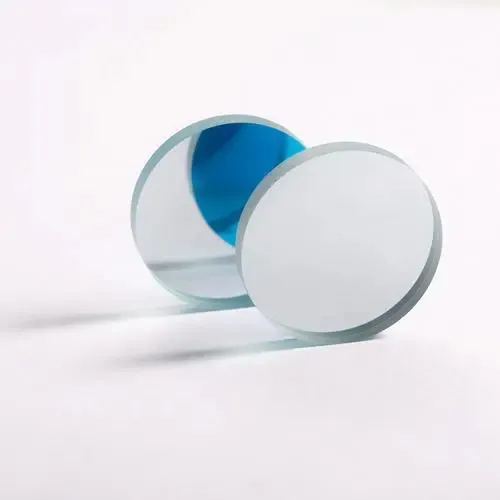
Optical Quartz and Crystal Glass in NMR and Precision Magnetometry Optics
In an NMR probe the optical window may carry a laser for hyperpolarisation or optical reading, or it may simply be a viewing port on a sample region; in a precision magnetometer the window is the optical access to the sensing vapour or trapped ensemble, and any birefringence or scatter in it adds noise to the measurement. The material therefore has to be homogeneous enough that the beam is not distorted and quiet enough that it does not itself become a source of optical anisotropy. Because these instruments sit in strong fields and often in vacuum or with reactive samples, the window is also a sealing and compatibility problem, not only an optical one.
Substrate and material selection
Fused silica is the workhorse: excellent transmission from the UV well into the infrared, very low intrinsic birefringence when stress-free, and good chemical inertness. Synthetic quartz adds tighter homogeneity and lower inclusion content for the most demanding beams, at higher cost. Sapphire is chosen when hardness, scratch resistance or a specific infrared band matters, but it is birefringent as a crystal and must be oriented carefully or used where its anisotropy is acceptable. For a vapour cell, the window material is also picked for low alkali reactivity and a clean, low-outgassing seal. The selection is a balance of transmission band, birefringence tolerance, hardness and sealing chemistry rather than a single best material.
What drives cost and lead time
Cost is driven by material grade and by how the window is finished. Standard fused-silica discs in common sizes are inexpensive and fast; synthetic quartz, oriented sapphire, or a window that must be polished to tight wedge and surface form costs more and takes longer. Lead time stretches when the part must be bonded or brazed into a cell or flange, because that adds a sealing step with its own qualification. Custom diameters, domed shapes, or anti-reflective coatings on one or both faces also add weeks. For most probes and magnetometer cells, the sensible route is a standard silica window with a simple AR coat, reserving exotic materials for the cases where the physics truly requires them.
The tolerances that actually matter
The numbers that move the measurement are homogeneity (so the beam is not wavefront-distorted), stress birefringence (so the window does not become an accidental waveplate), and parallelism or wedge (so the beam is not steered). Surface finish matters where scatter couples into the detector as noise. For a sealed cell, the sealing interface tolerance and the window thickness that the seal can survive matter more than cosmetic flatness. A few waves of surface form are often tolerable in a viewing port but not in a beam that is interferometrically read, so the tolerance should track the actual measurement, not a default fine number.
How it compares with the alternatives
Against sapphire, fused silica wins on low birefringence and cost and loses on hardness and a portion of the infrared; sapphire is the choice when the window is scratched in handling or must pass a band silica does not. Against borosilicate or standard optical glass, silica wins on transmission and homogeneity and loses on nothing optical except price. Against a polymer window, silica wins on outgassing and thermal stability and loses on impact resistance. For precision magnetometry the decisive comparison is usually silica versus sapphire on birefringence and seal chemistry: silica for quiet optics, sapphire where the environment is harsh.
Requirements specific to NMR and Precision Magnetometry Optics
The specific need here is optical quietness under field and, often, vacuum or reactive sample. The window must not introduce birefringence or scatter that the magnetometer would read as signal, and it must seal cleanly to a cell or flange without outgassing that poisons the vapour. The other point is that the window is usually part of a sealed assembly, so its tolerance and coating are qualified together with the seal, not as a standalone optic. Specify the transmission band against the laser in use and the birefringence against the measurement sensitivity.
- Fused silica for low birefringence and broad transmission; sapphire for harsh environments
- Homogeneity and stress birefringence are the measurement-critical tolerances
- Window is usually part of a sealed cell or flange - qualify the seal, not just the optic
- Specify transmission band and birefringence against the actual laser and sensitivity
Framework references: optical element tolerances follow ISO 10110; sealed-cell acceptance follows the device's own specification for outgassing and seal integrity. Transmission band and birefringence limits are set by the laser and the magnetometer sensitivity; confirm against the current instrument design.
Selection data at a glance
| Parameter | Typical value | Notes |
|---|---|---|
| Material | fused silica / synthetic quartz default | Sapphire for harsh use |
| Transmission | UV to mid-IR (silica) | Per laser wavelength |
| Birefringence | low when stress-free | Critical for magnetometry |
| Homogeneity | high; avoids wavefront error | Synthetic quartz tightest |
| Sealing | braze / bond to cell or flange | Low outgassing |
| AR coating | one or both faces, per band | State coated face |
Frequently asked questions
Is sapphire better than fused silica for these windows?
Not generally. Sapphire is harder and passes some infrared bands silica does not, but as a crystal it is birefringent and must be oriented or used where that is acceptable. Silica is the quieter, cheaper default; sapphire is for harsh handling or specific bands.
What tolerance actually affects the magnetometer reading?
Stress birefringence and homogeneity. A window that becomes an accidental waveplate or distorts the wavefront adds noise the instrument reads as signal. Surface form matters less unless the beam is interferometrically read.
Why is the seal part of the specification?
Because the window is usually brazed or bonded into a vapour cell or flange. Outgassing or a leaky seal poisons the sample and the measurement, so the window is qualified together with its seal, not as a standalone optic.
Need a quotation for optical quartz and crystal glass?
Send your drawing, target specification or coating requirement and an optical engineer will reply within 24 hours with a price and a lead time.
Request a Quote Email an engineer