Failures in quartz and crystal glass used in projection and display systems tend to follow a small number of patterns, and each pattern has a signature. This article walks through the common failure modes, how to tell them apart with measurements rather than guesswork, and the process or design changes that actually remove the root cause.
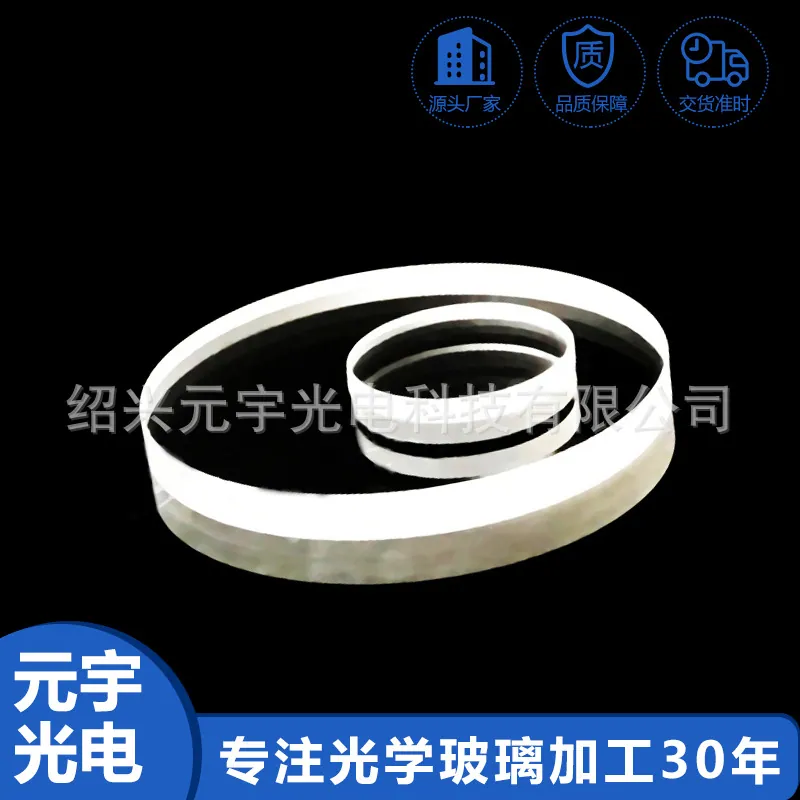
Optical Quartz and Crystal Glass in Projection and Display Systems
In projection and display systems, that translates into a specific set of requirements rather than a general preference for quality. Projection and display paths put several coated surfaces between the light source and the viewer, so each surface has to be both highly transmissive and color neutral. Ghost images caused by an uncoated rear surface are the recurring complaint, and in laser-illuminated projectors the coating must also handle speckle-sensitive coherence and higher flux.
Coating and deposition considerations
Coating quartz means managing stress and cleanliness. Its low expansion means the substrate will not relieve the stress a dense oxide stack introduces, so on thin parts a coating can visibly bow the window; a balanced design with a stress-compensating layer on the reverse face is sometimes required. Quartz attracts and holds contamination differently from soft glass, so pre-coating cleaning is longer and usually includes a UV-ozone or plasma step. For laser parts, coating absorption and damage threshold dominate the specification, and the coating must be evaluated at the operating wavelength and pulse duration rather than at a convenient broadband average. In Projection and Display Systems, the combination of a hard, low-absorption coating and a chamfered, fine-lapped edge is what makes a quartz window survive both the optical flux and the thermal cycle.
Design rules that reduce cost
Designing with quartz means exploiting its properties without paying for them twice. Use it where the UV transmission, the low expansion or the high damage threshold is actually required, and use ordinary optical glass elsewhere; a hybrid assembly that uses a quartz window and a borosilicate mounting ring has to account for the expansion mismatch, which is significant even though quartz itself moves very little. Keep edges chamfered and avoid clamping directly on an optical face. Avoid specifying both a very thin part and a very tight flatness unless the mounting will support it. For polarisation work, state the axis orientation on the drawing. In Projection and Display Systems, a short design review before the first cut usually removes one of the tight tolerances entirely, which is the cheapest possible redesign.
Common failure modes and how they show up
Quartz failures tend to be optical or thermal rather than mechanical. Solarisation, a gradual loss of UV transmission under prolonged exposure, occurs in some grades and is prevented by choosing high-OH material. Devitrification, the conversion of the amorphous surface into crystalline form at high temperature in the presence of contamination, produces a permanently hazy surface and is usually caused by alkali or metal contamination during handling or firing. Thermal stress cracks appear where a part is clamped or where an unaccounted gradient exists. Coating absorption causes damage spots in laser service. In Projection and Display Systems, a failure that appears at high temperature should always prompt a review of what touched the part - handling gloves, marking pens and packaging are all common sources of the contamination that triggers devitrification.
Inspection and measurement
Inspection of quartz parts extends beyond the usual surface quality checks. Transmission should be measured across the band of interest, including the deep UV where an ordinary spectrophotometer may not reach. Homogeneity and birefringence are checked interferometrically or with a polariscope, and inclusions are assessed against a bubble class. For laser optics, laser-induced damage threshold testing on a witness sample from the same lot gives far more confidence than a certificate alone. Dimensional checks follow the drawing, with particular attention to wafer TTV. In Projection and Display Systems, a witnessed damage test is often the only way to justify a material change to an internal customer, because the performance difference between two quartz grades may not be visible in any other measurement.
The tolerances that actually matter
Quartz parts are quoted like other optical elements, but a few tolerances deserve special attention. Flatness and transmitted wavefront are measured at a stated wavelength, and because quartz is stiff and low-expansion, excellent flatness is genuinely achievable rather than nominal. Birefringence is specified in nanometers per centimeter for fused parts and is intrinsic to crystalline material; if the application is polarisation-sensitive, that number belongs on the drawing. For wafers, total thickness variation and warp matter alongside the optical figure, because the part may be processed in a vacuum chuck where flatness is imposed mechanically. Surface quality is quoted in scratch-dig, and edge finish in chip size. In Projection and Display Systems, it is worth stating whether the surface figure must hold at temperature or only at room temperature.
Requirements specific to Projection and Display Systems
In projection and display systems, that translates into a specific set of requirements rather than a general preference for quality. Projection and display paths put several coated surfaces between the light source and the viewer, so each surface has to be both highly transmissive and color neutral. Ghost images caused by an uncoated rear surface are the recurring complaint, and in laser-illuminated projectors the coating must also handle speckle-sensitive coherence and higher flux.
- Transmission above 98 percent with dual-sided AR
- Color-neutral residual reflection
- Dichroic accuracy for color splitting within ±5 nm
- Thermal stability through lamp or laser heating
ISO 10110 drawings, ISO 9241 context for display ergonomics, and RoHS and REACH declarations.
Selection data at a glance
| Parameter | Typical value | Notes |
|---|---|---|
| Transmission band | 185-2500 nm (fused silica) | Deep UV to near IR |
| Refractive index | 1.458 (fused silica) | Low and highly uniform |
| CTE | 0.55 × 10⁻⁶ /K | Thermal shock resistant |
| OH content | < 10 ppm low-OH, > 200 ppm high-OH | Selected by UV or IR use |
| Birefringence | < 5 nm/cm (fused) | Crystalline quartz is anisotropic by nature |
| Flatness | λ/4 to λ/10 | Quartz wafers to λ/20 |
| Scratch-dig | 40-20 standard, 20-10 precision | ISO 10110-7 |
| Thickness range | 0.1-30 mm | Wafers from 0.1 mm |
| Edge finish | ground, chamfered or fine-lapped | Chips ≤ 0.05 mm |
Frequently asked questions
Why did my quartz window become hazy at high temperature?
That is devitrification, and it is almost always caused by contamination - alkali or metal traces from handling, marking or packaging - rather than by the material itself. Specify contamination-free handling for parts destined for high-temperature service.
Can quartz be coated for laser applications?
Yes, and the coating usually matters more than the substrate. Damage threshold is specified at the operating wavelength and pulse duration, and is verified on witness samples from the same material lot.
How flat can a quartz window be made?
Lambda/4 to λ/10 at 633 nm is routine, and quartz wafers can be polished to λ/20. Because quartz is stiff and low-expansion, the figure is stable, but it must be specified whether flatness is required free-standing or mounted.
Need a quotation for optical quartz and crystal glass?
Send your drawing, target specification or coating requirement and an optical engineer will reply within 24 hours with a price and a lead time.
Request a Quote Email an engineer