Optical Quartz and Crystal Glass covers a wider range of options than most drawings imply, and the differences between them decide both performance and price. This article compares the practical choices available for smartphone camera modules - substrate, coating process, thickness and tolerance - and shows where each trade-off pays off and where it does not.
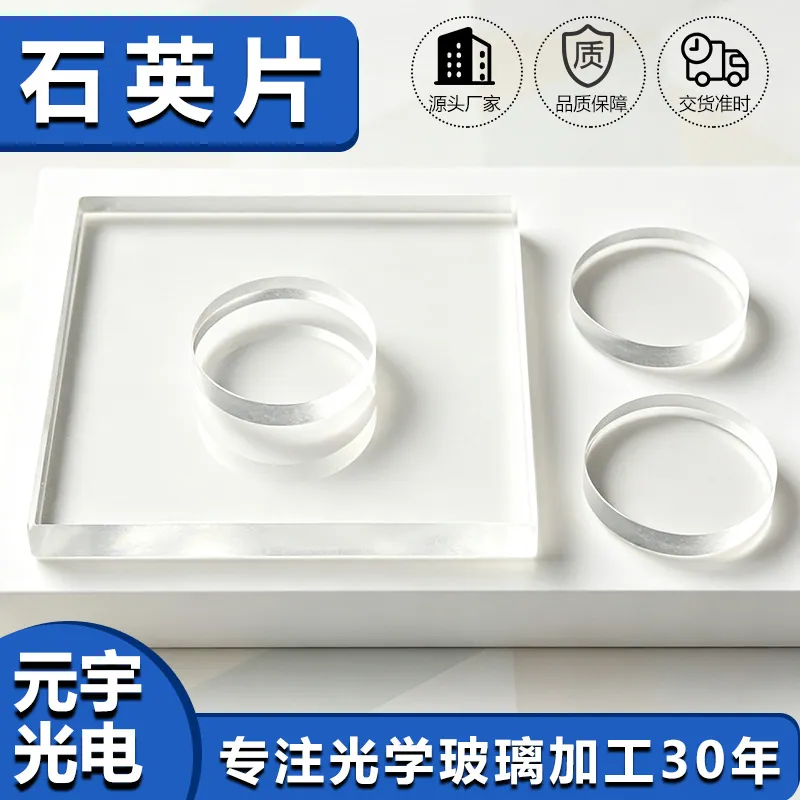
Optical Quartz and Crystal Glass in Smartphone Camera Modules
In smartphone camera modules, that translates into a specific set of requirements rather than a general preference for quality. Phone camera modules are the most space-constrained optical assemblies in mass production. Every component is measured in fractions of a millimeter, the stack is bonded and reflow-adjacent, and the module must survive drop testing, temperature cycling and years of pocket abrasion. Optical requirements center on color fidelity across a wide field of view, low flare from internal reflections, and stable performance after the adhesive cure.
Coating and deposition considerations
Coating quartz means managing stress and cleanliness. Its low expansion means the substrate will not relieve the stress a dense oxide stack introduces, so on thin parts a coating can visibly bow the window; a balanced design with a stress-compensating layer on the reverse face is sometimes required. Quartz attracts and holds contamination differently from soft glass, so pre-coating cleaning is longer and usually includes a UV-ozone or plasma step. For laser parts, coating absorption and damage threshold dominate the specification, and the coating must be evaluated at the operating wavelength and pulse duration rather than at a convenient broadband average. In Smartphone Camera Modules, the combination of a hard, low-absorption coating and a chamfered, fine-lapped edge is what makes a quartz window survive both the optical flux and the thermal cycle.
What drives cost and lead time
Quartz costs more than optical glass at every stage. The raw material is several times the price of BK7, and it polishes far more slowly because of its hardness, so a deep-UV grade window can cost five to ten times an equivalent borosilicate part. Grade selection drives the price more than size does: low-OH material and low-bubble, high-homogeneity grades carry large premiums. Flatness and surface quality follow the usual pattern, with each step tighter adding a finishing operation. In Smartphone Camera Modules, the sensible approach is to buy the cheapest quartz that satisfies the transmission requirement and to specify deep-UV grade only where the band actually needs it, since most parts specified as deep UV never see light below 350 nm.
Substrate and material selection
Within fused silica there is a real choice to make. Low-OH grades have almost no hydroxyl content and transmit further into the infrared, with less absorption around 2.7 micrometers, so they suit IR and high-power applications. High-OH grades contain several hundred parts per million of hydroxyl and are preferred where deep UV performance and resistance to solarisation matter. Natural quartz is used where its crystalline properties are needed, but it carries more inclusions and its anisotropy complicates polishing. Synthetic crystal (cultured quartz) offers the same optical behavior with better consistency. In Smartphone Camera Modules, the specification that prevents most disputes is not a grade name but a set of numbers: OH content, bubble class, and the transmission curve over the band of interest.
How it compares with the alternatives
Alternatives depend on what property is driving the choice. Where deep UV transmission is needed, calcium fluoride is the main competitor, offering transmission further into the ultraviolet at a much higher cost and with greater fragility. Where thermal stability is the driver, borosilicate or a low-expansion glass is often adequate at a fraction of the price. Where hardness is the driver, sapphire wins on scratch resistance and infrared transmission, though it is anisotropic and expensive. Where the part is simply a mechanical window, ordinary borosilicate will usually do the job. In Smartphone Camera Modules, the reliable test is to identify the single property that fails with the cheaper material, and to check whether the application actually reaches that limit.
Standards, documentation and traceability
Quartz optics are specified through the same drawing standards as other elements, ISO 10110 and ISO 12123, with additional material specifications covering OH content, bubble class and homogeneity. Laser applications reference damage threshold test standards and often require witness-sample data. Cleanliness specifications become important for semiconductor-adjacent parts, where particle count per unit area is controlled and documented. Environmental compliance is covered by RoHS and REACH declarations. In Smartphone Camera Modules, the documentation that most often determines whether a part can be released is traceability back to the material lot, because a homogeneity or inclusion problem discovered during assembly can only be contained if the affected parts can be identified.
Requirements specific to Smartphone Camera Modules
In smartphone camera modules, that translates into a specific set of requirements rather than a general preference for quality. Phone camera modules are the most space-constrained optical assemblies in mass production. Every component is measured in fractions of a millimeter, the stack is bonded and reflow-adjacent, and the module must survive drop testing, temperature cycling and years of pocket abrasion. Optical requirements center on color fidelity across a wide field of view, low flare from internal reflections, and stable performance after the adhesive cure.
- Thickness typically 0.21 - 0.55 mm
- Transmission above 90 percent in the visible band
- No visible color shading across a wide field of view
- Survives reflow-adjacent temperatures and drop testing
Suppliers usually work to module-maker internal standards covering particle cleanliness, outgassing and bond-line quality, alongside RoHS and REACH declarations.
Selection data at a glance
| Parameter | Typical value | Notes |
|---|---|---|
| Transmission band | 185-2500 nm (fused silica) | Deep UV to near IR |
| Refractive index | 1.458 (fused silica) | Low and highly uniform |
| CTE | 0.55 × 10⁻⁶ /K | Thermal shock resistant |
| OH content | < 10 ppm low-OH, > 200 ppm high-OH | Selected by UV or IR use |
| Birefringence | < 5 nm/cm (fused) | Crystalline quartz is anisotropic by nature |
| Flatness | λ/4 to λ/10 | Quartz wafers to λ/20 |
| Scratch-dig | 40-20 standard, 20-10 precision | ISO 10110-7 |
| Thickness range | 0.1-30 mm | Wafers from 0.1 mm |
| Edge finish | ground, chamfered or fine-lapped | Chips ≤ 0.05 mm |
Frequently asked questions
When should I choose quartz rather than optical glass?
When the part must transmit below roughly 300 nm, survive a rapid thermal cycle, or withstand high laser energy. For visible-light windows and filters, borosilicate or B270 performs the same function at a fraction of the cost.
What is the difference between low-OH and high-OH fused silica?
Low-OH material has minimal hydroxyl content and transmits further into the infrared. High-OH material contains several hundred parts per million of hydroxyl, which improves deep-UV transmission and resistance to solarisation.
Why did my quartz window become hazy at high temperature?
That is devitrification, and it is almost always caused by contamination - alkali or metal traces from handling, marking or packaging - rather than by the material itself. Specify contamination-free handling for parts destined for high-temperature service.
Need a quotation for optical quartz and crystal glass?
Send your drawing, target specification or coating requirement and an optical engineer will reply within 24 hours with a price and a lead time.
Request a Quote Email an engineer