Two quotations for the same quartz and crystal glass part in solar and photovoltaic manufacturing can differ by a factor of three, and the reason is rarely the material. This article breaks down the real cost drivers - tolerance, finishing operations, inspection level and batch size - and shows which specification changes save money and which only look as though they should.
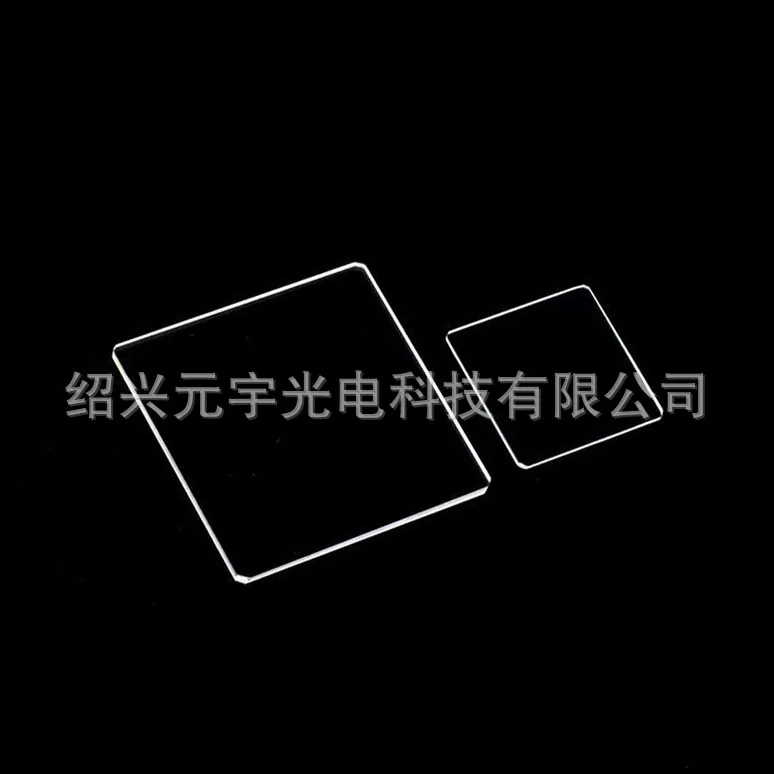
Optical Quartz and Crystal Glass in Solar and Photovoltaic Manufacturing
In solar and photovoltaic manufacturing, that translates into a specific set of requirements rather than a general preference for quality. Solar manufacturing combines very large glass areas with aggressive cost targets and 25-year outdoor exposure. Coatings are used to raise transmission and reduce soiling, while glass is used as tooling and protection in the production equipment itself. Durability under ultraviolet, humidity and thermal cycling is the entry ticket.
The tolerances that actually matter
Quartz parts are quoted like other optical elements, but a few tolerances deserve special attention. Flatness and transmitted wavefront are measured at a stated wavelength, and because quartz is stiff and low-expansion, excellent flatness is genuinely achievable rather than nominal. Birefringence is specified in nanometers per centimeter for fused parts and is intrinsic to crystalline material; if the application is polarisation-sensitive, that number belongs on the drawing. For wafers, total thickness variation and warp matter alongside the optical figure, because the part may be processed in a vacuum chuck where flatness is imposed mechanically. Surface quality is quoted in scratch-dig, and edge finish in chip size. In Solar and Photovoltaic Manufacturing, it is worth stating whether the surface figure must hold at temperature or only at room temperature.
What drives cost and lead time
Quartz costs more than optical glass at every stage. The raw material is several times the price of BK7, and it polishes far more slowly because of its hardness, so a deep-UV grade window can cost five to ten times an equivalent borosilicate part. Grade selection drives the price more than size does: low-OH material and low-bubble, high-homogeneity grades carry large premiums. Flatness and surface quality follow the usual pattern, with each step tighter adding a finishing operation. In Solar and Photovoltaic Manufacturing, the sensible approach is to buy the cheapest quartz that satisfies the transmission requirement and to specify deep-UV grade only where the band actually needs it, since most parts specified as deep UV never see light below 350 nm.
Substrate and material selection
Within fused silica there is a real choice to make. Low-OH grades have almost no hydroxyl content and transmit further into the infrared, with less absorption around 2.7 micrometers, so they suit IR and high-power applications. High-OH grades contain several hundred parts per million of hydroxyl and are preferred where deep UV performance and resistance to solarisation matter. Natural quartz is used where its crystalline properties are needed, but it carries more inclusions and its anisotropy complicates polishing. Synthetic crystal (cultured quartz) offers the same optical behavior with better consistency. In Solar and Photovoltaic Manufacturing, the specification that prevents most disputes is not a grade name but a set of numbers: OH content, bubble class, and the transmission curve over the band of interest.
Handling, cleaning and packaging
Quartz is hard but brittle, and its fine edges chip easily, so the handling rules are stricter than for soda-lime. Ground and chamfered edges are normal, and parts are usually supplied interleaved with a particle-free separator. Cleaning avoids hydrofluoric-acid-containing products entirely, since even trace HF attacks silica, and it avoids strong alkaline solutions that can etch the surface over time. Fingerprints on a UV part are functional defects, not cosmetic ones, because organic residue absorbs strongly below 250 nm and will be burned into the coating by UV exposure. In Solar and Photovoltaic Manufacturing, the packaging standard matters as much as the part: a scratch introduced in transit on a deep-UV window can be undetectable on arrival and fatal in service.
Requirements specific to Solar and Photovoltaic Manufacturing
In solar and photovoltaic manufacturing, that translates into a specific set of requirements rather than a general preference for quality. Solar manufacturing combines very large glass areas with aggressive cost targets and 25-year outdoor exposure. Coatings are used to raise transmission and reduce soiling, while glass is used as tooling and protection in the production equipment itself. Durability under ultraviolet, humidity and thermal cycling is the entry ticket.
- Twenty-five year UV and humidity stability
- Very large coated areas with uniform performance
- Hydrophobic or easy-clean surface behavior
- Cost per square meter under pressure
IEC 61215 and IEC 61730 context for module durability, plus RoHS and REACH declarations for the coated glass.
Selection data at a glance
| Parameter | Typical value | Notes |
|---|---|---|
| Transmission band | 185-2500 nm (fused silica) | Deep UV to near IR |
| Refractive index | 1.458 (fused silica) | Low and highly uniform |
| CTE | 0.55 × 10⁻⁶ /K | Thermal shock resistant |
| OH content | < 10 ppm low-OH, > 200 ppm high-OH | Selected by UV or IR use |
| Birefringence | < 5 nm/cm (fused) | Crystalline quartz is anisotropic by nature |
| Flatness | λ/4 to λ/10 | Quartz wafers to λ/20 |
| Scratch-dig | 40-20 standard, 20-10 precision | ISO 10110-7 |
| Thickness range | 0.1-30 mm | Wafers from 0.1 mm |
| Edge finish | ground, chamfered or fine-lapped | Chips ≤ 0.05 mm |
Frequently asked questions
What is the difference between low-OH and high-OH fused silica?
Low-OH material has minimal hydroxyl content and transmits further into the infrared. High-OH material contains several hundred parts per million of hydroxyl, which improves deep-UV transmission and resistance to solarisation.
Why did my quartz window become hazy at high temperature?
That is devitrification, and it is almost always caused by contamination - alkali or metal traces from handling, marking or packaging - rather than by the material itself. Specify contamination-free handling for parts destined for high-temperature service.
Can quartz be coated for laser applications?
Yes, and the coating usually matters more than the substrate. Damage threshold is specified at the operating wavelength and pulse duration, and is verified on witness samples from the same material lot.
Need a quotation for optical quartz and crystal glass?
Send your drawing, target specification or coating requirement and an optical engineer will reply within 24 hours with a price and a lead time.
Request a Quote Email an engineer