Optical Glass Materials covers a wider range of options than most drawings imply, and the differences between them decide both performance and price. This article compares the practical choices available for agricultural sensing and crop monitoring - substrate, coating process, thickness and tolerance - and shows where each trade-off pays off and where it does not.
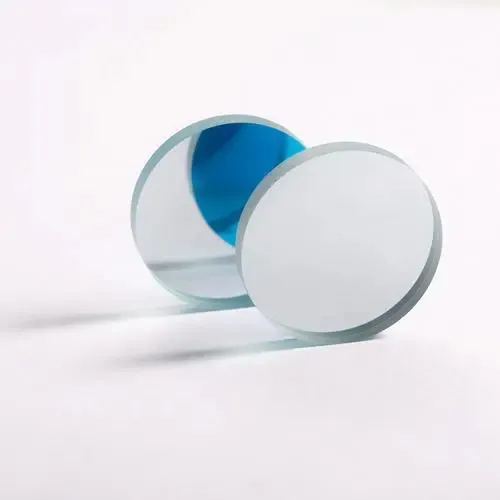
Optical Glass Materials in Agricultural Sensing and Crop Monitoring
In agricultural sensing and crop monitoring, that translates into a specific set of requirements rather than a general preference for quality. Agricultural optics live outdoors for a full season or more, exposed to ultraviolet, dust, irrigation spray and temperature swings, and they are usually deployed in numbers large enough that maintenance is impractical. Multispectral and NDVI instruments also depend on precise band separation, because the vegetative index is computed from narrow wavelength differences.
How it compares with the alternatives
Glass competes with crystalline materials such as sapphire, calcium fluoride and zinc selenide, with polymers such as PMMA and polycarbonate, and with hot-formed or molded glass. Polymers are cheap and light but cannot hold optical flatness, and they scratch. Crystals cover spectral ranges glass cannot reach - the mid and far infrared - and sapphire adds hardness and thermal conductivity, at a large cost premium and with size limits. Hot-formed glass shapes aspheres cheaply but leaves surface texture that must be polished out when tight flatness is required. For the flat, coated, dimensionally precise parts that make up most of what is used in Agricultural Sensing and Crop Monitoring, a well-chosen optical glass substrate remains the best combination of optical quality, cost and supply security.
Coating and deposition considerations
Not every glass takes a coating equally well, and the difference shows up in yield. Alkali-containing glasses can leach alkali ions into the coating interface under humidity, which is why barrier layers or alkali-free substrates are used for parts expected to survive decades outdoors. Low-index and high-expansion glasses need coating designs that are compensated for the stress a dense oxide stack introduces, otherwise a hard coating on a thin sheet will bow the part out of tolerance. Sapphire and quartz demand longer chamber times and careful pre-cleaning because their surfaces hold contamination differently. In Agricultural Sensing and Crop Monitoring, the practical rule is that the substrate and the coating should be selected together: a coating designed for B270 and deposited on borosilicate will be close but not identical, because the substrate index changes the effective optical thickness of every layer.
What drives cost and lead time
Material cost is not linear in performance, and the jumps are large. Moving from soda-lime to BK7 roughly doubles the substrate bill; moving to borosilicate or Eagle XG roughly doubles it again; fused silica and quartz are several times BK7; sapphire can be an order of magnitude above soda-lime for the same blank size. Those multipliers matter far less than the processing they imply, though. Harder materials grind and polish more slowly, sapphire requires diamond tooling, and quartz demands longer coating cycles - so the true cost difference between two material options is usually two to three times the raw material delta. In Agricultural Sensing and Crop Monitoring, the cheapest decision is normally to use the least exotic material that meets the transmission and thermal requirement, and to spend the saved budget on tighter inspection instead.
Substrate and material selection
The practical menu is shorter than the catalogs suggest. B270 and soda-lime cover most visible-light parts and polish quickly at low cost. BK7 brings better homogeneity and lower bubble content for imaging paths where wavefront matters. Borosilicate 3.3 and alkali-free grades such as Eagle XG add low thermal expansion and are the standard choice for thin sheets and for parts that must stay flat through a coating or a soldering process. Fused silica and quartz cover UV and high-energy applications because they combine deep-UV transmission with a very high laser damage threshold. Sapphire sits at the other end: it is nearly scratch-proof, works out to the mid infrared and conducts heat, but it is anisotropic, expensive and slow to machine. Blue glass is a special case, an absorptive material that removes near-infrared while passing visible light.
Requirements specific to Agricultural Sensing and Crop Monitoring
In agricultural sensing and crop monitoring, that translates into a specific set of requirements rather than a general preference for quality. Agricultural optics live outdoors for a full season or more, exposed to ultraviolet, dust, irrigation spray and temperature swings, and they are usually deployed in numbers large enough that maintenance is impractical. Multispectral and NDVI instruments also depend on precise band separation, because the vegetative index is computed from narrow wavelength differences.
- UV-stable coatings for multi-season exposure
- Precise narrow-band definition for vegetation indices
- Hydrophobic surface to shed dew and spray
- Low power consumption for remote installations
IP-rated enclosure compatibility, ISO 10110 drawings, and RoHS and REACH declarations.
Selection data at a glance
| Material | Index (nd) | Typical use | Notes |
|---|---|---|---|
| B270 / soda-lime | 1.523 | Cover glass, filters, lighting | Lowest cost, quick polishing |
| BK7 (N-BK7) | 1.517 | General optics, windows | Excellent homogeneity, low bubble |
| Borosilicate 3.3 | 1.471 | Heat-resistant windows, thin glass | CTE 3.3 ppm/K |
| Eagle XG | 1.510 | Display, thin-sheet optics | Alkali-free, very low warpage |
| Fused silica / quartz | 1.458 | UV, laser, high-temperature | Deep UV transmission, high damage threshold |
| Sapphire | 1.768 | Scratch-proof windows, IR | Mohs 9, anisotropic machining |
| Blue glass (BG-type) | 1.52 - 1.55 | IR-cut for cameras | Absorptive NIR, color correction |
| Glass wafer | varies | Sensors, packaging | 0.1-1 mm, low TTV |
Frequently asked questions
Which material should I use for a part that will be soldered or autoclaved?
A low-expansion substrate such as borosilicate 3.3, Eagle XG or fused silica. The failure you are avoiding is thermal shock and post-process warp, and both are driven by the coefficient of thermal expansion more than by strength.
How much does material choice affect lead time?
Soda-lime, B270 and standard borosilicate ship from stock in days. Fused silica, quartz and sapphire are frequently made to order, and their slower grinding and polishing rates add days to weeks on top of the material lead time.
Do you supply material certificates?
Yes. Certificates for index, transmission, expansion and defect class accompany the shipment, along with the melt or lot identification that allows full traceability of the finished parts.
Need a quotation for optical glass materials?
Send your drawing, target specification or coating requirement and an optical engineer will reply within 24 hours with a price and a lead time.
Request a Quote Email an engineer