Specifying optical glass materials for drone and UAV imaging payloads is largely a matter of deciding which three numbers actually govern the application and letting the rest follow. This guide walks through the parameters that belong on the drawing, the tolerances that genuinely change the price, and the specification items that are routinely left out and then argued about at first article.
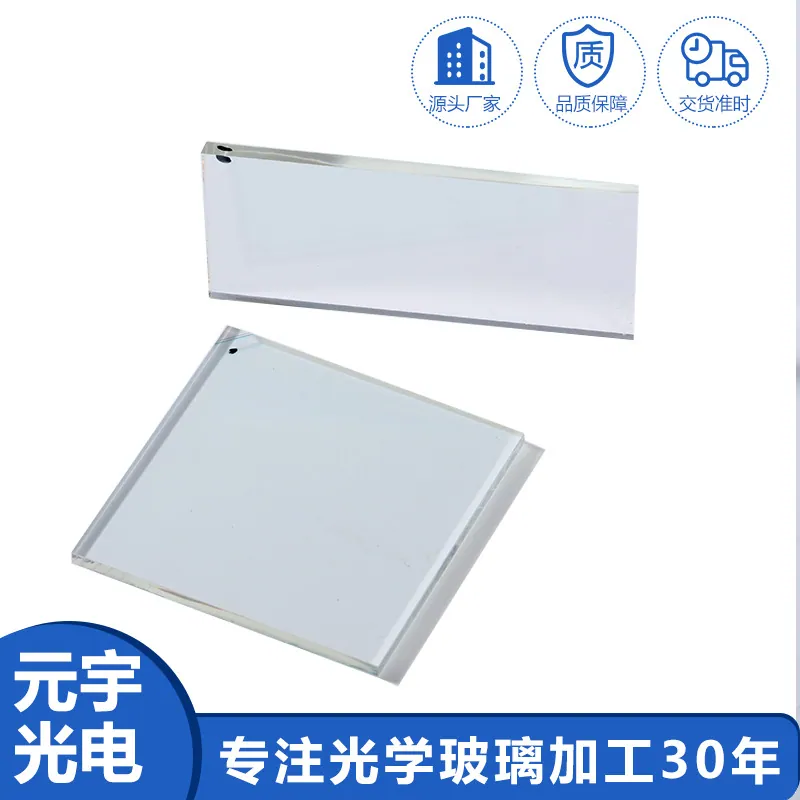
Optical Glass Materials in Drone and UAV Imaging Payloads
In drone and UAV imaging payloads, that translates into a specific set of requirements rather than a general preference for quality. Airborne imaging payloads trade weight against durability on every design decision. A gimbal-mounted camera window must be light enough not to affect flight time, flat enough not to distort a long lens, and robust enough to survive landing and dust. Multispectral agricultural payloads add the complication of several narrow bands in one small assembly.
Coating and deposition considerations
Not every glass takes a coating equally well, and the difference shows up in yield. Alkali-containing glasses can leach alkali ions into the coating interface under humidity, which is why barrier layers or alkali-free substrates are used for parts expected to survive decades outdoors. Low-index and high-expansion glasses need coating designs that are compensated for the stress a dense oxide stack introduces, otherwise a hard coating on a thin sheet will bow the part out of tolerance. Sapphire and quartz demand longer chamber times and careful pre-cleaning because their surfaces hold contamination differently. In Drone and UAV Imaging Payloads, the practical rule is that the substrate and the coating should be selected together: a coating designed for B270 and deposited on borosilicate will be close but not identical, because the substrate index changes the effective optical thickness of every layer.
How optical glass materials works in practice
Choosing an optical glass is a chain of constraints rather than a single decision. The first constraint is the transmission window - whether the part must work in the deep UV, the visible, or out to the near infrared. The second is thermal: how much the part will move, warp or crack when it is heated during coating, soldering, autoclaving or simply lamp operation. The third is mechanical: hardness, scratch resistance and the ability to survive handling at the thickness specified. Cost, polishability and availability follow. In Drone and UAV Imaging Payloads, the cheapest material that satisfies all three constraints is almost always the right answer, and the most common engineering error is to over-specify - putting fused silica on a part that will never see ultraviolet light, or sapphire on a window that will never be touched, doubles the bill for no measurable benefit.
The tolerances that actually matter
Glass is bought and sold against a handful of numbers that should always appear on the purchase order. Refractive index tolerance and homogeneity decide how much the wavefront will be distorted, typically quoted as an index variation across a melt. Bubble and inclusion class limits the size and count of internal defects, which matters in imaging and in laser paths where a bubble becomes a damage site. Striae grade controls the residual cord lines that cause local index variation. For sheet and wafer stock the mechanical numbers matter just as much: thickness tolerance, total thickness variation, warp and surface roughness. In Drone and UAV Imaging Payloads, the two attributes most often omitted from a specification and most often responsible for a rejected batch are warp after thermal processing and edge quality of the cut blank.
Design rules that reduce cost
Design decisions that cost nothing on paper save a great deal in production. Keep the material as thin as the stiffness requirement allows, because thickness raises material cost, thermal mass and coating stress. Design edges with chamfers and avoid sharp internal corners. If two different glasses must be bonded or soldered, check the expansion mismatch first, since a mismatch will crack the joint on the first thermal cycle. Leave a clear uncoated margin for retention and keep the optical aperture away from the edge, where warp and edge stress are greatest. For Drone and UAV Imaging Payloads, state which surface is the functional optical surface and how it will be referenced during assembly, because a symmetric part assembled backwards is one of the most common and most avoidable errors in small optical assemblies.
Requirements specific to Drone and UAV Imaging Payloads
In drone and UAV imaging payloads, that translates into a specific set of requirements rather than a general preference for quality. Airborne imaging payloads trade weight against durability on every design decision. A gimbal-mounted camera window must be light enough not to affect flight time, flat enough not to distort a long lens, and robust enough to survive landing and dust. Multispectral agricultural payloads add the complication of several narrow bands in one small assembly.
- Low weight with thin substrates
- Flatness and low wedge for long focal lengths
- Multispectral band accuracy where required
- Dust, salt and humidity resistance
Airworthiness documentation for commercial operations, ISO 10110 drawings, and RoHS and REACH declarations.
Selection data at a glance
| Material | Index (nd) | Typical use | Notes |
|---|---|---|---|
| B270 / soda-lime | 1.523 | Cover glass, filters, lighting | Lowest cost, quick polishing |
| BK7 (N-BK7) | 1.517 | General optics, windows | Excellent homogeneity, low bubble |
| Borosilicate 3.3 | 1.471 | Heat-resistant windows, thin glass | CTE 3.3 ppm/K |
| Eagle XG | 1.510 | Display, thin-sheet optics | Alkali-free, very low warpage |
| Fused silica / quartz | 1.458 | UV, laser, high-temperature | Deep UV transmission, high damage threshold |
| Sapphire | 1.768 | Scratch-proof windows, IR | Mohs 9, anisotropic machining |
| Blue glass (BG-type) | 1.52 - 1.55 | IR-cut for cameras | Absorptive NIR, color correction |
| Glass wafer | varies | Sensors, packaging | 0.1-1 mm, low TTV |
Frequently asked questions
Which material should I use for a part that will be soldered or autoclaved?
A low-expansion substrate such as borosilicate 3.3, Eagle XG or fused silica. The failure you are avoiding is thermal shock and post-process warp, and both are driven by the coefficient of thermal expansion more than by strength.
How much does material choice affect lead time?
Soda-lime, B270 and standard borosilicate ship from stock in days. Fused silica, quartz and sapphire are frequently made to order, and their slower grinding and polishing rates add days to weeks on top of the material lead time.
Do you supply material certificates?
Yes. Certificates for index, transmission, expansion and defect class accompany the shipment, along with the melt or lot identification that allows full traceability of the finished parts.
Need a quotation for optical glass materials?
Send your drawing, target specification or coating requirement and an optical engineer will reply within 24 hours with a price and a lead time.
Request a Quote Email an engineer