Requirements in stage lighting and entertainment have been shifting - thinner parts, wider bands, harsher environments - and those shifts change what optical glass materials suppliers are being asked to hold. This article reviews where the demand is heading, what it means for specifications, and how to structure sourcing so that a design is not locked to a single process.
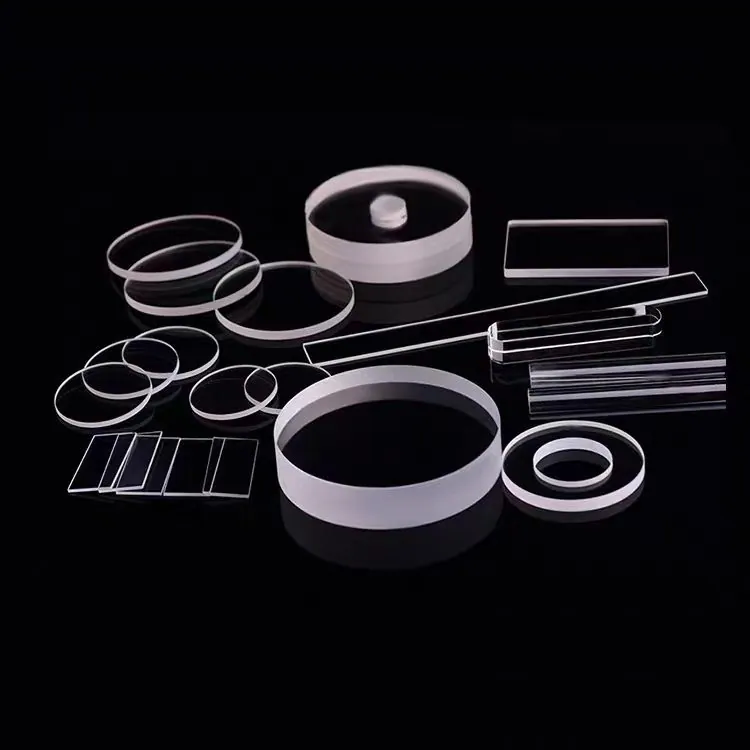
Optical Glass Materials in Stage Lighting and Entertainment
In stage lighting and entertainment, that translates into a specific set of requirements rather than a general preference for quality. Entertainment lighting combines the highest continuous flux of any application with the least forgiving audience: a stadium or a theatre instantly reveals color drift or a hazy filter. Gobo and color plates sit a few millimeters from a lamp, are expected to hold their color for thousands of hours, and are frequently handled and swapped between shows.
How optical glass materials works in practice
Choosing an optical glass is a chain of constraints rather than a single decision. The first constraint is the transmission window - whether the part must work in the deep UV, the visible, or out to the near infrared. The second is thermal: how much the part will move, warp or crack when it is heated during coating, soldering, autoclaving or simply lamp operation. The third is mechanical: hardness, scratch resistance and the ability to survive handling at the thickness specified. Cost, polishability and availability follow. In Stage Lighting and Entertainment, the cheapest material that satisfies all three constraints is almost always the right answer, and the most common engineering error is to over-specify - putting fused silica on a part that will never see ultraviolet light, or sapphire on a window that will never be touched, doubles the bill for no measurable benefit.
Design rules that reduce cost
Design decisions that cost nothing on paper save a great deal in production. Keep the material as thin as the stiffness requirement allows, because thickness raises material cost, thermal mass and coating stress. Design edges with chamfers and avoid sharp internal corners. If two different glasses must be bonded or soldered, check the expansion mismatch first, since a mismatch will crack the joint on the first thermal cycle. Leave a clear uncoated margin for retention and keep the optical aperture away from the edge, where warp and edge stress are greatest. For Stage Lighting and Entertainment, state which surface is the functional optical surface and how it will be referenced during assembly, because a symmetric part assembled backwards is one of the most common and most avoidable errors in small optical assemblies.
Standards, documentation and traceability
Optical glass is standardised at the material level by ISO 12123 and by the manufacturers' own designation systems, and at the drawing level by ISO 10110. Environmental and safety requirements arrive through RoHS and REACH declarations, and sector-specific programs add ISO 9001, IATF 16949 or ISO 13485 depending on the market. Where the part contacts food, medical tissue or drinking water, additional migration and biocompatibility testing may apply. In Stage Lighting and Entertainment, buyers increasingly ask for material declarations covering the full bill of materials, not just the glass, which means the coating materials and any adhesive used at assembly also need to be declared.
What drives cost and lead time
Material cost is not linear in performance, and the jumps are large. Moving from soda-lime to BK7 roughly doubles the substrate bill; moving to borosilicate or Eagle XG roughly doubles it again; fused silica and quartz are several times BK7; sapphire can be an order of magnitude above soda-lime for the same blank size. Those multipliers matter far less than the processing they imply, though. Harder materials grind and polish more slowly, sapphire requires diamond tooling, and quartz demands longer coating cycles - so the true cost difference between two material options is usually two to three times the raw material delta. In Stage Lighting and Entertainment, the cheapest decision is normally to use the least exotic material that meets the transmission and thermal requirement, and to spend the saved budget on tighter inspection instead.
How it compares with the alternatives
Glass competes with crystalline materials such as sapphire, calcium fluoride and zinc selenide, with polymers such as PMMA and polycarbonate, and with hot-formed or molded glass. Polymers are cheap and light but cannot hold optical flatness, and they scratch. Crystals cover spectral ranges glass cannot reach - the mid and far infrared - and sapphire adds hardness and thermal conductivity, at a large cost premium and with size limits. Hot-formed glass shapes aspheres cheaply but leaves surface texture that must be polished out when tight flatness is required. For the flat, coated, dimensionally precise parts that make up most of what is used in Stage Lighting and Entertainment, a well-chosen optical glass substrate remains the best combination of optical quality, cost and supply security.
Requirements specific to Stage Lighting and Entertainment
In stage lighting and entertainment, that translates into a specific set of requirements rather than a general preference for quality. Entertainment lighting combines the highest continuous flux of any application with the least forgiving audience: a stadium or a theatre instantly reveals color drift or a hazy filter. Gobo and color plates sit a few millimeters from a lamp, are expected to hold their color for thousands of hours, and are frequently handled and swapped between shows.
- Sustained high flux tolerance without color shift
- Patterned colors with registration to ±0.05 mm
- Heat-resistant substrate such as borosilicate or quartz
- Robust coated edge for repeated handling
EN 60598 luminaire safety context, fire-behavior considerations for stage materials, and RoHS and REACH declarations for the coated component.
Selection data at a glance
| Material | Index (nd) | Typical use | Notes |
|---|---|---|---|
| B270 / soda-lime | 1.523 | Cover glass, filters, lighting | Lowest cost, quick polishing |
| BK7 (N-BK7) | 1.517 | General optics, windows | Excellent homogeneity, low bubble |
| Borosilicate 3.3 | 1.471 | Heat-resistant windows, thin glass | CTE 3.3 ppm/K |
| Eagle XG | 1.510 | Display, thin-sheet optics | Alkali-free, very low warpage |
| Fused silica / quartz | 1.458 | UV, laser, high-temperature | Deep UV transmission, high damage threshold |
| Sapphire | 1.768 | Scratch-proof windows, IR | Mohs 9, anisotropic machining |
| Blue glass (BG-type) | 1.52 - 1.55 | IR-cut for cameras | Absorptive NIR, color correction |
| Glass wafer | varies | Sensors, packaging | 0.1-1 mm, low TTV |
Frequently asked questions
How much does material choice affect lead time?
Soda-lime, B270 and standard borosilicate ship from stock in days. Fused silica, quartz and sapphire are frequently made to order, and their slower grinding and polishing rates add days to weeks on top of the material lead time.
Do you supply material certificates?
Yes. Certificates for index, transmission, expansion and defect class accompany the shipment, along with the melt or lot identification that allows full traceability of the finished parts.
Is fused silica the same as quartz?
Not quite. Fused silica is synthetic, amorphous SiO2 and is the preferred choice for UV and laser optics because of its homogeneity and low impurity level. Quartz is the natural crystalline counterpart, used where its specific optical or thermal properties are needed.
Need a quotation for optical glass materials?
Send your drawing, target specification or coating requirement and an optical engineer will reply within 24 hours with a price and a lead time.
Request a Quote Email an engineer