A CO2 laser cuts and welds at 10.6 micrometres, and the guidance camera that watches the process through the same optical path needs an IR filter that blocks that powerful invisible beam while passing the visible or short-wave light the camera uses to see the seam. Getting the blocking and the passband right is what stops the camera from being blinded or burned. This guide sets out the tolerances and coating rules optical engineers should specify for IR filters in CO2 laser cutting and welding guidance.
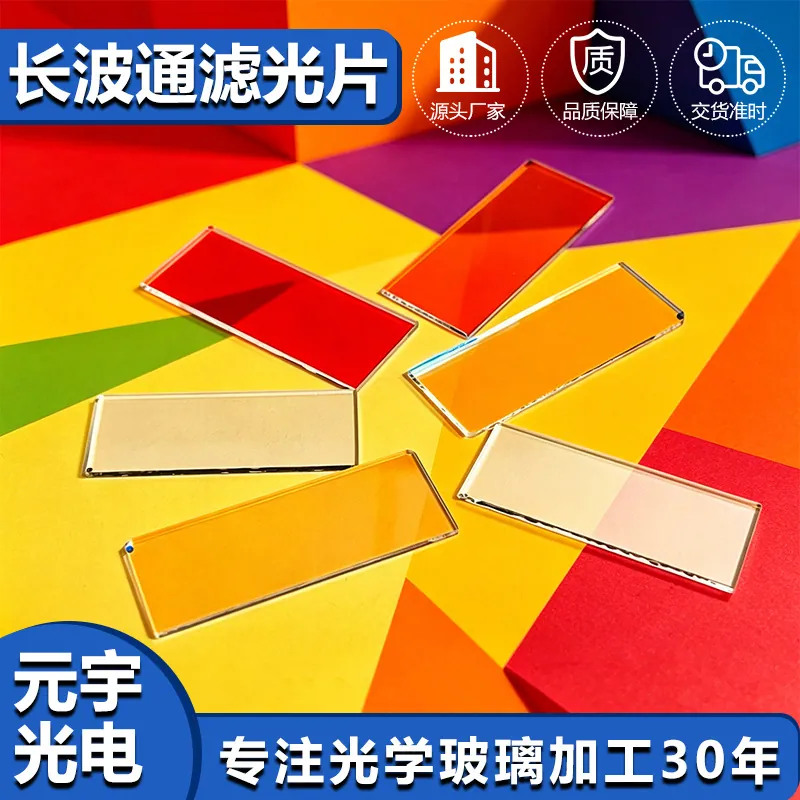
IR Filters in CO2 Laser Cutting and Welding Guidance
The guidance filter sits on the process camera and has to reject the 10.6 micrometre CO2 beam completely while passing the visible or near-infrared illumination the operator uses to watch the cut or weld, so the camera sees the seam and not the laser. The filter has to survive the beam's stray reflections and the heat of the process head, because a leak at 10.6 micrometres is enough to saturate or destroy the sensor. The material and coating choice is therefore as much about blocking depth and power handling as about the passband.
The tolerances that actually matter
For a CO2-guidance filter the optical density at 10.6 micrometres and the sharpness of the cut between block and pass bands matter most, because a shallow edge leaks laser light and a soft passband dims the view. Surface flatness matters where the filter sits in a focused viewing path and would add wavefront error, and surface quality matters where scatter becomes a glare source on the sensor. The tolerances that matter are the ones tied to blocking depth and to the viewing resolution, not generic cosmetic limits.
Design rules that reduce cost
Cost drops when the passband is matched to the camera's actual sensitivity rather than specified broadband, and when the blocking is called out only across the laser and its harmonics rather than across the whole IR. Specifying a standard substrate size and a single-edge filter rather than a complex multi-notch stack keeps the coating short, and a forgiving aperture sized to the field of view avoids custom framing. The cheap filter is the one whose band budget was written for the camera and the laser, not copied from a generic IR spec.
Coating and deposition considerations
The coating is a multilayer stack that peaks its reflection or absorption at 10.6 micrometres while passing the visible or SWIR, and it must survive the beam's stray energy and the process heat without delaminating or drifting. Dense, high-power-rated layers are preferred over decorative coatings that burn or haze under the laser environment, and the band is designed for the actual beam angle in the head. State the angle of incidence and the power the coating must withstand, because a stack tuned at normal incidence or low power fails in a real cutting head.
How IR filters works in practice
In use the filter blocks the CO2 line so the camera only sees the illuminated work piece, and the depth of the 10.6 micrometre block decides whether the sensor survives a stray reflection. A sharp edge between block and pass keeps the view bright while the laser is fully rejected, so the operator watches the seam in real time. A filter that meets the spec holds that separation through the heat of a cutting head; one that was under-specified lets laser light through and blinds or burns the camera.
Requirements specific to CO2 Laser Cutting and Welding Guidance
CO2-guidance duty makes blocking depth at 10.6 micrometres and power survival the headline requirements, so specify the optical density at the laser line, the cut sharpness and the power the coating must withstand before anything else. Match the passband to the camera's sensitivity, keep the substrate flat for the viewing path, and state the beam angle of incidence in the head. A filter qualified against the real laser environment is cheaper than a bright one that blinds the camera.
- Optical density at 10.6 um specified
- Power handling rated
- Passband matched to camera
- Sharp block-pass edge
- Flat substrate for view path
- Beam angle of incidence stated
Framework references: surface quality, flatness and coating adhesion per ISO 10110 and the relevant laser-safety or machine rule set (current official text). Environmental declarations such as RoHS are the supplier's to state against the current official text, not to be assumed for a component in a laser processing head.
Selection data at a glance
| Parameter | Typical value | Notes |
|---|---|---|
| Block | OD at 10.6 um | Laser |
| Pass | Camera band | View |
| Edge | Sharp block-pass | Bright |
| Power | Rated survive | Head |
| Flatness | For view path | Resolution |
| Angle | Stated for head | Coating |
Frequently asked questions
Why is blocking depth at 10.6 micrometres the critical number?
Because the CO2 beam is invisible and powerful, and any leak at that wavelength saturates or permanently damages the guidance camera. The optical density at the laser line, not the passband transmission, is what keeps the sensor alive in a stray reflection.
Can a visible-only camera skip the IR filter?
No. The CO2 beam travels the same path and will blind or burn the sensor the moment it leaks past the optics. The filter is what lets a visible or SWIR camera watch the process at all, by rejecting the laser while passing the illumination.
What tolerance matters most for the view?
The sharpness of the edge between the blocked laser band and the passed viewing band, because a soft edge either leaks laser light or dims the image. Flatness of the substrate also matters where the filter sits in a focused viewing path and would otherwise add wavefront error.
Need a quotation for ir filters?
Send your drawing, target specification or coating requirement and an optical engineer will reply within 24 hours with a price and a lead time.
Request a Quote Email an engineer