Non-dispersive infrared gas sensors read a target gas by isolating its absorption line with a narrow IR bandpass and comparing it against a reference band. For methane around 3.3 micrometres and many volatile organics nearby, the filter's band position and out-of-band blocking decide the detection floor. This comparison weighs the substrate, band and coating choices so an engineer can pick the filter that fits the gas, not the catalogue.
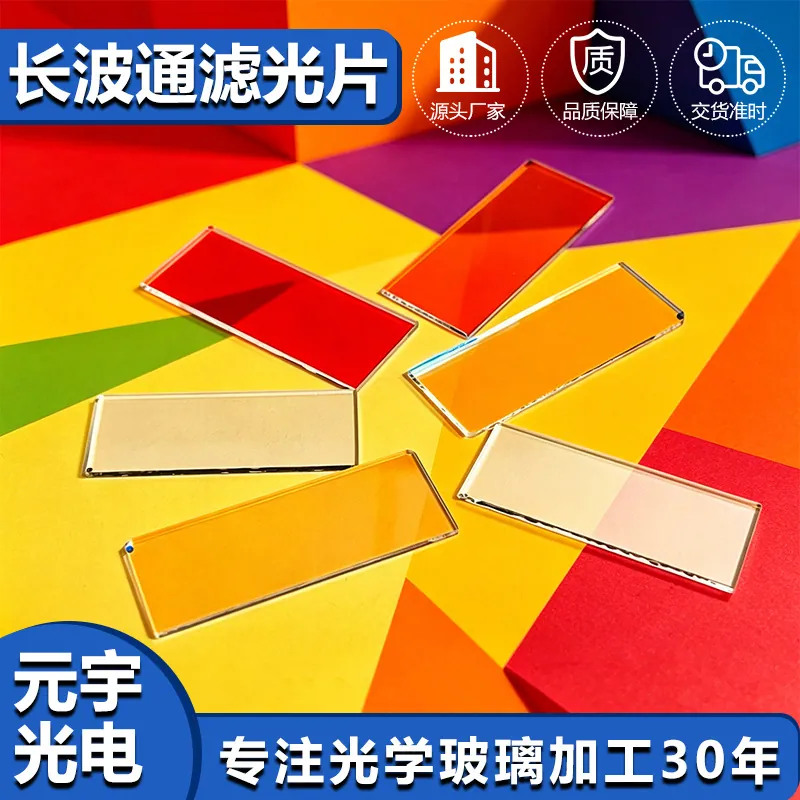
IR Filters in IR Filters for Methane and Volatile-Gas Detection
In an NDIR sensor the filter defines the wavelength the detector sees, so the gas reading is only as selective as the band the filter passes. For methane the line near 3.3 micrometres sits in a region where substrate choice and coating edge sharpness both matter, and a neighbouring volatile organic can be read on an adjacent line with its own filter. The filter is the spectral selector, so its band and blocking are the measurement.
Substrate and material selection
The substrate has to transmit at the gas line, which for methane and many VOCs points to a fluoride or chalcogenide-type IR material rather than visible glass that simply does not pass 3 micrometres. The choice trades transmission, hardness and cost, and sets the coating design the edge needs. Pick the substrate for the wavelength first, then let the band drive the stack.
What drives cost and lead time
Cost and lead time are set by the IR substrate and by how tight the band and the out-of-band blocking must be, because a sharp edge and deep blocking mean more layers and a longer coat. A standard line filter on a standard substrate ships quickly, while an exotic blocking or a custom centre wavelength is a longer cycle. Specifying the band no tighter than the gas line needs keeps both down.
The tolerances that actually matter
For a gas filter the centre-wavelength position and the edge slope control which absorption line is isolated, and the out-of-band blocking sets the detection floor by rejecting everything else. Surface quality matters less than in imaging, but the band must sit on the line across the device's temperature range or the reading drifts. The tolerances that matter are the spectral ones, not the cosmetic finish.
How it compares with the alternatives
Compared with a grating or a Fabry-Perot tunable selector, a fixed IR bandpass filter is cheaper, smaller and more rugged but locked to one line, which is exactly right for a single-gas or few-gas NDIR. Compared with a broadband detector with no filter, the bandpass is what gives selectivity at all. The right choice is the cheapest filter whose band sits on the line with blocking low enough for the required detection floor.
Requirements specific to IR Filters for Methane and Volatile-Gas Detection
Gas duty puts the band position and the out-of-band blocking on the detection path, so those lead the specification. Choose the IR substrate for the line, place the centre wavelength on the absorption feature, and specify blocking to the detection floor. Treat the filter as the spectral selector, qualified at the device's temperature range.
- Substrate transmits at gas line
- Centre wavelength on absorption line
- Edge slope isolates the line
- Out-of-band blocking to detection floor
- Band stable across temperature
- Cheapest filter meeting selectivity
Framework references: spectral band, centre-wavelength and blocking limits should be stated as design targets verified per batch, and the gas-measurement model framed against the relevant instrument documentation. Environmental declarations such as RoHS are the supplier's to state against the current official text, not to be assumed for a sensor component.
Selection data at a glance
| Parameter | Typical value | Notes |
|---|---|---|
| Substrate | Transmits at line | 3.3 um |
| Band | Centre on line | Select |
| Edge | Sharp slope | Isolate |
| Blocking | To detection floor | Floor |
| Temp | Stable across range | Drift |
| Pick | Cheapest valid | Selectivity |
Frequently asked questions
Why can't I use a visible glass filter for methane?
Because methane absorbs near 3.3 micrometres, far beyond where ordinary optical glass transmits; the filter would pass no light at the line at all. An IR substrate such as a fluoride or chalcogenide-type material is needed just to get the wavelength through.
What sets the detection floor?
Mostly the out-of-band blocking. If light outside the gas line reaches the detector, it adds a background the absorption change has to rise above, so deeper blocking lowers the floor. The centre-wavelength position and edge sharpness decide which line is isolated in the first place.
Does the filter need to be temperature stable?
Yes for a field gas sensor. The band shifts with temperature, and if it drifts off the absorption line the reading changes even when the gas concentration does not. Verifying the transmission at the device's temperature range is what tells you the band stays on the line.
Need a quotation for ir filters?
Send your drawing, target specification or coating requirement and an optical engineer will reply within 24 hours with a price and a lead time.
Request a Quote Email an engineer