Spectrometers and analytical instruments use IR filters to define the spectral windows the detector sees, and the demands on those filters keep tightening as instruments move from the bench to the field. The trend is toward broader useful bands, deeper blocking outside the band, and filters that hold their position as the device is miniaturised and heated, which changes how the parts should be specified and sourced.
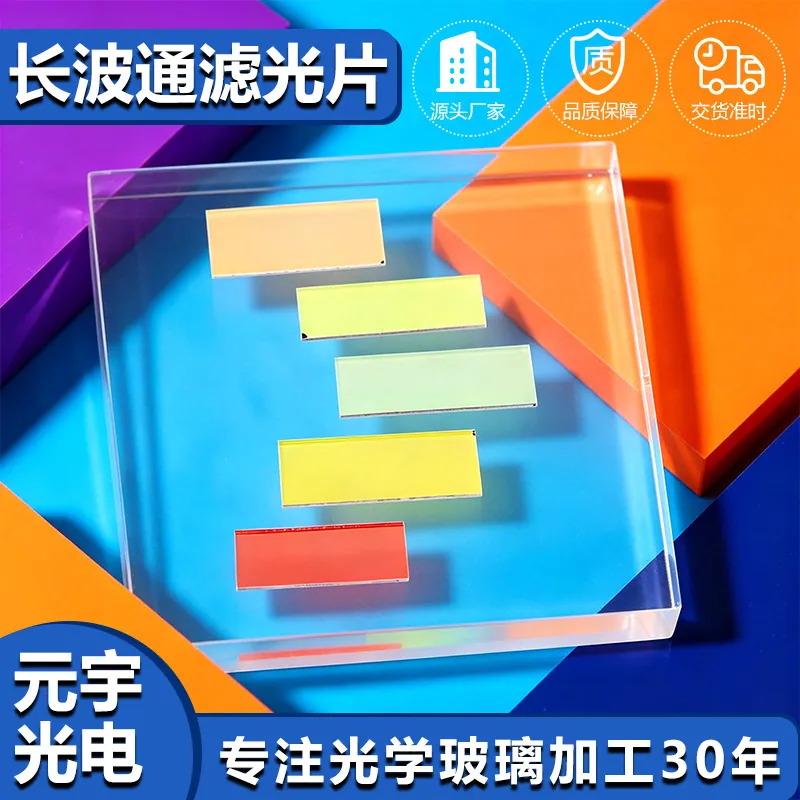
IR Filters in Spectroscopy and Analytical Instruments
In a spectrometer the IR filter sets the boundary of the measured band, whether as a long-pass that removes visible and near-IR scatter or as a band-pass that isolates a specific absorption feature. The detector is blind outside the filter's pass band, so the filter, not the grating or the sensor, often defines the true measurement edge. As instruments are asked to measure more species or wider concentration ranges, the filter has to pass a broader window while still suppressing the stray light and the second-order signals that would corrupt the baseline. That combination of wider band and deeper blocking is the central design pressure in current analytical instruments.
What drives cost and lead time
Cost and lead time are driven by the coating complexity and the substrate. A simple long-pass with a soft edge is cheap and fast; a steep, deep-blocking band-pass across an extended IR range needs many more layers and a more careful deposition, which lengthens the run and raises the reject rate. Substrate choice matters because some IR-transmitting glasses are costly and have long mill lead times, while a common silicate or a thin-film on a standard window is quicker. Custom sizes and non-standard physical outlines add edging and fixturing, and any requirement for a measured spectral curve per part rather than per lot extends both the schedule and the price.
How IR filters works in practice
In practice the filter is mounted in a wheel, a slider or a fixed position ahead of the detector, and its band defines the measurement window the firmware expects. Because the filter is the spectral gate, its edge position and blocking depth directly set the baseline noise and the cross-talk between adjacent spectral channels. The filter also shifts its band with temperature and, for interference stacks, with incidence angle, so a bench instrument with stable temperature behaves differently from a handheld left in a warm pocket. The practical design rule is to specify the filter against the real operating temperature and angle of the instrument, not against the nominal room-temperature, normal-incidence values printed on a datasheet.
Design rules that reduce cost
Cost falls when the band is specified no tighter than the measurement needs. A steeper edge than necessary adds layers and rejects; a blocking depth deeper than the instrument's stray-light budget wastes deposition. Standardising on a small set of catalogue bands across a product family lets the same filter be bought in volume, and fixing the physical size to a stock square or disc avoids custom edging. Where the instrument already controls illumination tightly, a softer-edged colour-glass or coated-glass IR filter can replace a hard multilayer at a fraction of the cost, provided the band shape still meets the analytical requirement.
Standards, documentation and traceability
For analytical instruments the documentation is part of the product, not an afterthought. Each filter should ship with a measured spectral curve and a statement of the edge, peak and blocking values, traceable to the lot and ideally to the individual part for regulated applications. The coating's environmental rating, its shift with temperature and its cleaning compatibility should be recorded so the instrument designer can predict drift over the product life. Batch-to-batch consistency matters because a fleet of field instruments is calibrated once against a reference, so the filter tolerance has to be held tightly enough that calibration survives part variation.
Requirements specific to Spectroscopy and Analytical Instruments
A spectrometer or analytical instrument adds band shape, baseline stability and regulatory traceability to the usual IR-filter requirements. Specify the edge steepness and blocking depth against the instrument's actual stray-light budget rather than over-building the stack, fix the band to the real operating temperature and angle, and require a measured spectral curve per lot or per part. Standardise on a few catalogue bands across the family to hold cost and lead time, and record the coating's environmental and thermal behaviour so field calibration stays valid across the fleet.
- Band edge and blocking set against the stray-light budget
- Filter specified against real temperature and angle
- Measured spectral curve required per lot or part
- Few standard bands shared across the product family
- Environmental and thermal shift recorded for calibration
Framework references: optical coating spectral and environmental performance is commonly described using the terminology in ISO 10110 for substrate quality and established interference-coating conventions for band edges; regulated analytical instruments may also need to align filter documentation with the instrument's own quality system. Edge, blocking and shift values should be confirmed against the current issue of the applicable standard and the instrument's illumination and calibration plan.
Selection data at a glance
| Parameter | Typical value | Notes |
|---|---|---|
| Band shape | No tighter than needed | Layers and cost |
| Blocking | To stray-light budget | Baseline noise |
| Substrate | Common IR glass first | Lead time |
| Operating point | Real temp + angle | Band stability |
| Documentation | Measured curve per lot | Fleet calibration |
| Size | Stock square or disc | Avoids edging |
Frequently asked questions
Why does my handheld spectrometer drift from the bench unit?
Usually the IR filter's band shifts with temperature and incidence angle. The bench unit sits at a stable temperature and normal incidence, while a handheld warms in use and may tilt the filter. Specify the filter against the real operating point rather than room-temperature nominal values.
Do I need the deepest possible blocking?
Only to the level your stray-light budget demands. Blocking deeper than necessary adds deposition layers, raises cost and extends lead time without improving the measurement, so set the depth from the instrument's own baseline requirement.
Can I use a colour-glass IR filter instead of a multilayer?
Where the illumination is tightly controlled and a softer edge is acceptable, yes, and it is far cheaper. Choose a hard multilayer only when you need a steep edge or a specific narrow band that glass cannot provide.
Need a quotation for ir filters?
Send your drawing, target specification or coating requirement and an optical engineer will reply within 24 hours with a price and a lead time.
Request a Quote Email an engineer