Two quotations for the same IR filters part in thermal imaging and night vision can differ by a factor of three, and the reason is rarely the material. This article breaks down the real cost drivers - tolerance, finishing operations, inspection level and batch size - and shows which specification changes save money and which only look as though they should.
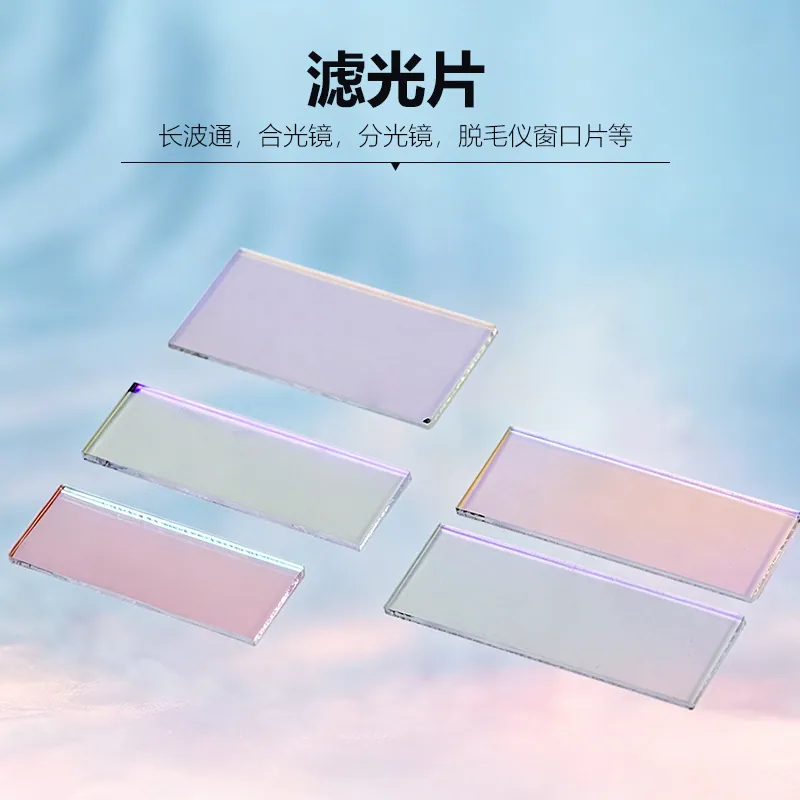
IR Filters in Thermal Imaging and Night Vision
In thermal imaging and night vision, that translates into a specific set of requirements rather than a general preference for quality. Long-wave infrared systems work in a band where ordinary glass is opaque, which pushes designs toward germanium, silicon, sapphire, zinc selenide and chalcogenide materials. These substrates behave quite differently from visible-light glass: some are soft, some are thermally sensitive, and they require diamond turning or specialised polishing rather than conventional finishing.
Substrate and material selection
The substrate decides transmission, thickness and durability. B270 and D263T borosilicate are the standard carriers for camera and sensor windows: clear, dimensionally stable, and thin enough to laminate or to fit behind a lens. Absorptive blue glass is used where the NIR must be removed without an angle-dependent coating, and it can also be combined with a dichroic layer to sharpen the edge. Sapphire enters when the window must resist abrasion - handheld devices and outdoor instruments - and its hardness also brings a wider transmission band, out to about 4.5 micrometers. In Thermal Imaging and Night Vision, the substrate is usually specified together with the cut-on wavelength, because the two interact: a dichroic edge deposited on a substrate with some intrinsic NIR absorption will read further blue than the same stack on clear glass.
Handling, cleaning and packaging
The dichroic surface is both the optical function and the most vulnerable part of the component. Handle by the edge, never wipe dry, and clean only with the approved process: neutral detergent, cascaded deionised water rinses, then an alcohol or nitrogen dry. Fingerprints etch a hard oxide layer over time and create a permanent localised transmission dip that cannot be polished out. Storage uses particle-free interleaves and never stacks two coated faces together. Because the coating is a stack of thin layers, it is also sensitive to mechanical impact at the edge, so a chamfer is standard. In Thermal Imaging and Night Vision, the assembly process deserves equal attention: adhesives that outgas, or a potting compound that cures with shrinkage, can both shift the spectrum of a well-made part.
The tolerances that actually matter
An IR filter is specified by its curve, so the tolerances that matter are spectral. A typical commercial part holds the cut-on wavelength to plus or minus five nanometers and the visible transmission to within a few percent of nominal; precision imaging parts tighten the wavelength to two nanometers and also constrain the slope of the transition. All of these numbers are only meaningful at a stated angle of incidence, and the acceptance angle belongs on the drawing next to the spectral tolerance. Mechanical tolerances follow the mounting: thickness to plus or minus 0.02 mm for a drop-in window, outline to plus or minus 0.05 mm, and a chamfer on every edge. In Thermal Imaging and Night Vision, the specification most often forgotten is the permitted variation of color across the aperture, which is what a user actually notices when a wide lens produces a green frame edge.
What drives cost and lead time
Layer count is the main cost lever. A simple IR-cut stack is a routine chamber run; adding a broadband AR on the second surface, a hydrophobic top layer, or tightening the transition from 30 nm to 10 nm each adds chamber time, increases sensitivity to layer thickness error and reduces yield, so prices rise faster than the layer count suggests. Substrate grade and thickness matter less than expected, except for sapphire, which is materially more expensive in every respect. Size is the second lever: parts that fit comfortably inside the chamber's uniform zone cost far less per unit than parts that must be positioned at the edge, where thickness uniformity degrades. In Thermal Imaging and Night Vision, the cheapest real saving usually comes from relaxing the angle specification rather than from changing the material.
Requirements specific to Thermal Imaging and Night Vision
In thermal imaging and night vision, that translates into a specific set of requirements rather than a general preference for quality. Long-wave infrared systems work in a band where ordinary glass is opaque, which pushes designs toward germanium, silicon, sapphire, zinc selenide and chalcogenide materials. These substrates behave quite differently from visible-light glass: some are soft, some are thermally sensitive, and they require diamond turning or specialised polishing rather than conventional finishing.
- Transmission across 8 - 14 micrometers
- Low thermal defocus across the operating range
- Hard carbon or DLC coating for durability
- Athermalised mounting for germanium elements
MIL specifications for IR coatings and surface quality, ISO 10110 drawings adapted for IR materials, and defense-related qualification protocols.
Selection data at a glance
| Parameter | Typical value | Notes |
|---|---|---|
| IR-cut cut-on | 630-700 nm | Tuned to the sensor response |
| Visible transmission | T ≥ 90 %, R ≤ 1 % | Average 420-620 nm |
| NIR blocking | OD2 - OD4 (1 % - 0.01 %) | 700-1100 nm |
| Edge steepness | 10-30 nm transition | Dichroic designs |
| Angle of incidence | 0-30 deg specified | Passband shifts blue with angle |
| Wavelength tolerance | ± 5 nm standard, ± 2 nm precision | Measured at stated AOI |
| Substrate | B270, D263T, blue glass, sapphire | Absorptive option removes NIR without angle shift |
| Thickness | 0.3-3 mm | 0.55 - 1.1 mm typical for camera windows |
| Environmental | Humidity, salt spray, abrasion tested | MIL-C-48497 / MIL-PRF-13830B |
Frequently asked questions
Do the filters pass humidity and salt spray testing?
Ion-assisted hard oxide coatings do. Every shipment can include humidity, adhesion, abrasion and salt spray results, and the parts are routinely qualified against MIL-style test methods when the application requires it.
Can you supply the filter laminated to a sensor window or a cover glass?
Yes, coating on thin substrates down to 0.3 mm allows direct lamination or bonding. State the adhesive or bonding method at quotation so the coating stress and the assembly thermal cycle can be considered together.
How tight can the wavelength tolerance be?
Plus or minus five nanometers is routine and plus or minus two nanometers is achievable on precision imaging parts. Tighter than that usually requires sorting parts by measurement, which raises cost sharply.
Need a quotation for ir filters?
Send your drawing, target specification or coating requirement and an optical engineer will reply within 24 hours with a price and a lead time.
Request a Quote Email an engineer