Thermal cameras and flame or fire detectors rely on long-wave infrared filters whose spectral and environmental traceability decides whether the detector sees the signal or the background. Inspection and documentation are the whole job here, because a filter that drifts a few percent in blocking can turn a working alarm into a silent one.
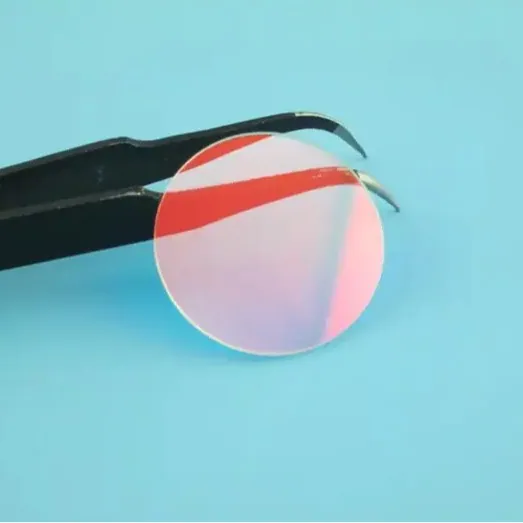
IR Filters in Thermal Imaging and Fire Detection
A thermal camera or a flame detector isolates its band with a long-wave infrared filter that passes the target radiation while rejecting the solar and ambient background. For a fire detector the band is chosen so flame or hot-gas emission stands out against the environment, and for a thermal camera the filter defines the detector's usable band. Because the detector is broadband and blind to colour, the filter is doing the spectral selection that the sensor cannot, and its out-of-band blocking is what keeps the reading honest.
Inspection and measurement
Inspection covers the spectral transmission curve with its cut-on and cut-off, the centring and surface quality, the flatness where the filter lies in the imaging path, and the coating adhesion. The curve is measured on the actual substrate, not on a coupon, because thin-film shift with substrate and angle is real. A pass is a curve in the record, not a visual okay.
Standards, documentation and traceability
The documentation is the product. Each filter type ships with its spectral specification, the environmental rating, a batch spectral curve, and the traceability of the measurement itself so the numbers are defensible. The cut-on wavelength is stated explicitly, and any angle or temperature dependence is on file, because a detector built to the wrong cut-on fails in the field in a way that looks like an electronics fault.
Common failure modes and how they show up
The failures that reach the field are coating delamination after humidity or thermal cycling, a spectral shift from angle or temperature, a mechanical seal failure that lets moisture into the detector, and scratches on an exposed filter. Delamination shows as a patchy transmission loss; a seal failure shows as a rising noise floor as the detector window fogs from inside.
Handling, cleaning and packaging
Infrared substrates such as germanium, zinc selenide, silicon and sapphire are sensitive to the wrong cleaning solvent and to scratches, and they are easily charged, so handling is by the edge with approved solvents and static-safe packaging. Anti-reflective layers are specified where the substrate's own reflection would cost signal, and the cleaning method is part of the specification rather than left to the bench.
The tolerances that actually matter
The numbers that change the result are the cut-on and cut-off wavelength tolerance, the optical density in the blocking band, the surface flatness where the filter is imaged, and the centration. Interference IR filters shift with angle, so the f-number the detector imposes belongs in the tolerance, and a filter specified only at normal incidence will drift on a fast optic.
Requirements specific to Thermal Imaging and Fire Detection
Thermal imaging and fire detection add a detector-matched cut-on, high out-of-band optical density to reject solar and ambient background, and environmental sealing against humidity to the usual filter requirements. For flame detection the spectral response has to be fast and matched to the emission bands of interest, and every filter should ship with its batch spectral curve and environmental rating so a replacement reproduces the original behaviour.
- Cut-on wavelength matched to the detector band
- High optical density in the out-of-band (solar and ambient rejection)
- Environmental sealing and coating adhesion
- Batch spectral curve and traceability
Framework references: ISO 10110 for optical and surface quality. Environmental sealing and substrate choice (germanium, zinc selenide, silicon, sapphire) follow the detector's band and the facility's environmental file; confirm the current issue of the relevant standards before release.
Selection data at a glance
| Parameter | Typical value | Notes |
|---|---|---|
| Cut-on | Detector-band specific | LWIR example |
| Blocking OD | ≥ 3-4 typical | Background reject |
| Substrate | Ge / ZnSe / Si | Band-matched |
| Flatness | λ/4 where imaged | ISO 10110 |
| Sealing | Humidity-proof | Detector safe |
| Traceability | Batch spectral | Reproducible |
Frequently asked questions
Why block so much out-of-band?
Thermal detectors see a broad infrared band, so without high optical density in the solar and ambient bands the background overwhelms the small signal you are trying to read.
Do infrared filters shift with angle?
Yes, interference filters do, so the design has to account for the optic's f-number or tolerance for the shift it introduces.
Can I clean a germanium filter with alcohol?
Only if the coating is rated for it. Confirm the approved solvent, because the wrong cleaner can damage the anti-reflective layer on an IR substrate.
Need a quotation for ir filters?
Send your drawing, target specification or coating requirement and an optical engineer will reply within 24 hours with a price and a lead time.
Request a Quote Email an engineer