Failures in laser cutting of glass used in agricultural sensing and crop monitoring tend to follow a small number of patterns, and each pattern has a signature. This article walks through the common failure modes, how to tell them apart with measurements rather than guesswork, and the process or design changes that actually remove the root cause.
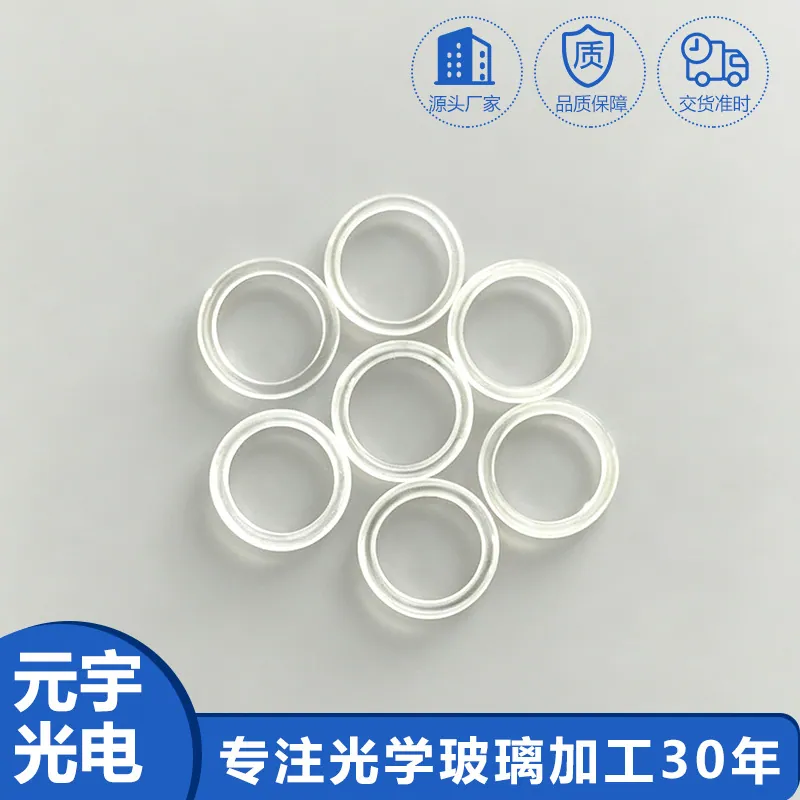
Laser Cutting of Glass in Agricultural Sensing and Crop Monitoring
In agricultural sensing and crop monitoring, that translates into a specific set of requirements rather than a general preference for quality. Agricultural optics live outdoors for a full season or more, exposed to ultraviolet, dust, irrigation spray and temperature swings, and they are usually deployed in numbers large enough that maintenance is impractical. Multispectral and NDVI instruments also depend on precise band separation, because the vegetative index is computed from narrow wavelength differences.
Inspection and measurement
Inspection after laser cutting concentrates on the edge, because that is where the process leaves its signature. A visual check under magnification for chips, cracks and discoloration is the first step; a cross-section or a micrograph confirms the absence of a heat-affected zone and subsurface damage. Dimensional verification uses an optical comparator or a vision system for outline and hole positions, and a profilometer or white-light interferometer for edge roughness and taper. For parts destined for optical coating, cleanliness and outgassing are also checked. In Agricultural Sensing and Crop Monitoring, the useful incoming test is a bend or thermal cycle on a sample from the batch, because edge damage that survives a visual check usually reveals itself under stress.
Coating and deposition considerations
Cutting and coating interact in two directions. First, a laser-cut edge must be clean and free of contamination before coating, because a cracked or heat-damaged edge will outgas in the chamber and produce coating defects around the perimeter. Second, if the part is coated before cutting, most laser processes will damage the coating near the cut line, so coated-then-cut is generally limited to processes where the coating is removed from the cut zone and the edge is subsequently cleaned. For Agricultural Sensing and Crop Monitoring, the reliable sequence is cut first, finish the edge, clean, then coat - and to state in the drawing that the coating covers the optical aperture only, leaving any cut edge bare so that edge preparation is not compromised.
Design rules that reduce cost
Laser cutting rewards drawings that suit the process. Keep cut edges away from optical surfaces, since a cut edge will never have the surface quality of a polished face. Design holes at least one material thickness from the edge and avoid narrow webs that will warp or break during handling. Internal corners should carry radii, because even a laser leaves a stress concentration at a sharp vertex. Where the part will be coated, restrict the coating to the aperture and leave the edge bare. Specify chip size and taper explicitly; if neither is stated, the shop will choose a process that meets the price rather than the application. For Agricultural Sensing and Crop Monitoring, a short note on the drawing about post-cut thermal or mechanical exposure is worth more than any tolerance, because it lets the process be selected correctly the first time.
Common failure modes and how they show up
Laser cutting failures are edge failures. Thermal processing can leave micro-cracks that only propagate later, when the part is thermally cycled or mechanically loaded - a problem that shows up in the field rather than at inspection. Heat-affected zones reduce local strength and can produce a visible discoloration along the cut. Taper that exceeds specification causes fit problems in a slot or a frame. Contamination from the cutting process causes coating pinholes or bond-line defects. In Agricultural Sensing and Crop Monitoring, a part that passes dimensional inspection and fails in service is almost always a part whose edge was cut thermally and never inspected for micro-cracks, which is why the process should be chosen from the service environment rather than from the price list alone.
Requirements specific to Agricultural Sensing and Crop Monitoring
In agricultural sensing and crop monitoring, that translates into a specific set of requirements rather than a general preference for quality. Agricultural optics live outdoors for a full season or more, exposed to ultraviolet, dust, irrigation spray and temperature swings, and they are usually deployed in numbers large enough that maintenance is impractical. Multispectral and NDVI instruments also depend on precise band separation, because the vegetative index is computed from narrow wavelength differences.
- UV-stable coatings for multi-season exposure
- Precise narrow-band definition for vegetation indices
- Hydrophobic surface to shed dew and spray
- Low power consumption for remote installations
IP-rated enclosure compatibility, ISO 10110 drawings, and RoHS and REACH declarations.
Selection data at a glance
| Parameter | Typical capability | Notes |
|---|---|---|
| Cutting methods | CO2 thermal, ultrafast filamentation, scribe and break | Selected by thickness and edge spec |
| Kerf width | 20 - 100 micrometers (ultrafast) | CO2 is wider, water-assisted narrower |
| Edge quality | no micro-cracks with ultrafast, Ra < 1 micrometer | Thermal methods leave a heat-affected zone |
| Thickness range | 0.05-20 mm | Ultrafast preferred below 1 mm |
| Outline tolerance | ±0.05 mm typical, ±0.02 mm on small parts | Complex contours without tooling |
| Edge chips | ≤ 0.02 mm with ultrafast | CO2 needs post-processing |
| Taper | < 5 micrometers per 100 micrometers of depth | Ultrafast, low-taper |
| Set-up cost | none - no hard tooling | Economical from one piece |
| Ideal for | thin glass, tempered glass, complex outlines, wafers | Also drills holes and slots |
Frequently asked questions
Can you cut chemically strengthened glass?
Yes, and ultrafast filamentation is the preferred method because it introduces very little heat and preserves the compressive surface layer better than thermal cutting. Cutting before strengthening is the more robust sequence when the geometry allows.
How accurate is laser cutting compared with machining?
Outline tolerance of plus or minus 0.05 mm is routine and plus or minus 0.02 mm is achievable on small parts, with the significant advantage of no hard tooling. The trade is edge quality: a machined edge can be chamfered and polished, a laser-cut edge is as cut.
Can laser cutting drill holes as well as outlines?
Yes. Holes, slots and internal apertures are all produced in the same pass, with the smallest practical diameter determined by thickness and by the process chosen. Complex internal geometry is one of the main reasons to use a laser.
Need a quotation for laser cutting of glass?
Send your drawing, target specification or coating requirement and an optical engineer will reply within 24 hours with a price and a lead time.
Request a Quote Email an engineer