Two quotations for the same laser cutting of glass part in biometric and fingerprint recognition can differ by a factor of three, and the reason is rarely the material. This article breaks down the real cost drivers - tolerance, finishing operations, inspection level and batch size - and shows which specification changes save money and which only look as though they should.
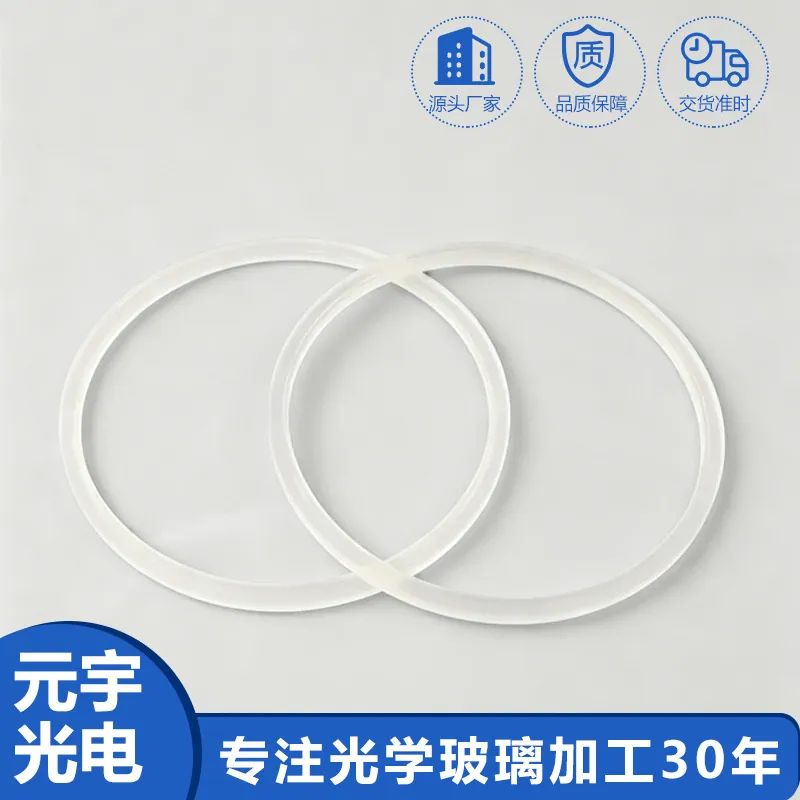
Laser Cutting of Glass in Biometric and Fingerprint Recognition
In biometric and fingerprint recognition, that translates into a specific set of requirements rather than a general preference for quality. Biometric systems must separate the live signal from everything else in the scene, which makes spectral filtering the primary function of the optics. Fingerprint and iris systems work at defined wavelengths, often under near-infrared illumination, and a filter that leaks the wrong band will compromise recognition as surely as a dirty sensor.
Handling, cleaning and packaging
Laser cutting produces parts with a clean edge but no protective chamfer, so the edges are thinner and sharper than a ground edge and chip easily if parts are stacked or poured into a bin. Parts are stored in trays with individual pockets, and any subsequent handling is edge-based. Thermal cutting can leave a very fine dust that must be removed before coating or bonding. Where the cut outline is complex, the parts should be kept in their original sheet until needed, since separating them early multiplies handling events. In Biometric and Fingerprint Recognition, this is the practical reason laser cutting pairs well with thin, fragile, high-value parts: the process removes the mechanical forces, but everything that happens after the cut still has to respect how thin the material is.
The tolerances that actually matter
Laser cutting is specified on outline accuracy, edge quality and taper. Outline tolerance of plus or minus 0.05 mm is routine and plus or minus 0.02 mm is achievable on small parts, without the tooling costs that a machined profile would require. Edge quality is the differentiator: ultrafast cutting produces chips under 0.02 mm and an edge roughness below a micrometer, while thermal methods leave a heat-affected zone that is normally removed by grinding or polishing. Taper, the difference in kerf width between the entry and exit faces, is significant for thick parts and is smallest with ultrafast processing. In Biometric and Fingerprint Recognition, the number that most often decides the process is the permitted edge chip size, since it determines whether the part can be used straight from the laser or needs a finishing step.
What drives cost and lead time
Laser cutting has essentially no tooling cost and a moderate per-part cost, which makes it ideal for prototypes, low volumes and complex outlines that would otherwise need a mold or a machined profile. The per-part cost scales with the total cut length, the thickness and the number of passes, so a large outline with many holes costs more than a simple rectangle of the same area. Ultrafast processing is slower and more capital-intensive than CO2, so it carries a higher rate per meter cut, offset by the elimination of a finishing step. In Biometric and Fingerprint Recognition, the economic crossover usually appears when the number of parts is large enough that hard tooling would amortise, or when the edge specification is loose enough that thermal cutting plus grinding is cheaper.
Substrate and material selection
Different glasses cut differently. Soda-lime and B270 cut easily by any method and are the least sensitive to thermal effects. Borosilicate, because of its low expansion, is more tolerant of CO2 cutting than ordinary glass and is often cut thermally without cracking. Fused silica and quartz absorb less in the visible and are usually processed with ultrafast lasers or with CO2 radiation at the surface. Chemically strengthened glass is the difficult case: the compressive surface layer must be penetrated without relaxing it, which is where filamentation cutting has an advantage over thermal methods, since it introduces far less heat. In Biometric and Fingerprint Recognition, the material often dictates the process more than the geometry does, and specifying a chemically strengthened substrate after the cutting process has been selected is a common and expensive mistake.
Design rules that reduce cost
Laser cutting rewards drawings that suit the process. Keep cut edges away from optical surfaces, since a cut edge will never have the surface quality of a polished face. Design holes at least one material thickness from the edge and avoid narrow webs that will warp or break during handling. Internal corners should carry radii, because even a laser leaves a stress concentration at a sharp vertex. Where the part will be coated, restrict the coating to the aperture and leave the edge bare. Specify chip size and taper explicitly; if neither is stated, the shop will choose a process that meets the price rather than the application. For Biometric and Fingerprint Recognition, a short note on the drawing about post-cut thermal or mechanical exposure is worth more than any tolerance, because it lets the process be selected correctly the first time.
Requirements specific to Biometric and Fingerprint Recognition
In biometric and fingerprint recognition, that translates into a specific set of requirements rather than a general preference for quality. Biometric systems must separate the live signal from everything else in the scene, which makes spectral filtering the primary function of the optics. Fingerprint and iris systems work at defined wavelengths, often under near-infrared illumination, and a filter that leaks the wrong band will compromise recognition as surely as a dirty sensor.
- Tight band-pass or IR-cut definition at the operating wavelength
- Scratch-resistant user-facing surface
- Stable behavior across a wide angle of incidence
- High transmission for low-power illumination
ISO/IEC 19794 context for biometric data quality, ISO 10110 drawings, and RoHS and REACH declarations.
Selection data at a glance
| Parameter | Typical capability | Notes |
|---|---|---|
| Cutting methods | CO2 thermal, ultrafast filamentation, scribe and break | Selected by thickness and edge spec |
| Kerf width | 20 - 100 micrometers (ultrafast) | CO2 is wider, water-assisted narrower |
| Edge quality | no micro-cracks with ultrafast, Ra < 1 micrometer | Thermal methods leave a heat-affected zone |
| Thickness range | 0.05-20 mm | Ultrafast preferred below 1 mm |
| Outline tolerance | ±0.05 mm typical, ±0.02 mm on small parts | Complex contours without tooling |
| Edge chips | ≤ 0.02 mm with ultrafast | CO2 needs post-processing |
| Taper | < 5 micrometers per 100 micrometers of depth | Ultrafast, low-taper |
| Set-up cost | none - no hard tooling | Economical from one piece |
| Ideal for | thin glass, tempered glass, complex outlines, wafers | Also drills holes and slots |
Frequently asked questions
Does laser cutting leave micro-cracks?
It depends on the process. Ultrafast filamentation cutting produces an edge with no micro-cracks and chips below 0.02 mm. CO2 thermal cutting leaves a heat-affected zone and requires edge grinding or polishing if the part will be stressed.
Can you cut chemically strengthened glass?
Yes, and ultrafast filamentation is the preferred method because it introduces very little heat and preserves the compressive surface layer better than thermal cutting. Cutting before strengthening is the more robust sequence when the geometry allows.
How accurate is laser cutting compared with machining?
Outline tolerance of plus or minus 0.05 mm is routine and plus or minus 0.02 mm is achievable on small parts, with the significant advantage of no hard tooling. The trade is edge quality: a machined edge can be chamfered and polished, a laser-cut edge is as cut.
Need a quotation for laser cutting of glass?
Send your drawing, target specification or coating requirement and an optical engineer will reply within 24 hours with a price and a lead time.
Request a Quote Email an engineer