Endoscope illumination has quietly become an LED problem. The xenon lamp that dominated for thirty years is being retired across the board, partly for lifetime and partly because narrowband imaging needs spectral control that a broadband lamp cannot provide without a filter wheel in the light path. The replacement is a light engine with two or three LEDs and a way to put their outputs into one fibre bundle. That way is increasingly a small dichroic combiner.
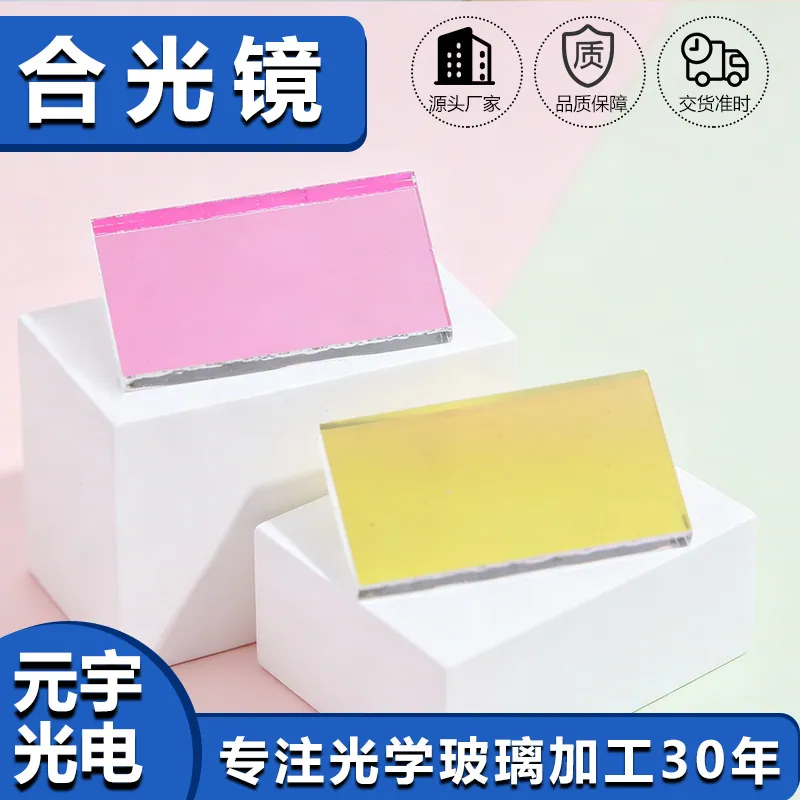
This quarter's product news in the category is not a dramatic breakthrough. It is a set of incremental improvements that, taken together, move the combiner from a custom one-off to a catalogue part: tighter angle tolerance on the coating, substrate options down to 0.5 mm, and autoclave durability demonstrated over hundreds of cycles.
Why three channels
White illumination from LEDs is usually produced either by a blue emitter with a phosphor layer or by combining red, green and blue emitters. The phosphor route is cheap and has good colour rendering, but it cannot produce the narrow 415 nm band that narrowband imaging relies on to highlight vascular structure. The combined route can, at the cost of three emitters, three collimators and two combiners.
A typical layout puts a 415 nm violet LED and a 530 nm green LED on either side of a combiner that reflects one and transmits the other, then a second combiner that adds a 620 nm red channel. The output is coupled into a fibre bundle with a 1 to 3 mm active diameter, which means the combiners themselves are 4 to 8 mm on a side. At that scale, the mechanics dominate the optics: a 1 degree angular error over a 30 mm optical path moves the beam by half a millimetre, which is a large fraction of the fibre core.
What autoclaving does to a coating
Reusable endoscopes are steam-sterilised at 134 degrees C for 18 minutes, and a device may see 500 of those cycles over its life. That environment is hostile to optical assemblies in three ways. The thermal excursion loads every bond line. The steam attacks any water-soluble residue left from cleaning. And the repeated condensation and evaporation cycle can drive moisture into interfaces that were dry at assembly.
For a dichroic combiner, the practical consequences are delamination at the coating-substrate interface, haze from moisture in the cement layer, and a slow shift in centre wavelength as the coating densifies. Suppliers address them with dense oxide coatings deposited by ion-assisted or sputtering processes rather than evaporated stacks, with substrate edges that are polished and sealed, and with adhesives qualified for the full cycle count rather than a single autoclave run.
The number to ask for is not "autoclavable" but "500 cycles at 134 degrees C with transmission change below 1 percent and no visible delamination". Those are very different claims.
The new part, in specification terms
The combiner now available in this class is a cube or plate assembly with the following envelope. Band edge at 500 nm for the violet-green pair and at 580 nm for the red addition, both specified at 45 degrees incidence with a tolerance of plus or minus 1.5 degrees. Transmission above 95 percent in the passband and reflectance above 95 percent in the stopband, measured at the working angle rather than at normal incidence. Substrate in borosilicate or fused silica, 0.5 to 1.0 mm, with a wedge below 2 arc minutes so that the transmitted beam does not walk as the assembly heats.
Physically, the parts run from 4 by 4 by 4 mm up to 10 by 10 by 10 mm, with the option of a cemented cube or two separate plates in a machined holder. Coating durability is specified to withstand 500 autoclave cycles, and the assembly is qualified for repeated cleaning with the alcohol-based wipes common in sterile processing.
Where the design still needs work
Two issues remain open in most programmes. The first is thermal: an LED die dissipates 1 to 3 W within a few millimetres of the combiner, and the resulting gradient across a 5 mm cube bends the transmitted wavefront enough to change the illumination profile at the fibre. Copper mounting and a thermal path through the holder, rather than through the glass, are the usual mitigations.
The second is colour consistency. LED bins vary, and a combiner with a sharp edge will transmit a slightly different spectrum from each bin. Systems that rely on a fixed white point need either tight binning or a feedback photodiode, and the optical design should leave room for the latter.
Commercials
Minimum order quantities for a coated combiner in this size class start in the low hundreds for a catalogue specification and drop for a drawing that is already qualified. Lead time for a first article runs four to six weeks, with the coating and the cementing as the two scheduling constraints. Custom band edges are available on the same substrate envelope, and the practical limit is the edge steepness: a 15 nm transition at 45 degrees is routine, a 5 nm transition requires a design study and a thicker stack.
For light engine designers, the significance is less about any single number than about availability. A combiner that can be bought as a specified part, with autoclave data and a repeatable angle tolerance, removes a custom optics programme from the development schedule. In a market where endoscope lifetimes are shortening and narrowband modalities are proliferating, that is the part of the announcement that matters.
Product page: miniature dichroic combiners — specifications, coating options and lead times.