Specifying lens protection windows for aerospace and defense optics is largely a matter of deciding which three numbers actually govern the application and letting the rest follow. This guide walks through the parameters that belong on the drawing, the tolerances that genuinely change the price, and the specification items that are routinely left out and then argued about at first article.
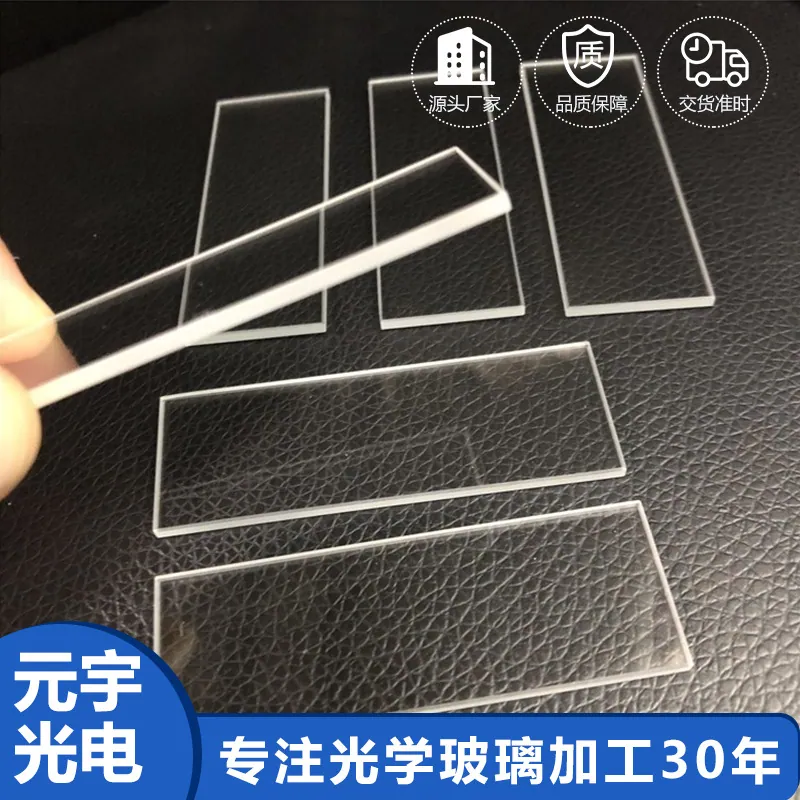
Lens Protection Windows in Aerospace and Defense Optics
In aerospace and defense optics, that translates into a specific set of requirements rather than a general preference for quality. Aerospace optics are qualified against thermal vacuum, vibration, shock and radiation environments, and once qualified they are difficult to change, which makes documentation and reproducibility the dominant requirement. Weight is critical, coatings must survive without moisture uptake, and every part carries a certification trail.
How lens protection windows works in practice
A lens protection window is the transparent barrier between a lens or sensor and the outside world. Its job is to keep water, dust, salt, fingerprints and impact away from the optical surfaces behind it while changing the light as little as possible. That sounds trivial and is not: every extra surface introduces reflection, every coating introduces scatter, and every mechanical mounting decision changes the wavefront. The design target is therefore a window that measures at or above the transmission of bare glass while remaining optically neutral, and that survives the environment it is exposed to. In Aerospace and Defense Optics, the window is frequently also the first element of the optical system, so its flatness, thickness uniformity and coating quality are part of the imaging chain rather than generic protection.
The tolerances that actually matter
A protection window is specified on transmission, flatness and thickness uniformity, in that order. Transmission should be quoted with the coating: above 98 percent is normal for dual-sided AR in the visible. Flatness and parallelism matter because the window sits in the imaging path - a wedge steers the beam, and a curved surface shifts the focal plane, so a few arcminutes of wedge can be significant in a long focal length system. Thickness tolerance matters for the same reason and also for sealing. Haze is a separate specification and should never be left implicit, because a coated part with excellent transmission and one percent haze looks like a dirty lens. In Aerospace and Defense Optics, add a required abrasion resistance and, where relevant, a water contact angle for hydrophobic coatings.
Design rules that reduce cost
Design decisions center on exposure and mounting. Decide what the window will meet - rain, salt, sand, cleaning chemicals, a gloved hand - and pick substrate and coating accordingly. Keep the optical aperture inside the coated area and leave a clear, uncoated margin of 0.5 to 1 millimeter for gaskets and adhesives so that sealing pressure never sits on a coating. Specify the chamfer. If the window also carries an IR-cut or bandpass function, confirm that the coating is deposited on the correct face, since reversing front and back is a classic first-article error. In Aerospace and Defense Optics, the aim is a part that is optically invisible and mechanically unremarkable, which is exactly what makes it easy to specify badly.
Coating and deposition considerations
The standard coating is a broadband anti-reflective layer on both faces, tuned to the sensor band rather than to the visible alone. That detail matters more than it appears: a visible-only AR coating on a window in front of an 850 nm illuminator will reflect the illumination back into the system and produce flare. Beyond AR, functional layers are usually added - a hard outer layer for abrasion, a hydrophobic and oleophobic top layer so that rain and fingerprints shed rather than smear, and sometimes an anti-static layer to reduce dust attraction. Many protection windows also carry a functional coating on the inner face, most commonly IR-cut, which lets one part do two jobs. In Aerospace and Defense Optics, the combination that gives the best field reliability is usually dual-sided AR plus a hydrophobic topcoat on a sapphire or hard-coated borosilicate substrate.
Substrate and material selection
Substrate choice follows exposure. B270 and ultra-clear float glass are adequate for indoor equipment and protected outdoor installations. Borosilicate adds thermal stability for parts exposed to sunlight or heat. Sapphire is the choice when the surface will be touched, dragged or abraded, and it also transmits further into the infrared, but it costs several times more and is harder to finish. Quartz appears where the spectral band reaches into the ultraviolet. Thickness is a mechanical decision with an optical consequence: thicker windows resist impact and sealing pressure better, but they add mass, cost and thermal inertia, and on a fast optical system they can shift focus. In Aerospace and Defense Optics, the most common specification error is using float glass where the part will be exposed to abrasion, and the most common cost error is using sapphire where nothing will ever touch it.
Requirements specific to Aerospace and Defense Optics
In aerospace and defense optics, that translates into a specific set of requirements rather than a general preference for quality. Aerospace optics are qualified against thermal vacuum, vibration, shock and radiation environments, and once qualified they are difficult to change, which makes documentation and reproducibility the dominant requirement. Weight is critical, coatings must survive without moisture uptake, and every part carries a certification trail.
- Thermal vacuum and vibration survival
- Low weight with high specific stiffness
- Coating stability with no moisture shift
- Full first-article and process documentation
AS9100 quality systems, MIL specifications for coatings and surface quality, and customer-specific environmental qualification protocols.
Selection data at a glance
| Parameter | Typical value | Notes |
|---|---|---|
| Transmission | T ≥ 98 % with dual-sided AR | Per the sensor band |
| Substrate | B270, borosilicate, sapphire, quartz | Sapphire for abrasive environments |
| Thickness | 0.3-5 mm | 0.5 - 1.1 mm typical for camera windows |
| Haze | ≤ 0.2 %, typically ≤ 0.05 % | Critical for imaging |
| Hardness | 9H pencil, 0000 steel wool pass | Hard oxide or sapphire |
| Water contact angle | >= 100 deg with hydrophobic layer | Rain and fingerprint shedding |
| Environmental | salt spray, 85/85 humidity, UV, -40 to +105 °C | Grade depends on exposure |
| Outline tolerance | ± 0.05 mm, laser-cut shapes available | Chamfer 0.1 - 0.3 mm |
| Options | IR-cut or bandpass function integrated | One window, two jobs |
Frequently asked questions
Does a protection window degrade image quality?
Not if it is specified properly. Dual-sided AR keeps transmission above 98 percent, and flatness plus parallelism control keeps the window optically neutral. Quality loss usually comes from an uncoated inner face or from a coating band that misses the illumination wavelength.
When is sapphire worth the extra cost?
When the surface will be repeatedly touched, dragged or exposed to abrasive particles, and when the window is a sealed rather than serviceable component. For protected indoor equipment, hard-coated borosilicate is usually sufficient.
Can the window also filter infrared?
Yes. An IR-cut or bandpass coating on the inner face lets a single part protect the lens and shape the spectrum, which saves thickness and assembly steps in compact modules.
Need a quotation for lens protection windows?
Send your drawing, target specification or coating requirement and an optical engineer will reply within 24 hours with a price and a lead time.
Request a Quote Email an engineer