In front of an expensive cinema or broadcast lens sits a disposable idea: a flat protective window that takes the scratches, dust and impacts so the lens does not have to. The trick is that the window must be optically invisible, adding no flare, no colour shift and no distortion. This guide covers how these windows fail, how they are inspected, and the standards and traceability that qualify them.
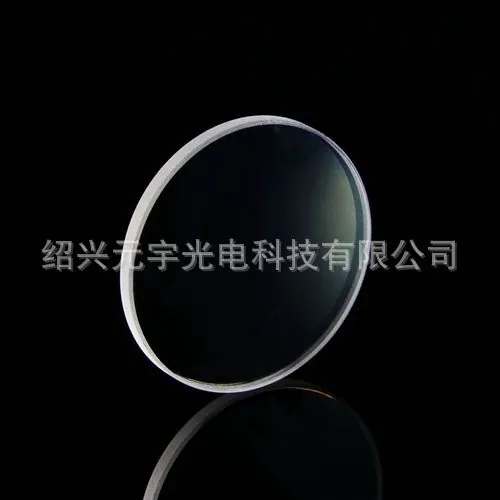
Lens Protection Windows in Cinematography and Broadcast
A protective window is a precision optical flat placed ahead of the lens to absorb the abuse of location and live work: grit, cleaning, the occasional knock. Its job is to add nothing observable while being tough enough to be replaced cheaply. Because it sits in the converging or near-collimated front of a high-resolution, wide-aperture optical system, even a subtle wedge, coating ripple or surface defect becomes visible as flare, softness or a colour cast that no grading can fully remove. The window is therefore specified as an optical element, not a piece of clear plastic.
Common failure modes and how they show up
The obvious one is scratching, which scatters light into a haze and shows directly in highlights. Coating delamination appears as a patchy reflection or a coloured smear that moves with angle. A dirty or degraded anti-reflection coating raises surface reflections that read as low-contrast flare across the frame. Fogging or a trapped schlieren from a poor edge seal shows as a soft region. A wedge or poor flatness in the window introduces a small aberration or focus shift that is hardest to spot because it looks like a slightly soft lens rather than a damaged one.
Handling, cleaning and packaging
These windows are cleaned often, so the handling rules are part of the product. A proper microfibre and an IR- or optical-safe fluid avoid the very scratches and coating damage the window exists to absorb. Solvents that attack the coating must be avoided, and the window should be capped and cased when not in use. Anti-static handling helps because a charged surface pulls dust that scratches on the next wipe. Packaging keeps the surfaces apart and capped so the window arrives clean and stays clean until fitted.
Inspection and measurement
Incoming inspection measures surface defects against a cosmetic standard, flatness and transmitted wavefront because a wedge or irregularity becomes an aberration, and transmission and coating uniformity because a thin or uneven anti-reflection layer flares. Coating adhesion and abrasion are checked against the cleaning the window will actually receive, since a coating that fails after a few wipes is useless on location. Lot traceability ties each window to its coating run so a field failure can be correlated to a batch rather than treated as a one-off.
Standards, documentation and traceability
Cosmetic limits are commonly expressed under a framework such as ISO 10110-7, and military surface-quality documents such as MIL-PRF-13830B are widely referenced in the industry as a familiar framework for scratch-dig. Transmission and coating uniformity are documented per lot, and the coating recipe is recorded so a replacement matches the original. Traceability to the coating run and the substrate melt lets a cinematographer or rental house trust that two windows in a kit behave identically, which matters when lenses are matched across a multi-camera shoot.
Coating and deposition considerations
The anti-reflection design must cover the full visible and usually extend into the near infrared for modern sensors, and it must be spectrally neutral so the window does not tint skin tones or skies. A hydrophobic or anti-smudge topcoat keeps fingerprints and rain from sticking and makes cleaning safer. Low residual reflection is the priority because any surface bounce inside a wide-aperture lens becomes flare or ghosting. The edge of the window is often matte-treated so its own reflection does not enter the frame at wide angle, a detail that separates a proper protective window from a generic flat.
Requirements specific to Cinematography and Broadcast Lens Protection
A cinema or broadcast window is judged by what it does not do: no added flare, no colour shift, no resolution loss across the full sensor bandwidth and into the near infrared. It must survive the cleaning and handling of location and live work, so the anti-reflection coating is qualified for abrasion and solvent resistance, not just peak transmission. The matte edge and neutral AR keep it invisible even at wide angle and with bright sources in frame, and the window is delivered in a capped, anti-static package with lot traceability so matched lenses stay consistent across a production. Because the window is disposable by design, the specification balances optical invisibility against the toughness that lets it be replaced without risking the lens behind it.
- Full visible + NIR AR, spectrally neutral (no skin-tone tint)
- Low residual reflection to avoid flare and ghosts
- Abrasion- and solvent-resistant coating for location use
- Matte edge so its reflection stays out of frame
- Cosmetic + wavefront inspected, lot-traceable
Framework references: cosmetic surface quality under ISO 10110-7, with MIL-PRF-13830B referenced in the industry as a familiar scratch-dig framework; flatness and wavefront under ISO 10110. Confirm the current official text of each applicable standard rather than a single historical value. Substance restrictions (RoHS/REACH) apply as a declaration on the material.
Selection data at a glance
| Parameter | Typical value | Notes |
|---|---|---|
| AR band | visible + near IR | neutral |
| Residual reflect | low, both faces | no flare |
| Coating | abrasion + solvent resistant | location use |
| Edge | matte treated | out of frame |
| Cosmetic | ISO 10110-7 frame | lot traced |
Frequently asked questions
Does a protective window hurt image quality?
A good one is optically invisible: neutral AR across visible and near IR, low residual reflection, and flat enough to add no aberration. A poor one adds flare, a colour cast or softness that grading cannot fully fix.
Why is the edge matte?
A polished edge reflects, and at wide angle that reflection can enter the frame. Matte-treating the edge keeps the window's own bounce out of the shot, which is why it is a feature, not a finish choice.
Why lot traceability for a disposable window?
Because two windows in a multi-camera kit must behave identically. Tying each to its coating run lets a rental house trust that matched lenses stay matched, and a field failure can be correlated to a batch.
Need a quotation for lens protection windows?
Send your drawing, target specification or coating requirement and an optical engineer will reply within 24 hours with a price and a lead time.
Request a Quote Email an engineer