Building-façade and architectural inspection cameras need large protective windows that survive weather, abrasion and repeated cleaning while keeping the image clear. The cost of such a window is set less by the glass itself than by its size, the anti-reflective and hard coatings, and the environmental rating the installation demands. This note separates the cost drivers optical engineers should challenge before releasing a specification for a façade or architectural inspection camera window.
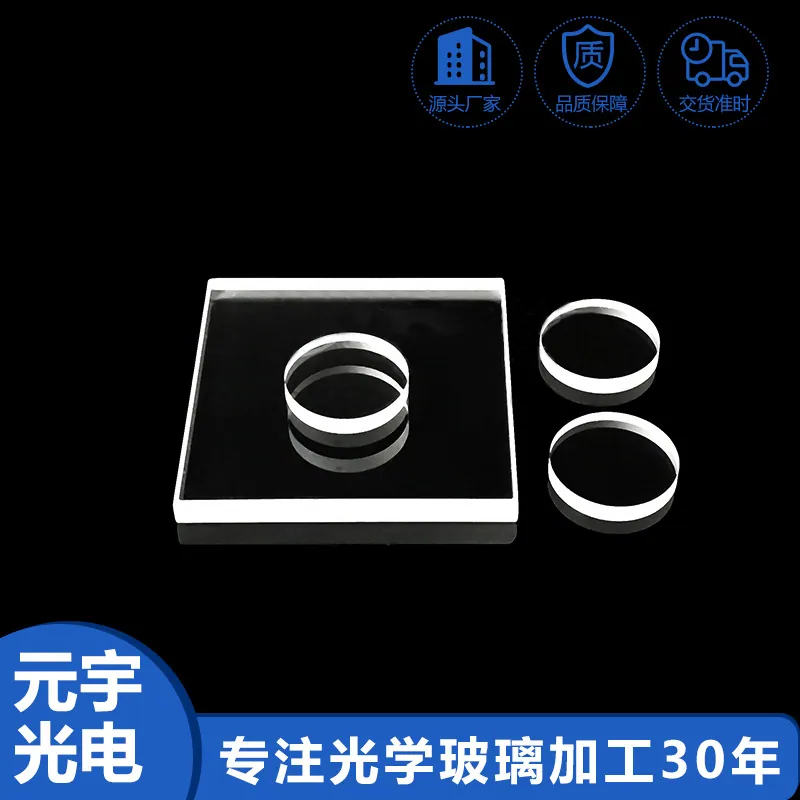
Lens Protection Windows in Building-Façade and Architectural Inspection Cameras
Building-façade and architectural inspection cameras need large protective windows that survive weather, abrasion and repeated cleaning while keeping the image clear. The cost of such a window is set less by the glass itself than by its size, the anti-reflective and hard coatings, and the environmental rating the installation demands. This note separates the cost drivers optical engineers should challenge before releasing a specification for a façade or architectural inspection camera window.
Handling, cleaning and packaging
Large windows are handled at the edges and are easy to chip or to flex enough to crack, so handling fixtures and careful packing dominate the practical cost more than the raw blank. Cleaning before coating must leave no residue or scratch, because a defect on a wide aperture is far more visible than on a small one. Design the part to survive automated handling and specify protective packing, because breakage in transit or on the bench can erase any material saving.
The tolerances that actually matter
For a wide window the optical power of the plate and its wedge matter, because a slight wedge steers the image and a curved face adds defocus across the field. Surface flatness and scratch-dig are held where the image quality demands, but for a protective cover the more decisive figures are the coating uniformity across the large area and the absence of edge chips. Tighten the tolerances that move the picture, and relax the cosmetic limits that do not.
What drives cost and lead time
The dominant driver is aperture size: large blanks mean more material, longer coating runs and a higher breakage rate, all of which add cost and schedule. A double-sided AR plus a hard, cleanable outer layer is the next cost step, and an environmental rating for weather and vandal resistance adds qualification time. The economical window is the smallest aperture and simplest coating stack that still meets the installation's duty, not the largest and hardest-coated part on the shelf.
Substrate and material selection
The substrate has to be stiff enough not to flex in its frame and clear enough not to soften the image. Soda-lime is adequate for benign indoor or short-duty use, while chemically strengthened or borosilicate glass is preferred where impact, thermal swing or outdoor weathering are expected. Choose the grade that matches the exposure rather than the hardest available, because over-specifying the substrate adds cost without improving the picture.
Inspection and measurement
Qualify the window across its full aperture, not at a centre spot: measure transmission and AR residual reflection at several points to confirm coating uniformity, and check wedge and flatness because both shift the image on a wide cover. Inspect the edge for chips under good lighting, since a wide window shows every defect. A part accepted on a centre-spot measurement can still fail in the field where the whole aperture is used.
Requirements specific to Building-Façade and Architectural Inspection Cameras
Façade duty exposes the window to weather, abrasion and frequent cleaning, so coating durability, edge integrity and aperture-uniform AR lead the specification. Choose a substrate graded to the actual exposure, hold wedge and flatness where they move the image, and qualify the part across the full aperture rather than a centre spot. A window specified to the hardest substrate and widest coating it can carry will cost and ship later than one written to the real installation duty.
- Aperture size is the main cost and lead driver
- AR plus hard cleanable coat as needed
- Wedge and flatness held where image moves
- Substrate graded to actual exposure
- Edge chips inspected, wide aperture
- Full-aperture qualification, not centre spot
Framework references: flatness, wedge, scratch-dig and coating uniformity per ISO 10110; environmental and impact rating assessed against the relevant architectural or outdoor-equipment rule set. Environmental declarations such as RoHS are the supplier's to state against the current official text, not to be assumed for a component used in a camera window.
Selection data at a glance
| Parameter | Typical value | Notes |
|---|---|---|
| Aperture | Smallest fit | Cost |
| Coating | AR + hard | Duty |
| Wedge | Held image | Optical |
| Substrate | Graded exposure | Field |
| Edge | Chip free | Wide |
| Qualify | Full aperture | Field |
Frequently asked questions
Why is a large window so much more expensive than a small one?
Because cost scales with more than area: bigger blanks mean more material, longer coating runs, a higher breakage rate in handling and packing, and more qualification time for a uniform coating. The cheapest window is the smallest aperture that still meets the installation's duty.
What tolerance actually moves the picture?
Wedge and flatness. A slight wedge steers the image and a curved face adds defocus across a wide field, while a centre-thick protective window can act like a weak lens. Tighten those where image quality matters and relax cosmetic surface limits that do not.
Why qualify across the whole aperture, not a centre spot?
Because a wide window is used across its entire face, and coating uniformity or a hidden edge chip only shows away from the centre. A centre-spot pass can hide a non-uniform AR or a defective edge that degrades the real image in the field.
Need a quotation for lens protection windows?
Send your drawing, target specification or coating requirement and an optical engineer will reply within 24 hours with a price and a lead time.
Request a Quote Email an engineer