Li-Fi and visible-light communication turn an LED or a photodiode into a data port, and the protection window in front of that port has to pass the visible-light band with minimal loss while shielding the emitter and receiver from dust, moisture and finger contact. Because the window sits in the active optical path, its transmission and surface quality are part of the link budget rather than an afterthought. This guide sets out the numbers that belong on the drawing for Li-Fi and optical-wireless windows.
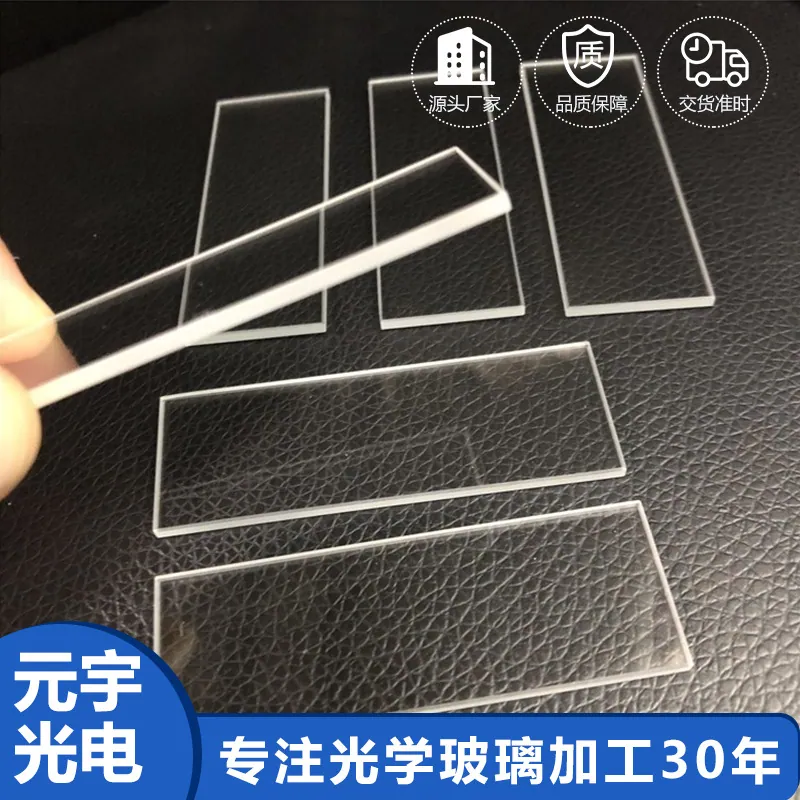
Lens Protection Windows in Li-Fi and Optical Wireless
A Li-Fi access point or a VLC receiver is fundamentally an LED or a photodiode that also has to survive a real room, so it wears a flat window over the optoelectronics. That window is not a passive cover: every percent it reflects or scatters is a percent out of the link budget, and any wavefront distortion it adds matters more on a tightly collimated link than on a broad room-light emitter. The part's job is to protect the device while costing as little optical power as possible, which is why its transmission and figure are specified together with its durability.
How lens protection windows works in practice
In practice the part is a flat, anti-reflective-coated window seated over the emitter or detector, set near-normal to the beam. Its first job is to block dust, moisture and fingerprints from reaching the optoelectronics, and its second is to pass the visible band the link uses with as little reflection as possible. A multi-layer AR stack brings surface reflectance down so the link budget is not silently eaten at both faces, and a hard top surface lets the window be wiped without hazing.
The tolerances that actually matter
For a Li-Fi window the useful numbers are transmission across the visible band and residual reflectance at the link wavelength, plus surface form and parallelism where the window sits in a collimated or imaging path. Surface roughness and haze matter because a scattered surface puts light where the receiver does not want it, and scratch-dig matters where a defect sits in the beam. Mechanically the tolerances that move cost are surface form and edge quality, while flatness alone is less critical on a diffuse room-light link.
Design rules that reduce cost
Two decisions dominate the cost of a Li-Fi window. The first is whether one side or both sides carry the AR layer; single-sided leaves the second face returning about four percent back into the link, which on a power-limited VLC receiver is exactly the loss the coating was meant to remove. The second is bandwidth: a stack tuned only to the visible band is cheaper to qualify and is usually sufficient, whereas a window that also front-ends a near-IR proximity sensor needs that band specified and tested. Keep the stack within the band the link uses, mount with a compliant seal rather than a rigid clamp, and mark the coating face on the drawing.
Coating and deposition considerations
A Li-Fi AR stack is a multilayer dielectric of alternating silica and a higher-index oxide. The difference from a consumer cover is the visible-band emphasis and the durability regime rather than the recipe: the coating has to survive repeated wipe-down and occasional abrasive contact in a public or industrial space. That pushes toward dense oxide layers and a hard top surface rather than a soft anti-glare etch that would haze after a season of cleaning. State clearly whether the pane is coated before or after any sealing, because the two age differently.
Substrate and material selection
For an indoor Li-Fi port, a clear optical glass substrate is the default: hard, stable and cheap. For a rugged or outdoor unit, a coated polycarbonate or a tempered glass may be chosen for impact resistance, at some cost in scratch resistance and surface figure. The trade is durability and weight against optical quality, and the decision follows where the access point is mounted and who can touch it, because a window that survives the environment but scatters the link is the wrong trade.
Requirements specific to Li-Fi and Optical Wireless
Li-Fi duty adds a link-budget sensitivity and a public-durability need to the usual window constraints. Specify reflectance and transmission across the visible band the link uses, qualify the AR stack against the real wipe regime rather than a generic indoor test, and require a hard, non-hazing surface. For rugged units choose the substrate for impact and weight against the optical loss it introduces, mark the coating face on the drawing, and keep a lot record tying each window to its first-article spectral curve so replacements track the original link budget.
- Reflectance and transmission specified across the visible link band
- Coating qualified against the real wipe regime, not a generic test
- Hard, non-hazing top surface for public spaces
- Single- or double-sided AR chosen against link budget
- Substrate chosen for impact and weight against optical loss
- Lot traceability with a first-article spectral curve
Framework references: surface form and surface quality per ISO 10110, and link-budget limits treated under the relevant radio-spectrum and optical-wireless framework rather than as a bulk-optic grade. Where the unit is safety-related glazing, impact classification follows the applicable equipment rule set, and RoHS and REACH declarations depend on the coating stack and are the supplier's to state against the current official text.
Selection data at a glance
| Parameter | Typical value | Notes |
|---|---|---|
| Visible reflectance | <= 0.5 % average | 380-700 nm |
| Transmission at link band | >= 92 % typical | Per LED/PD |
| Surface form | PV <= 0.5 um standard | ISO 10110-5 |
| Substrate | Clear glass or polycarbonate | Per environment |
| Environment | Wipe-down, public | Li-Fi duty |
| Coating face | Documented on drawing | Path-dependent |
Frequently asked questions
Does a Li-Fi window need AR on both faces?
If the link is power-limited, usually yes. A single-sided window returns about four percent from the uncoated face straight back into the budget, which on a VLC receiver that is already struggling for signal is a loss the coating was meant to remove. Double-sided AR is the safer default for receiver windows.
Why not just use a bare LED without a window?
Because the emitter or detector then accumulates dust, moisture and fingerprints that shift the link budget in ways no one can predict or recalibrate for in the field. A window costs a little optical power up front but keeps the link stable over the product's life, which is the trade the specification is making.
Does the substrate choice affect the link?
Yes, on rugged units. Polycarbonate or tempered glass survives impact and reduces weight but scratches and figures less well than optical glass, so a scattered or distorted window can cost link margin. The choice follows where the unit is mounted and who can touch it, balancing durability against the optical loss it introduces.
Need a quotation for lens protection windows?
Send your drawing, target specification or coating requirement and an optical engineer will reply within 24 hours with a price and a lead time.
Request a Quote Email an engineer