Optical encoders and motion-feedback systems read a code disk, a glass scale or a reticle through a protective window that is part of the optical path, not just a dust cover. That window has to hold flatness, low scatter and a clean interface, because any wedge, stress or ghost image lands directly on the position reading. The trade-offs are between substrate, coating and sealing, and they are different from the choices made for a camera that only needs a tough front element.
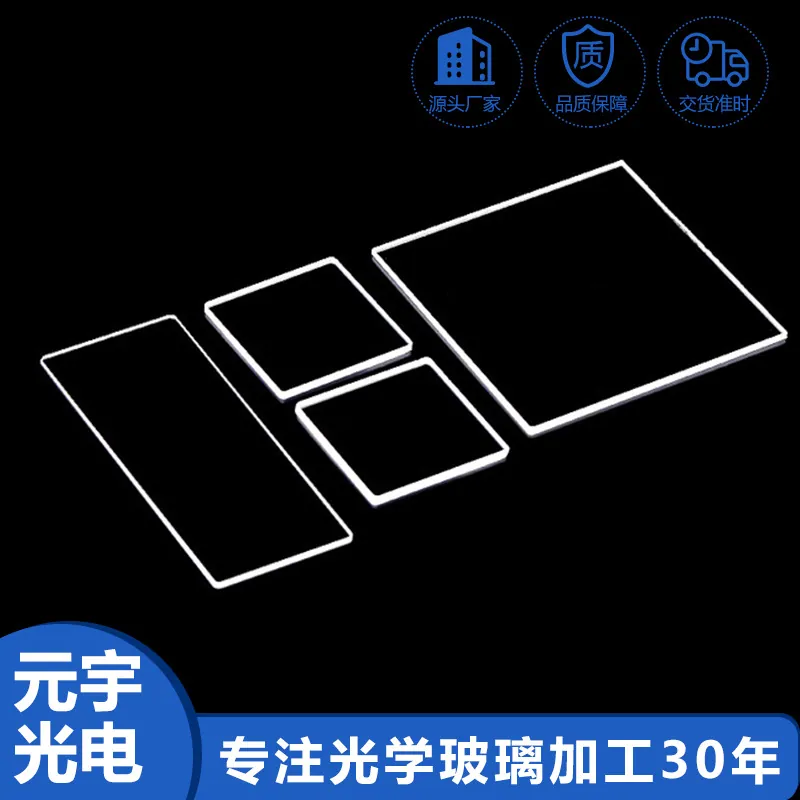
Lens Protection Windows in Optical Encoders and Motion Feedback
In an encoder the window may be the seal over a glass scale, the cover of a rotary disk or a beamsplitter flat inside the read head. Because the light path passes through it twice in reflective scales, even a small wedge or a stressed mount becomes a measured error rather than a cosmetic one. The window therefore sits in the metrology loop, so its flatness, coating and how it is bonded all show up in the reported position, not just in image quality.
What drives cost and lead time
Cost and lead time are driven by substrate grade, flatness tolerance and coating count. Fused silica or a low-expansion glass costs more than crown but removes thermal drift in a precision encoder; a tighter flatness specification multiplies the grinding and testing time; and a dual-sided anti-reflective coat plus an anti-static layer adds deposition steps. Lead time follows the same split, with standard catalog windows available quickly and a strain-free, tight-tolerance part needing a longer queue.
Substrate and material selection
Fused silica is the usual choice where thermal stability and very low intrinsic birefringence matter, because the scale error must not move with temperature on a shop floor. Borosilicate sits in the middle for cost and stability, while sapphire resists abrasion but introduces birefringence that must be managed in a polarized read path. For cost-led encoders a low-expansion crown can be enough if the flatness and coating are specified to match the accuracy class.
How it compares with the alternatives
Against a polymer window, glass wins on scratch resistance and dimensional stability but loses on impact toughness; against sapphire, glass wins on cost and low birefringence but loses on surface hardness; against a metal-tape or reflective scale with no window at all, the window adds a sealed, cleanable interface at the cost of two extra optical surfaces to control. The practical choice tracks the accuracy class: higher classes pay for silica and tight flatness, lower classes stay with coated crown.
Coating and deposition considerations
A dual-sided anti-reflective coat maximises signal at the encoder wavelength, and a hard coat resists the alcohol wipes used during service. An anti-static layer helps in dusty environments by limiting charge that could attract debris onto the scale. If the read path is polarized, the coating and any adhesive must be chosen so they do not add retardance; otherwise the window silently degrades the signal contrast that the decoder depends on.
Requirements specific to Optical Encoders and Motion Feedback
Encoder and motion-feedback applications add tight flatness for scale accuracy, low birefringence for polarized reads, and index-matched sealing so no ghost image appears at the bond line. Specify the window flatness against the encoder accuracy class, require a strain-free material and mount, use an index-matched adhesive at the seal to avoid reflections that the decoder reads as a false edge, and treat the part as ESD-sensitive through handling and packing.
- Flatness tied to encoder accuracy class, not a generic flat spec
- Low intrinsic birefringence for polarized read paths
- Index-matched seal to avoid ghost images at the bond line
- Dual-sided AR plus hard, anti-static surface for service
- Strain-free mount and ESD-safe handling throughout
Framework references: dimensional and surface tolerances for glass components are generally stated in ISO 10110; the flatness and surface grades should be confirmed against the current issue of that standard and against the encoder accuracy class rather than a generic window claim. RoHS and REACH declarations are the supplier's to state against the current official text.
Selection data at a glance
| Parameter | Typical value | Notes |
|---|---|---|
| Substrate | Fused silica or crown | Class-dependent |
| Flatness | Tied to accuracy class | ISO 10110-5 |
| Coating | Dual-sided AR + hard | Signal and wear |
| Sealing | Index-matched adhesive | No ghost edge |
| Birefringence | Low for polarized reads | Signal contrast |
| Handling | ESD-safe through pack | Yield |
Frequently asked questions
Why not just use a sapphire window for an encoder?
Sapphire is harder and more abrasion resistant, but it carries birefringence that can distort a polarized read path, and it costs far more than glass. For most encoders a low-birefringence glass window meets the accuracy class at a fraction of the price, with sapphire reserved for extreme wear points.
What does an index-matched seal actually prevent?
A normal adhesive at the window edge has a different index from glass, so it creates a faint reflection at the bond line. In a reflective scale the decoder can read that reflection as a false edge, adding periodic error. An index-matched adhesive removes the contrast step so no ghost appears.
Does the encoder wavelength change the coating choice?
Yes. The anti-reflective stack is designed around the source wavelength, typically a red or infrared LED, so the two surfaces are tuned to pass that band. A coating tuned elsewhere wastes signal, and on a low-contrast scale that shows up directly as noise on the position read.
Need a quotation for lens protection windows?
Send your drawing, target specification or coating requirement and an optical engineer will reply within 24 hours with a price and a lead time.
Request a Quote Email an engineer