Lens Protection Windows covers a wider range of options than most drawings imply, and the differences between them decide both performance and price. This article compares the practical choices available for robotics and factory automation - substrate, coating process, thickness and tolerance - and shows where each trade-off pays off and where it does not.
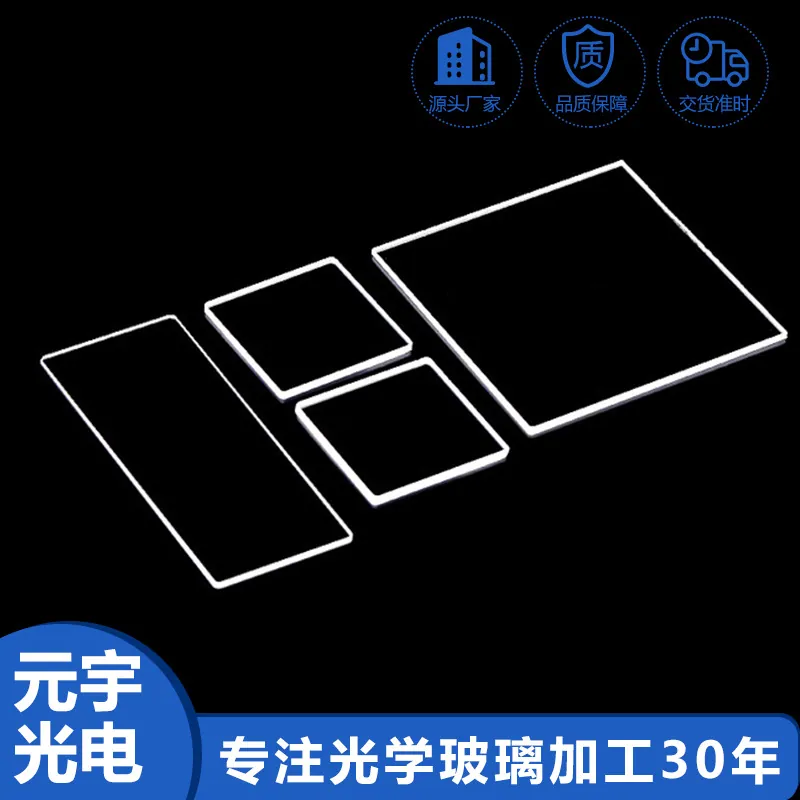
Lens Protection Windows in Robotics and Factory Automation
In robotics and factory automation, that translates into a specific set of requirements rather than a general preference for quality. Robots and automated cells use optical components continuously in environments built for metal, not glass: coolant, swarf, vibration and cleaning chemicals. Sensors and vision windows must survive being wiped, bumped and hosed down, while maintaining the repeatability the control system assumes.
What drives cost and lead time
Cost is dominated by the coating and the substrate, not by the glass area. A dual-sided broadband AR coating typically costs more than the substrate it sits on. Sapphire multiplies the material line and adds finishing time, and functional coatings such as IR-cut on the inner face add another deposition pass. Size matters when the part exceeds the chamber's uniform zone; complex outlines add laser cutting or CNC profiling. In Robotics and Factory Automation, the practical trade is between a cheap coated float glass replaced periodically and an expensive sapphire window that lasts for the life of the product - the right answer depends entirely on whether the window is a serviceable item or a sealed part.
Substrate and material selection
Substrate choice follows exposure. B270 and ultra-clear float glass are adequate for indoor equipment and protected outdoor installations. Borosilicate adds thermal stability for parts exposed to sunlight or heat. Sapphire is the choice when the surface will be touched, dragged or abraded, and it also transmits further into the infrared, but it costs several times more and is harder to finish. Quartz appears where the spectral band reaches into the ultraviolet. Thickness is a mechanical decision with an optical consequence: thicker windows resist impact and sealing pressure better, but they add mass, cost and thermal inertia, and on a fast optical system they can shift focus. In Robotics and Factory Automation, the most common specification error is using float glass where the part will be exposed to abrasion, and the most common cost error is using sapphire where nothing will ever touch it.
How it compares with the alternatives
Alternatives include an uncoated window, an etched anti-glare surface, a molded polymer window and simply leaving the lens exposed behind a mechanical shroud. Uncoated glass is cheap and loses about eight percent of the light; etched glass scatters glare at the cost of transmission; polymer windows are light and impact-resistant but scratch easily and cannot take a hard oxide coating. Leaving the lens bare is viable only in sealed, clean, protected enclosures. For the exposed imaging systems that dominate Robotics and Factory Automation, a coated glass or sapphire window remains the only option that preserves transmission, resists the environment and can carry a functional coating at the same time.
Coating and deposition considerations
The standard coating is a broadband anti-reflective layer on both faces, tuned to the sensor band rather than to the visible alone. That detail matters more than it appears: a visible-only AR coating on a window in front of an 850 nm illuminator will reflect the illumination back into the system and produce flare. Beyond AR, functional layers are usually added - a hard outer layer for abrasion, a hydrophobic and oleophobic top layer so that rain and fingerprints shed rather than smear, and sometimes an anti-static layer to reduce dust attraction. Many protection windows also carry a functional coating on the inner face, most commonly IR-cut, which lets one part do two jobs. In Robotics and Factory Automation, the combination that gives the best field reliability is usually dual-sided AR plus a hydrophobic topcoat on a sapphire or hard-coated borosilicate substrate.
Requirements specific to Robotics and Factory Automation
In robotics and factory automation, that translates into a specific set of requirements rather than a general preference for quality. Robots and automated cells use optical components continuously in environments built for metal, not glass: coolant, swarf, vibration and cleaning chemicals. Sensors and vision windows must survive being wiped, bumped and hosed down, while maintaining the repeatability the control system assumes.
- Impact and abrasion tolerance for a factory floor
- Repeatable optical performance over millions of cycles
- Solvent and coolant resistance
- Compact outline with simple mounting geometry
ISO 10218 context for robotic safety, ISO 10110 drawings, and customer-specific environmental test protocols.
Selection data at a glance
| Parameter | Typical value | Notes |
|---|---|---|
| Transmission | T ≥ 98 % with dual-sided AR | Per the sensor band |
| Substrate | B270, borosilicate, sapphire, quartz | Sapphire for abrasive environments |
| Thickness | 0.3-5 mm | 0.5 - 1.1 mm typical for camera windows |
| Haze | ≤ 0.2 %, typically ≤ 0.05 % | Critical for imaging |
| Hardness | 9H pencil, 0000 steel wool pass | Hard oxide or sapphire |
| Water contact angle | >= 100 deg with hydrophobic layer | Rain and fingerprint shedding |
| Environmental | salt spray, 85/85 humidity, UV, -40 to +105 °C | Grade depends on exposure |
| Outline tolerance | ± 0.05 mm, laser-cut shapes available | Chamfer 0.1 - 0.3 mm |
| Options | IR-cut or bandpass function integrated | One window, two jobs |
Frequently asked questions
What should the water contact angle be?
Above 100 degrees for a good hydrophobic layer, which makes rain and fingerprints shed rather than smear. The layer is a consumable in abrasive environments and is normally specified with an abrasion durability requirement.
How do I stop the window from fogging?
A hydrophobic and oleophobic topcoat reduces water retention and fingerprint smearing. For sealed assemblies, consider filling the cavity with dry nitrogen and controlling the dew point rather than relying on the coating alone.
Which face should the functional coating go on?
Functional coatings belong on the inner face where they are protected. Reversing front and back is a common first-article error, so the drawing should state explicitly which surface faces the sensor and which faces the environment.
Need a quotation for lens protection windows?
Send your drawing, target specification or coating requirement and an optical engineer will reply within 24 hours with a price and a lead time.
Request a Quote Email an engineer