Two quotations for the same lens protection windows part in security and surveillance cameras can differ by a factor of three, and the reason is rarely the material. This article breaks down the real cost drivers - tolerance, finishing operations, inspection level and batch size - and shows which specification changes save money and which only look as though they should.
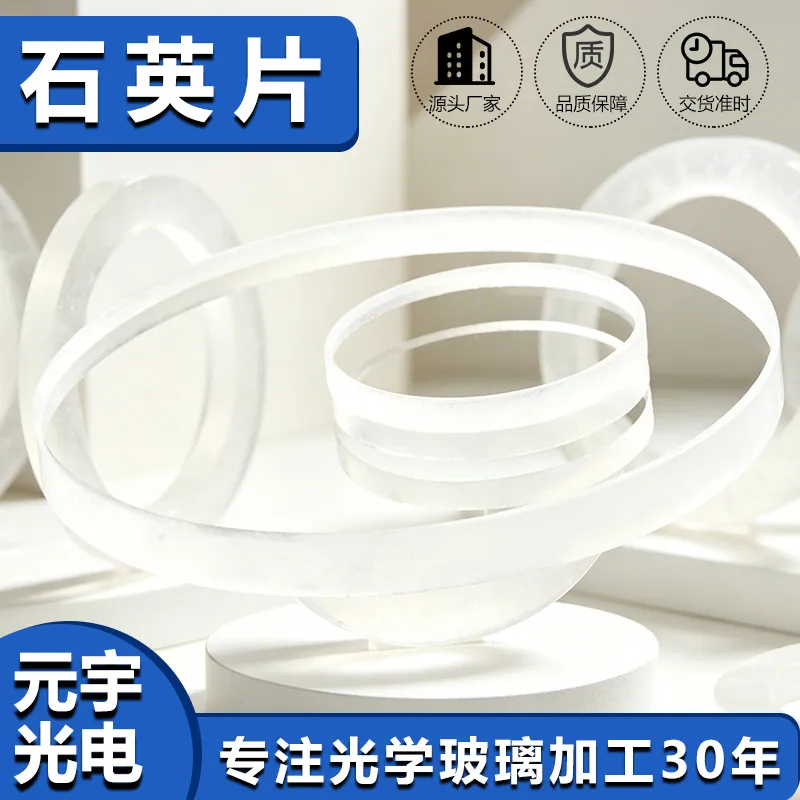
Lens Protection Windows in Security and Surveillance Cameras
In security and surveillance cameras, that translates into a specific set of requirements rather than a general preference for quality. Surveillance cameras run continuously, often outdoors, and must deliver usable images at night under near-infrared illumination. That combination makes IR-cut behavior and window durability the two defining requirements: the window has to pass the day spectrum faithfully, block infrared during daylight, and still transmit 850 nanometer illumination after dark on dual-mode designs.
What drives cost and lead time
Cost is dominated by the coating and the substrate, not by the glass area. A dual-sided broadband AR coating typically costs more than the substrate it sits on. Sapphire multiplies the material line and adds finishing time, and functional coatings such as IR-cut on the inner face add another deposition pass. Size matters when the part exceeds the chamber's uniform zone; complex outlines add laser cutting or CNC profiling. In Security and Surveillance Cameras, the practical trade is between a cheap coated float glass replaced periodically and an expensive sapphire window that lasts for the life of the product - the right answer depends entirely on whether the window is a serviceable item or a sealed part.
Substrate and material selection
Substrate choice follows exposure. B270 and ultra-clear float glass are adequate for indoor equipment and protected outdoor installations. Borosilicate adds thermal stability for parts exposed to sunlight or heat. Sapphire is the choice when the surface will be touched, dragged or abraded, and it also transmits further into the infrared, but it costs several times more and is harder to finish. Quartz appears where the spectral band reaches into the ultraviolet. Thickness is a mechanical decision with an optical consequence: thicker windows resist impact and sealing pressure better, but they add mass, cost and thermal inertia, and on a fast optical system they can shift focus. In Security and Surveillance Cameras, the most common specification error is using float glass where the part will be exposed to abrasion, and the most common cost error is using sapphire where nothing will ever touch it.
Handling, cleaning and packaging
Protection windows are handled more than any other optical part in a system, because they are the interface the customer touches. That reality has to be designed in: a chamfer so fingers and gaskets meet glass rather than coating, a hydrophobic layer so cleaning is easy, and a mounting method that does not clamp the coated face. Shipping uses individual pockets or interleaved separators, and installation instructions should name the cleaning chemicals and cloths that will not damage the coating. In Security and Surveillance Cameras, most field complaints about hazy or smeared windows trace back to cleaning during service, so a short care note in the product documentation prevents more returns than a tighter coating specification would.
The tolerances that actually matter
A protection window is specified on transmission, flatness and thickness uniformity, in that order. Transmission should be quoted with the coating: above 98 percent is normal for dual-sided AR in the visible. Flatness and parallelism matter because the window sits in the imaging path - a wedge steers the beam, and a curved surface shifts the focal plane, so a few arcminutes of wedge can be significant in a long focal length system. Thickness tolerance matters for the same reason and also for sealing. Haze is a separate specification and should never be left implicit, because a coated part with excellent transmission and one percent haze looks like a dirty lens. In Security and Surveillance Cameras, add a required abrasion resistance and, where relevant, a water contact angle for hydrophobic coatings.
Inspection and measurement
Inspection covers optical performance and durability in equal measure. Transmission and reflectance are measured over the sensor band, haze on a haze meter, and flatness or transmitted wavefront on an interferometer. Durability is verified with abrasion, cross-hatch adhesion, humidity soak and salt spray, with water contact angle checked when a hydrophobic layer is specified. Dimensional checks confirm outline, thickness, chamfer and edge quality, and where the part carries a printed or coated feature, registration is measured as well. In Security and Surveillance Cameras, the test that most often reveals a weak part is not the optical measurement but the environmental sequence: humidity followed by abrasion, because that combination finds adhesion problems that neither test finds alone.
Requirements specific to Security and Surveillance Cameras
In security and surveillance cameras, that translates into a specific set of requirements rather than a general preference for quality. Surveillance cameras run continuously, often outdoors, and must deliver usable images at night under near-infrared illumination. That combination makes IR-cut behavior and window durability the two defining requirements: the window has to pass the day spectrum faithfully, block infrared during daylight, and still transmit 850 nanometer illumination after dark on dual-mode designs.
- IR-cut edge between 645 and 680 nm
- Outdoor-grade abrasion and salt spray resistance
- Hydrophobic topcoat for rain shedding
- Service life of five years or more with no transmission loss
IP-rated enclosure compatibility, MIL-style abrasion and humidity testing, RoHS and REACH declarations, and increasingly NDAA-related supply chain documentation.
Selection data at a glance
| Parameter | Typical value | Notes |
|---|---|---|
| Transmission | T ≥ 98 % with dual-sided AR | Per the sensor band |
| Substrate | B270, borosilicate, sapphire, quartz | Sapphire for abrasive environments |
| Thickness | 0.3-5 mm | 0.5 - 1.1 mm typical for camera windows |
| Haze | ≤ 0.2 %, typically ≤ 0.05 % | Critical for imaging |
| Hardness | 9H pencil, 0000 steel wool pass | Hard oxide or sapphire |
| Water contact angle | >= 100 deg with hydrophobic layer | Rain and fingerprint shedding |
| Environmental | salt spray, 85/85 humidity, UV, -40 to +105 °C | Grade depends on exposure |
| Outline tolerance | ± 0.05 mm, laser-cut shapes available | Chamfer 0.1 - 0.3 mm |
| Options | IR-cut or bandpass function integrated | One window, two jobs |
Frequently asked questions
How do I stop the window from fogging?
A hydrophobic and oleophobic topcoat reduces water retention and fingerprint smearing. For sealed assemblies, consider filling the cavity with dry nitrogen and controlling the dew point rather than relying on the coating alone.
Which face should the functional coating go on?
Functional coatings belong on the inner face where they are protected. Reversing front and back is a common first-article error, so the drawing should state explicitly which surface faces the sensor and which faces the environment.
Does a protection window degrade image quality?
Not if it is specified properly. Dual-sided AR keeps transmission above 98 percent, and flatness plus parallelism control keeps the window optically neutral. Quality loss usually comes from an uncoated inner face or from a coating band that misses the illumination wavelength.
Need a quotation for lens protection windows?
Send your drawing, target specification or coating requirement and an optical engineer will reply within 24 hours with a price and a lead time.
Request a Quote Email an engineer