Failures in lens protection windows used in smartphone camera modules tend to follow a small number of patterns, and each pattern has a signature. This article walks through the common failure modes, how to tell them apart with measurements rather than guesswork, and the process or design changes that actually remove the root cause.
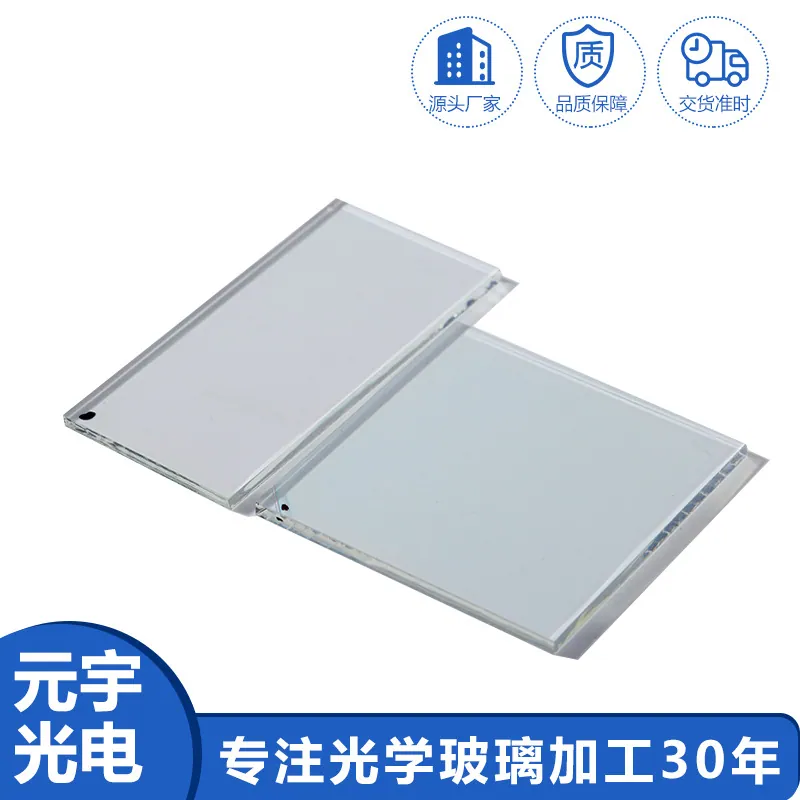
Lens Protection Windows in Smartphone Camera Modules
In smartphone camera modules, that translates into a specific set of requirements rather than a general preference for quality. Phone camera modules are the most space-constrained optical assemblies in mass production. Every component is measured in fractions of a millimeter, the stack is bonded and reflow-adjacent, and the module must survive drop testing, temperature cycling and years of pocket abrasion. Optical requirements center on color fidelity across a wide field of view, low flare from internal reflections, and stable performance after the adhesive cure.
Coating and deposition considerations
The standard coating is a broadband anti-reflective layer on both faces, tuned to the sensor band rather than to the visible alone. That detail matters more than it appears: a visible-only AR coating on a window in front of an 850 nm illuminator will reflect the illumination back into the system and produce flare. Beyond AR, functional layers are usually added - a hard outer layer for abrasion, a hydrophobic and oleophobic top layer so that rain and fingerprints shed rather than smear, and sometimes an anti-static layer to reduce dust attraction. Many protection windows also carry a functional coating on the inner face, most commonly IR-cut, which lets one part do two jobs. In Smartphone Camera Modules, the combination that gives the best field reliability is usually dual-sided AR plus a hydrophobic topcoat on a sapphire or hard-coated borosilicate substrate.
Design rules that reduce cost
Design decisions center on exposure and mounting. Decide what the window will meet - rain, salt, sand, cleaning chemicals, a gloved hand - and pick substrate and coating accordingly. Keep the optical aperture inside the coated area and leave a clear, uncoated margin of 0.5 to 1 millimeter for gaskets and adhesives so that sealing pressure never sits on a coating. Specify the chamfer. If the window also carries an IR-cut or bandpass function, confirm that the coating is deposited on the correct face, since reversing front and back is a classic first-article error. In Smartphone Camera Modules, the aim is a part that is optically invisible and mechanically unremarkable, which is exactly what makes it easy to specify badly.
Common failure modes and how they show up
The field failures are recognisable: haze from abrasion, smeared coating from aggressive cleaning, water spotting that has etched the surface, delamination beginning at the edge, and cracking from over-tight clamping or thermal shock. Optical failures such as flare or ghosting usually indicate an uncoated inner face or a coating band that does not cover the illumination wavelength. In Smartphone Camera Modules, the useful diagnostic is location: damage concentrated at the center suggests abrasion or cleaning, damage at the edge suggests clamping or sealing, and a uniform gray veil suggests a coating deposition problem rather than anything the user did.
Inspection and measurement
Inspection covers optical performance and durability in equal measure. Transmission and reflectance are measured over the sensor band, haze on a haze meter, and flatness or transmitted wavefront on an interferometer. Durability is verified with abrasion, cross-hatch adhesion, humidity soak and salt spray, with water contact angle checked when a hydrophobic layer is specified. Dimensional checks confirm outline, thickness, chamfer and edge quality, and where the part carries a printed or coated feature, registration is measured as well. In Smartphone Camera Modules, the test that most often reveals a weak part is not the optical measurement but the environmental sequence: humidity followed by abrasion, because that combination finds adhesion problems that neither test finds alone.
What drives cost and lead time
Cost is dominated by the coating and the substrate, not by the glass area. A dual-sided broadband AR coating typically costs more than the substrate it sits on. Sapphire multiplies the material line and adds finishing time, and functional coatings such as IR-cut on the inner face add another deposition pass. Size matters when the part exceeds the chamber's uniform zone; complex outlines add laser cutting or CNC profiling. In Smartphone Camera Modules, the practical trade is between a cheap coated float glass replaced periodically and an expensive sapphire window that lasts for the life of the product - the right answer depends entirely on whether the window is a serviceable item or a sealed part.
Requirements specific to Smartphone Camera Modules
In smartphone camera modules, that translates into a specific set of requirements rather than a general preference for quality. Phone camera modules are the most space-constrained optical assemblies in mass production. Every component is measured in fractions of a millimeter, the stack is bonded and reflow-adjacent, and the module must survive drop testing, temperature cycling and years of pocket abrasion. Optical requirements center on color fidelity across a wide field of view, low flare from internal reflections, and stable performance after the adhesive cure.
- Thickness typically 0.21 - 0.55 mm
- Transmission above 90 percent in the visible band
- No visible color shading across a wide field of view
- Survives reflow-adjacent temperatures and drop testing
Suppliers usually work to module-maker internal standards covering particle cleanliness, outgassing and bond-line quality, alongside RoHS and REACH declarations.
Selection data at a glance
| Parameter | Typical value | Notes |
|---|---|---|
| Transmission | T ≥ 98 % with dual-sided AR | Per the sensor band |
| Substrate | B270, borosilicate, sapphire, quartz | Sapphire for abrasive environments |
| Thickness | 0.3-5 mm | 0.5 - 1.1 mm typical for camera windows |
| Haze | ≤ 0.2 %, typically ≤ 0.05 % | Critical for imaging |
| Hardness | 9H pencil, 0000 steel wool pass | Hard oxide or sapphire |
| Water contact angle | >= 100 deg with hydrophobic layer | Rain and fingerprint shedding |
| Environmental | salt spray, 85/85 humidity, UV, -40 to +105 °C | Grade depends on exposure |
| Outline tolerance | ± 0.05 mm, laser-cut shapes available | Chamfer 0.1 - 0.3 mm |
| Options | IR-cut or bandpass function integrated | One window, two jobs |
Frequently asked questions
Does a protection window degrade image quality?
Not if it is specified properly. Dual-sided AR keeps transmission above 98 percent, and flatness plus parallelism control keeps the window optically neutral. Quality loss usually comes from an uncoated inner face or from a coating band that misses the illumination wavelength.
When is sapphire worth the extra cost?
When the surface will be repeatedly touched, dragged or exposed to abrasive particles, and when the window is a sealed rather than serviceable component. For protected indoor equipment, hard-coated borosilicate is usually sufficient.
Can the window also filter infrared?
Yes. An IR-cut or bandpass coating on the inner face lets a single part protect the lens and shape the spectrum, which saves thickness and assembly steps in compact modules.
Need a quotation for lens protection windows?
Send your drawing, target specification or coating requirement and an optical engineer will reply within 24 hours with a price and a lead time.
Request a Quote Email an engineer