There is always more than one way to solve the optical problem in solar and photovoltaic manufacturing, and the options are not equally good at everything. This article compares lens protection windows against the materials, processes and design approaches it competes with, on the criteria that matter commercially: performance, durability, unit cost and lead time.
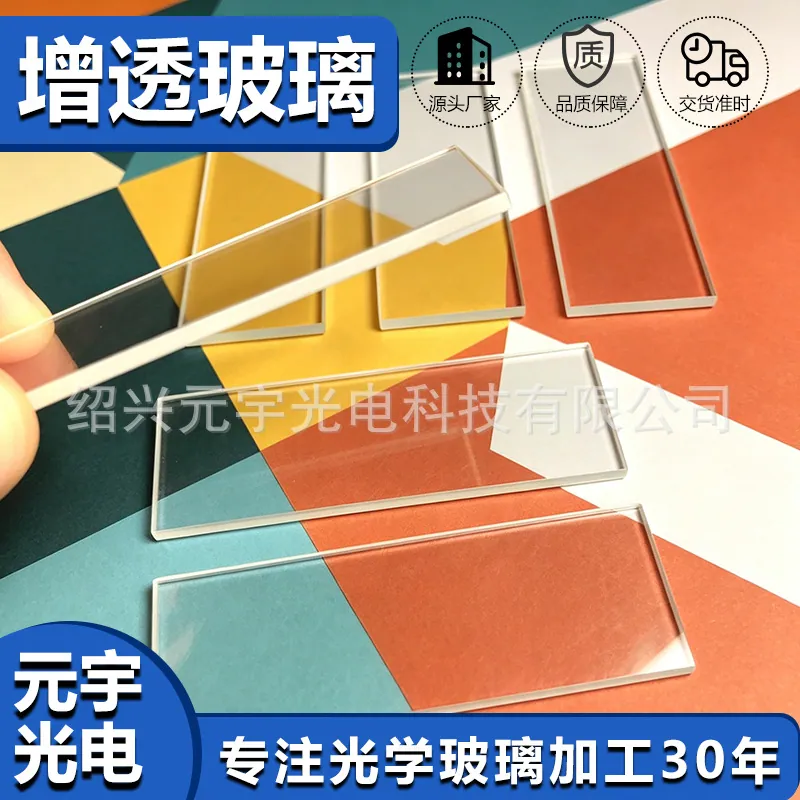
Lens Protection Windows in Solar and Photovoltaic Manufacturing
In solar and photovoltaic manufacturing, that translates into a specific set of requirements rather than a general preference for quality. Solar manufacturing combines very large glass areas with aggressive cost targets and 25-year outdoor exposure. Coatings are used to raise transmission and reduce soiling, while glass is used as tooling and protection in the production equipment itself. Durability under ultraviolet, humidity and thermal cycling is the entry ticket.
The tolerances that actually matter
A protection window is specified on transmission, flatness and thickness uniformity, in that order. Transmission should be quoted with the coating: above 98 percent is normal for dual-sided AR in the visible. Flatness and parallelism matter because the window sits in the imaging path - a wedge steers the beam, and a curved surface shifts the focal plane, so a few arcminutes of wedge can be significant in a long focal length system. Thickness tolerance matters for the same reason and also for sealing. Haze is a separate specification and should never be left implicit, because a coated part with excellent transmission and one percent haze looks like a dirty lens. In Solar and Photovoltaic Manufacturing, add a required abrasion resistance and, where relevant, a water contact angle for hydrophobic coatings.
How it compares with the alternatives
Alternatives include an uncoated window, an etched anti-glare surface, a molded polymer window and simply leaving the lens exposed behind a mechanical shroud. Uncoated glass is cheap and loses about eight percent of the light; etched glass scatters glare at the cost of transmission; polymer windows are light and impact-resistant but scratch easily and cannot take a hard oxide coating. Leaving the lens bare is viable only in sealed, clean, protected enclosures. For the exposed imaging systems that dominate Solar and Photovoltaic Manufacturing, a coated glass or sapphire window remains the only option that preserves transmission, resists the environment and can carry a functional coating at the same time.
Substrate and material selection
Substrate choice follows exposure. B270 and ultra-clear float glass are adequate for indoor equipment and protected outdoor installations. Borosilicate adds thermal stability for parts exposed to sunlight or heat. Sapphire is the choice when the surface will be touched, dragged or abraded, and it also transmits further into the infrared, but it costs several times more and is harder to finish. Quartz appears where the spectral band reaches into the ultraviolet. Thickness is a mechanical decision with an optical consequence: thicker windows resist impact and sealing pressure better, but they add mass, cost and thermal inertia, and on a fast optical system they can shift focus. In Solar and Photovoltaic Manufacturing, the most common specification error is using float glass where the part will be exposed to abrasion, and the most common cost error is using sapphire where nothing will ever touch it.
What drives cost and lead time
Cost is dominated by the coating and the substrate, not by the glass area. A dual-sided broadband AR coating typically costs more than the substrate it sits on. Sapphire multiplies the material line and adds finishing time, and functional coatings such as IR-cut on the inner face add another deposition pass. Size matters when the part exceeds the chamber's uniform zone; complex outlines add laser cutting or CNC profiling. In Solar and Photovoltaic Manufacturing, the practical trade is between a cheap coated float glass replaced periodically and an expensive sapphire window that lasts for the life of the product - the right answer depends entirely on whether the window is a serviceable item or a sealed part.
Requirements specific to Solar and Photovoltaic Manufacturing
In solar and photovoltaic manufacturing, that translates into a specific set of requirements rather than a general preference for quality. Solar manufacturing combines very large glass areas with aggressive cost targets and 25-year outdoor exposure. Coatings are used to raise transmission and reduce soiling, while glass is used as tooling and protection in the production equipment itself. Durability under ultraviolet, humidity and thermal cycling is the entry ticket.
- Twenty-five year UV and humidity stability
- Very large coated areas with uniform performance
- Hydrophobic or easy-clean surface behavior
- Cost per square meter under pressure
IEC 61215 and IEC 61730 context for module durability, plus RoHS and REACH declarations for the coated glass.
Selection data at a glance
| Parameter | Typical value | Notes |
|---|---|---|
| Transmission | T ≥ 98 % with dual-sided AR | Per the sensor band |
| Substrate | B270, borosilicate, sapphire, quartz | Sapphire for abrasive environments |
| Thickness | 0.3-5 mm | 0.5 - 1.1 mm typical for camera windows |
| Haze | ≤ 0.2 %, typically ≤ 0.05 % | Critical for imaging |
| Hardness | 9H pencil, 0000 steel wool pass | Hard oxide or sapphire |
| Water contact angle | >= 100 deg with hydrophobic layer | Rain and fingerprint shedding |
| Environmental | salt spray, 85/85 humidity, UV, -40 to +105 °C | Grade depends on exposure |
| Outline tolerance | ± 0.05 mm, laser-cut shapes available | Chamfer 0.1 - 0.3 mm |
| Options | IR-cut or bandpass function integrated | One window, two jobs |
Frequently asked questions
When is sapphire worth the extra cost?
When the surface will be repeatedly touched, dragged or exposed to abrasive particles, and when the window is a sealed rather than serviceable component. For protected indoor equipment, hard-coated borosilicate is usually sufficient.
Can the window also filter infrared?
Yes. An IR-cut or bandpass coating on the inner face lets a single part protect the lens and shape the spectrum, which saves thickness and assembly steps in compact modules.
What should the water contact angle be?
Above 100 degrees for a good hydrophobic layer, which makes rain and fingerprints shed rather than smear. The layer is a consumable in abrasive environments and is normally specified with an abrasion durability requirement.
Need a quotation for lens protection windows?
Send your drawing, target specification or coating requirement and an optical engineer will reply within 24 hours with a price and a lead time.
Request a Quote Email an engineer