For thirty years the fluorescence microscope had a stable anatomy: light source, excitation filter, dichroic beamsplitter at 45 degrees in a filter cube, emission filter, and an objective doing its own job below. The dichroic lived in the cube, a 25-millimetre square plate swapped by the user. That anatomy is changing. Confocal scan heads, spinning-disk systems, light-sheet microscopes and the newest high-content screening platforms increasingly move dichroic splitting inside the optical train — smaller, higher-incident-angle, sometimes curved or wedged — and the component conversation shifts from catalogue cubes to engineered, integrated parts.
What the new architectures demand
A filter cube is forgiving: 45 degrees, collimated light, generous clear aperture, room to spare. An integrated splitter is none of those things. Confocal systems pass the dichroic over wide cone angles, where edge steepness degrades with angle spread unless the coating design is optimized for the cone rather than for a collimated beam. Spinning-disk systems run high power continuously, so absorption and coating damage thresholds matter more than in a casual imaging session. Light-sheet instruments need large rectangular dichroics at nonstandard angles, often specified for a polarization direction that a conventional cube ignores.
Volume adds pressure. A research lab buys one cube. A screening instrument OEM buys thousands of splitters per year for machines that must produce identical images across a fleet. That moves the component from a hand-selected optic toward a manufactured part with lot-level spectral data, and it rewards suppliers who can hold a cut-on wavelength within a fraction of a nanometre across production.
The multiplexing squeeze
The application side compounds the difficulty. Modern assays label three, four, five fluorophores, some separated by barely twenty nanometres of emission peak. The dichroic between them has to reflect one band and transmit the adjacent band with transition edges steep enough that neither fluorophore bleeds into the other channel. Steep edges at high incidence angles are the classic hard problem in thin films, because the effective wavelength shifts with angle and the shift itself is polarization-dependent. Coatings for integrated microscope splitters are therefore designed with angle-band compensation — stacks tuned so the passband stays put across the working cone — and validated with measurements at several angles, not one.
Autofluorescence is the other quiet requirement. In a cube system, stray fluorescence from filter substrates adds a constant background the software subtracts. In a sensitive integrated path, substrate fluorescence becomes a specification line: synthetic fused silica or low-autofluorescence glasses are selected explicitly, and buyers increasingly ask for the measurement, not the claim.
What buyers should put on the table
For OEM sourcing conversations, the useful checklist has changed shape:
- Spectral curves measured at the actual incidence angle and cone, on delivered parts, with lot traceability.
- Steepness quoted as transition width between defined transmission and reflection points — not a vague "sharp edge".
- Substrate fluorescence data at the excitation wavelengths in use.
- Damage threshold or bleaching data where the illumination is a continuous laser.
- Dimensional control: parallelism, wedge and thickness tolerance, because integrated mounts leave no adjustment for a tilted splitter.
- A requalification plan: what the supplier guarantees lot-to-lot, and what the OEM re-measures on incoming inspection.
The supply consequence
The dichroic filter is quietly becoming a machined, toleranced, lot-controlled component rather than a laboratory consumable. Suppliers with in-house coating, measurement and substrate control are consolidating that demand; buyers who keep specifying catalogue cubes for integrated systems will pay for the mismatch in image variability across their fleets. The next round of instrument launches will make the difference visible: same fluorophores, same camera, noticeably different contrast — traced back to a splitter that nobody treated as a production part.
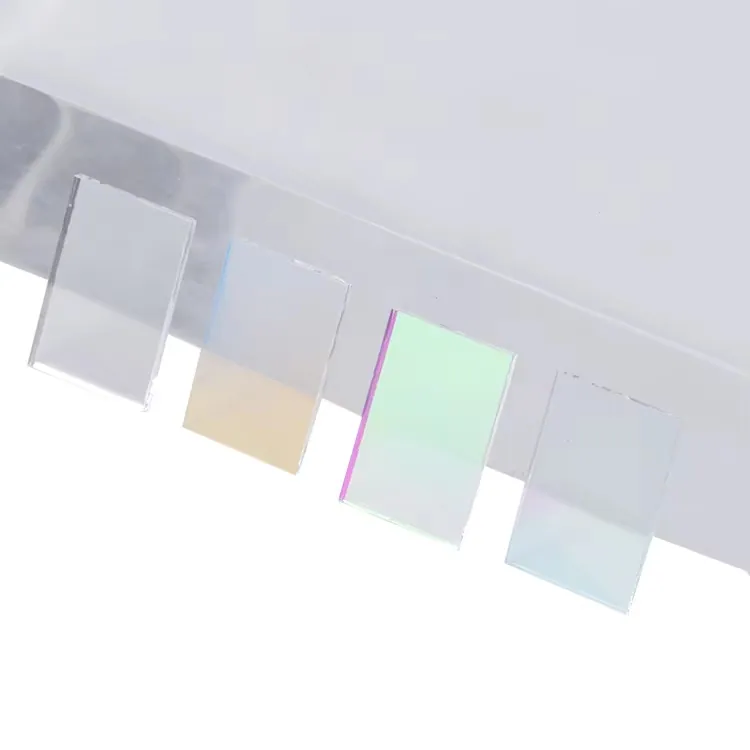
Product page: dichroic filters for fluorescence systems — specifications, coating options and lead times.