Biofluorescence imaging has become a routine tool in marine biology: a blue excitation band illuminates corals, fish and cephalopods, and the longer-wavelength emission is imaged through a barrier or long-pass window. Optical blue glass - the coloured-glass family that absorbs above a cut-on wavelength - is one of several ways to shape those two bands, and it behaves differently from interference coatings in cost, blocking and field ruggedness. This comparison lines up blue glass against the main alternatives so an optical engineer can choose without over-specifying.
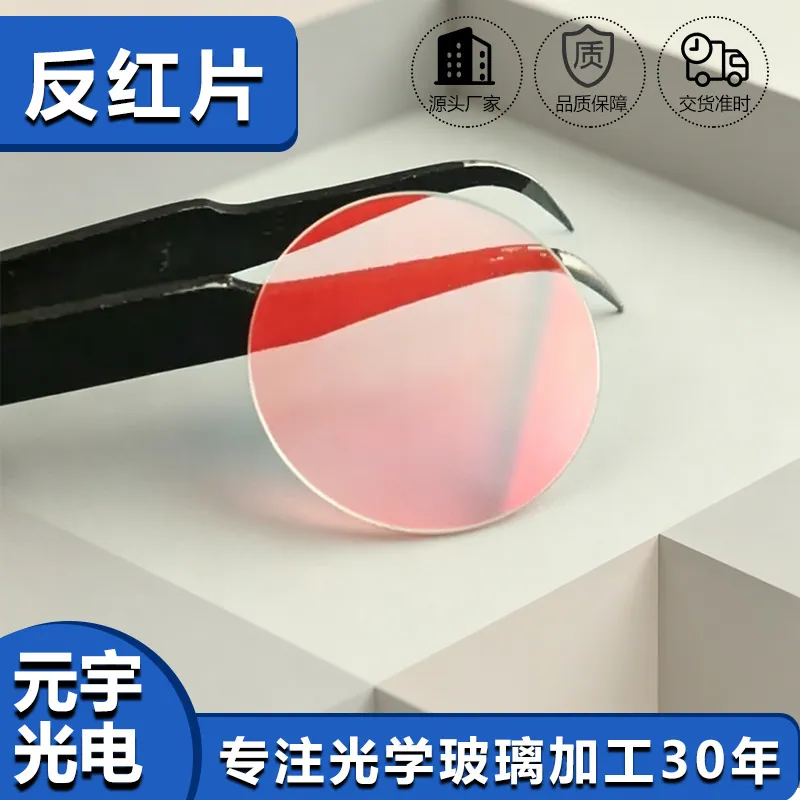
Optical Blue Glass in Biofluorescence and Marine Biology Imaging
A biofluorescence rig needs two optical functions: a clean blue excitation window that rejects the visible and the infrared the camera would otherwise see, and an emission barrier that passes the shifted, longer-wavelength fluorescence while killing the blue leak. Optical blue glass, historically the BG-class coloured glass, performs the second job well - it absorbs short wavelengths and passes long ones - and it can also shape the excitation when paired correctly. Because it is a bulk coloured glass rather than a thin film, its blocking is deep and angle-insensitive, which matters when the light path is not perfectly collimated, as it rarely is in a field housing on a reef or in a flow tank.
What drives cost and lead time
Coloured glass is inexpensive as a raw material and the cut-and-polish step is standard, so a blue-glass barrier filter is usually cheaper than a custom dielectric stack of equal blocking. Cost rises when the part must be thin, large, or held to tight surface and wedge tolerances, or when it has to be matched as a pair across an excitation and emission set. Lead time is short for stock thicknesses in common glasses, and longer when a specific cut-on, a large diameter, or a laminated or strengthened version is required. Compared with interference filters, blue glass wins on unit price and on the absence of angle-shift; compared with simple plastic dyes, it wins on thermal and chemical stability in a salt-water environment.
The tolerances that actually matter
For a barrier filter the number that matters is the cut-on wavelength and its slope, because that decides how much blue leak reaches the sensor. The useful tolerances are the cut-on position, the out-of-band blocking depth (especially at the excitation line), and the in-band transmission across the emission band. Mechanically, parallelism and surface form matter where the glass sits in an imaging cone, while a protective window can be looser. A few nanometres of cut-on shift are usually tolerable in a screening system but not in a quantitative one, so the cut-on should be specified against the actual excitation wavelength rather than a nominal blue band.
How it compares with the alternatives
Against a dielectric long-pass filter, blue glass gives deeper, angle-independent blocking and lower cost, at the price of a softer edge and some in-band absorption that a hard-coated filter avoids. Against a plastic or gel dye, blue glass is far more stable under heat, UV and salt water and does not fade, which is decisive in marine field work. Against an exciter interference filter on the illumination side, blue glass is a poor exciter on its own because its edge is gradual, so the excitation band is usually set by a dedicated bandpass and blue glass is reserved for the emission barrier. In practice the two are complementary rather than competing.
Substrate and material selection
Choose the coloured-glass type by its cut-on and its chemical durability. Standard blue glasses handle freshwater and most lab environments; for open-ocean or intertidal use, confirm the glass resists prolonged salt exposure and cleaning, and consider an edge seal or a protective cover slip if the surface will be wiped. Thickness is a trade between blocking margin and weight or path length - thicker glass blocks deeper but adds absorption in the pass band, so the choice is a balance, not a maximum. For instruments that see strong sunlight or UV, verify the glass does not itself fluoresce in a way that contaminates the emission band.
Coating and deposition considerations
Blue glass is a bulk material, so there is no coating step for the colour itself, but it is routinely given an anti-reflective layer on both faces to recover the few percent lost at each surface and to suppress ghost reflections in an imaging path. An AR layer also helps when the glass is paired with a dielectric exciter, keeping the combined stack neutral. Where the part must survive abrasion from sand or cleaning, a hard AR overcoat is worth specifying. The coating should be centred on the emission band of interest, and any AR applied to the illumination side must not reintroduce a blue leak that the barrier is trying to remove.
Requirements specific to Biofluorescence and Marine Biology Imaging
Marine and aquaculture use is the hard case: the filter sits in humidity, salt and often direct sun, and it is handled by field biologists rather than in a cleanroom. That favours blue glass over dye films and favours a hard AR overcoat and a confirmed salt-durability grade. The other distinctive point is that the excitation and emission wavelengths are fixed by the organism and the light source, so the cut-on and any exciter band should be specified against measured spectra, not a generic blue, to keep the fluorescence signal above the leak.
- Blue glass excels as a deep, angle-independent emission barrier, not as a sharp exciter
- Cut-on position and out-of-band blocking at the excitation line are the release numbers
- Cheaper and more salt-durable than dielectric or dye alternatives for field use
- Add a hard AR overcoat for abrasion and to suppress surface ghosts
Framework references: coloured-glass filter selection follows the manufacturer spectral data sheet; optical drawing and tolerances reference ISO 10110 where the part is a dimensioned component. Cut-on and blocking values are set by the excitation source and the organism's emission; confirm against measured spectra rather than a nominal blue band.
Selection data at a glance
| Parameter | Typical value | Notes |
|---|---|---|
| Function | long-pass emission barrier / blue leak rejection | Pair with a bandpass exciter |
| Cut-on wavelength | per instrument emission band | Sets leak at excitation line |
| Blocking (excitation line) | deep, angle-independent | Bulk glass advantage |
| In-band transmission | high across emission band | Watch in-band absorption |
| Durability | salt, UV, abrasion resistant grades | Field marine use |
| AR overcoat | both faces, centred on emission | Suppresses ghosts |
Frequently asked questions
Can blue glass replace the excitation filter?
Not well on its own. Its edge is gradual, so it makes a poor sharp exciter. It is normally used as the emission barrier, while a dedicated bandpass sets the blue excitation band. The two are complementary.
Why choose coloured glass over a dielectric long-pass filter?
Deeper and angle-independent blocking, lower cost, and far better stability in salt water and sunlight. The trade-off is a softer cut-on edge and some in-band absorption, which matters only in quantitative work.
Does the glass survive open-ocean field use?
Standard grades handle most lab and freshwater work; for intertidal or open-ocean deployment confirm salt durability and add a hard AR overcoat plus, if wiped often, an edge seal or cover slip.
Need a quotation for optical blue glass?
Send your drawing, target specification or coating requirement and an optical engineer will reply within 24 hours with a price and a lead time.
Request a Quote Email an engineer